Whitewater’s post office opened in 1840, and 12% of its homes were built before 1940
More historic than 83% of U.S. towns · #71 of 362 in Wisconsin. What drives it
6 places in town are on the National Register, among them a historic district with 42 buildings. Below: 1 old photo or paper, maps from 1884 on, and the census since 1860.
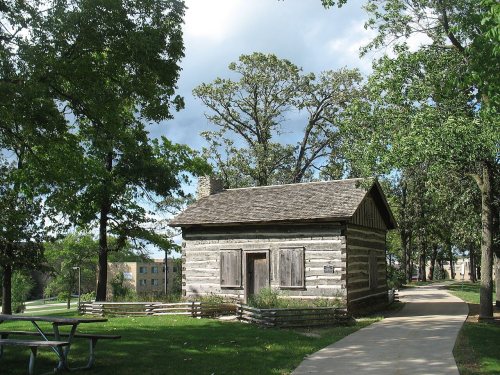
Founding year: the first Whitewater post office (Blevins & Helbock, CC0).The full story ↓
History grade
What drives Whitewater’s History grade
On its age, its old homes and the National Register, Whitewater is more historic than 83% of U.S. towns, #71 of 362 in Wisconsin. All 3 inputs are above most U.S. towns; its National Register listings ranks highest and its share of homes from before 1940 lowest.
A−
HistoryA character grade: shown, never part of Whitewater’s overall grade.
Wisconsin towns list more on the Register than most of the country (a typical Wisconsin town has 3.0 per 10,000 residents, the U.S. 2.4), so Whitewater’s 29.7 sits above most of its state (85% of Wisconsin towns have fewer) while its 47 historic buildings outnumber those of 84% of U.S. towns.
How sure. Graded on any two of the three inputs instead, the letter would range from B+ to A. The pre-1940 share is a Census survey estimate (±3.0 points). The founding year is the first post office, not a stated founding date.
Founding year: the first post office (other dates in Quick answers). Homes: Census ACS 2020–24. National Register: National Park Service, May 2026 list; each listing counted once (boundary changes and added documentation belong to their listing), and a historic district counts its contributing buildings. How TownRatings grades history →
What stands out about Whitewater’s past
Read from the archive, the National Register and the record. The page puts what stands out first.
Whitewater was founded at the confluence of Whitewater Creek and Spring Brook, and named for the white sand in their beds. A gristmill was built on Whitewater creek, the resulting pond now called Cravath Lake. The town grew quickly when the first railroad line in Wisconsin passed through in 1853, but struggled when the two largest employers left town.
Passages that mention Whitewater, cut from the printed page as they were published.
History of Walworth County, Wisconsin, containing an account of its settlement, growth, development and resources...its war record, biographical sketches, portraits of prominent men and early settlers1882 · page 584Read the page →
Read the text
legal officers, there exists no village government, and that in the absence of all such government, it l)ccomes the duty of the Supervisors of the town to extend town government over the territory embraced within the village incorporation ; therefore, "Resulved, That we, the Supervisors of the Town of Whitewater, do hereby declare our intention of exercising the powers and duties of Supervisors, as fully witliin the territory embraced in the incorporated village of Whitewater as in anj' other parts of said town.
Text read by machine from the scan; it may contain errors.
History of Walworth County, Wisconsin, containing an account of its settlement, growth, development and resources...its war record, biographical sketches, portraits of prominent men and early settlers1882 · page 769Read the page →
Read the text
When, by act of the Territoral Legislatm-e. approved February 2. 1838, the county of Walworth was first divided into towns, the territory now constituting the town of Kichmoud was a part of the town of Elkhorn. It so remained until February 18, 1840, when, by an act of the Legislature approved on that day, what is now the towns of Whitewater and Richmond— being Towns 3 and 4 in Range 15 east — were erected into a single town and called Whitewater. By an act of the Territorial Legislature, approved January 12, 1841, the south half of the town of Whitewater, being Town 3 in Range 15 east, was erected into a new one and called Richmond, fi'om a town of the same name in Rhode Island, from which came a few of its earliest settlers.
Text read by machine from the scan; it may contain errors.
Scans and text from the Internet Archive. Books published in 1930 or earlier, which are in the public domain.
Timeline
Whitewater, 1840 to 1936
Woven from the archive, old maps, post office records, the National Register and the people born here.
Fire insurance maps drew every building, what it was made of and what it was used for, so insurers could price the risk of fire. Pick a year, then a sheet.
The Whitewater post office opened in 1840, the earliest record of the town by name (U.S. post office records).
How does Whitewater rank for history?
Whitewater is more historic than 83% of U.S. towns, #71 of 362 in Wisconsin. The History grade combines the town’s founding era, the share of homes built before 1940 and its National Register listings. It’s a character grade, so it isn’t part of the overall grade. How it works.
What is on the National Register in Whitewater?
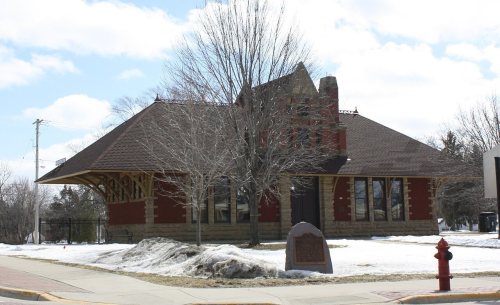
6 listings: 5 buildings, among them the East Wing (Old Main) (listed 1984, the first), and 1 historic district, the Main Street Historic District, with 42 contributing buildings. 47 historic buildings in all.
How old are the homes in Whitewater?
12% of Whitewater’s homes were built before 1940 (Census estimate, ±3.0 points), against a typical 12% for a Wisconsin town; the median home was built in 1981.
Founding dates: Wikidata, Wikipedia, the U.S. post office records of Blevins & Helbock (CC0) and the Census. Homes by year built: Census ACS 2020–24. National Register of Historic Places: National Park Service (list of May 22, 2026). Old photos, postcards and papers: Wikimedia Commons, the Library of Congress and other public archives, credited on each item’s page. Maps: U.S. Geological Survey historical topographic maps (via Esri) and Sanborn fire-insurance maps (Library of Congress). History text and census tables: Wikipedia (CC BY-SA 4.0). Places that used to be: USGS Geographic Names Information System (2021).
From Wikimedia Commons (1), Wikidata (5), the National Register of Historic Places (6), Wikipedia, Wikidata and Wikipedia for famous people, U.S. Geological Survey historical maps, U.S. Census counts (via Wikipedia), the US Post Offices dataset (Blevins & Helbock), the USGS Geographic Names Information System, Sanborn fire insurance maps (Library of Congress) and old county and town histories (Internet Archive). Archive images are copied here with their credits and licenses, shown on each photo’s page. Refreshed monthly.