Founding year: Wikidata. First post office: 1846.The full story ↓
History grade
What drives Shullsburg’s History grade
On its age, its old homes and the National Register, Shullsburg is more historic than 98% of U.S. towns. All 3 inputs are above most U.S. towns; its share of homes from before 1940 ranks highest and its age lowest.
A+
HistoryA character grade: shown, never part of Shullsburg’s overall grade.
Wisconsin towns list more on the Register than most of the country (a typical Wisconsin town has 3.0 per 10,000 residents, the U.S. 2.4), so Shullsburg’s 287 sits above most of its state (99% of Wisconsin towns have fewer) while its 34 historic buildings outnumber those of 82% of U.S. towns.
How sure. Graded on any two of the three inputs instead, the letter would range from A to A+. The pre-1940 share is a Census survey estimate (±8.6 points). Two sources give 1827.
Founding year: Wikidata (other dates in Quick answers). Homes: Census ACS 2020–24. National Register: National Park Service, May 2026 list; each listing counted once (boundary changes and added documentation belong to their listing), and a historic district counts its contributing buildings. How TownRatings grades history →
What stands out about Shullsburg’s past
Read from the archive, the National Register and the record. The page puts what stands out first.
Shullsburg was founded during the 1820s in parts by Jesse Shull and Henry Gratiot and due to their ventures into lead mining. Following the Black Hawk War conflict Gratiot's Grove (Wisconsin) and other small settlements consolidated into Shullsburg. Shullsburg is where the term "Badgers" was first coined to describe the local lead miners, per the Milwaukee Journal. The oldest known documented reference to the "Badgers" is a location called "Badger Hill" on an 1838 Map titled "A Birdseye View of Shullsburg" by I.W. Glines which is in the Archives of the Wisconsin Historical Society. The University of Wisconsin adopted the badger as their official mascot in 1889.
Passages that mention Shullsburg, cut from the printed page as they were published.
History of Lafayette county, Wisconsin, containing an account of its settlement, growth, development and resources1881 · page 570Read the page →
Read the text
It was not until about 1840 that the present village began to make itself known, though cabins had been in existence upon its site for several years. The village of Gratiot's Grove, lying south of Shullsburg, where it had been laid out by the Gratiots several years previous, commanded public patronage, and with Old Shullsburg, west of the present village, disputed the continuance of such patronage. Subsequent to the establishment of Gratiot's Grove, extensive mineral discoveries in the immediate vicinity of Shullsburg, including the Badger, Irish, Giant, Clay and other diggings, attracted the presence of miners, and laid the foundation for the present village.
Text read by machine from the scan; it may contain errors.
History of Lafayette county, Wisconsin, containing an account of its settlement, growth, development and resources1881 · page 370Read the page →
Read the text
McNulty Bline. — In June, 1873, work was recommenced in these old ranges, and considerable capital expended in erecting new machinery and buildings, the old ones having been burned. It is now owned and operated by Messrs. J. M. Ryan, of Galena, and M. A. Fox, of Shullsburg, The mine is situated on the northeast quarter of the northeast quarter of Section 15, Township 1, Range 2 east, a short distance south of the village of Shullsburg. There is here a thickness of about two hundred feet of Galena limestone, or four-fifths of the entire formation. The ore is obtained in the usual opening common to all the mines of the Shullsburg district, between what are known as the green and clay beds, of which the green bed is re-
Text read by machine from the scan; it may contain errors.
Scans and text from the Internet Archive. Books published in 1930 or earlier, which are in the public domain.
Timeline
Shullsburg, 1827 to 1917
Woven from the archive, old maps, post office records, the National Register and the people born here.
In 1827, according to Wikidata. Shullsburg’s post office opened in 1846.
How does Shullsburg rank for history?
Shullsburg is more historic than 98% of U.S. towns. The History grade combines the town’s founding era, the share of homes built before 1940 and its National Register listings. It’s a character grade, so it isn’t part of the overall grade. How it works.
What is on the National Register in Shullsburg?
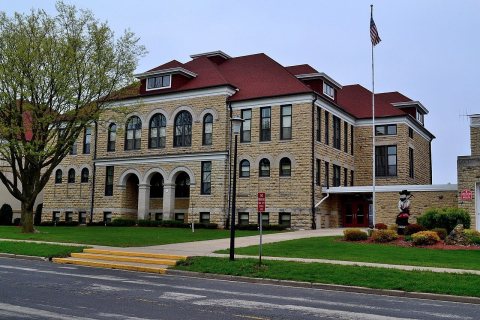
One place: the Water Street Commercial Historic District (listed 1990).
How old are the homes in Shullsburg?
47% of Shullsburg’s homes were built before 1940 (Census estimate, ±8.6 points), against a typical 12% for a Wisconsin town; the median home was built in 1946.
Founding dates: Wikidata, Wikipedia, the U.S. post office records of Blevins & Helbock (CC0) and the Census. Homes by year built: Census ACS 2020–24. National Register of Historic Places: National Park Service (list of May 22, 2026). Old photos, postcards and papers: Wikimedia Commons, the Library of Congress and other public archives, credited on each item’s page. Maps: U.S. Geological Survey historical topographic maps (via Esri) and Sanborn fire-insurance maps (Library of Congress). History text and census tables: Wikipedia (CC BY-SA 4.0). Places that used to be: USGS Geographic Names Information System (2021).
From Wikimedia Commons (6), the National Register of Historic Places (1), Wikipedia, Wikidata and Wikipedia for famous people, the US Post Offices dataset (Blevins & Helbock), the USGS Geographic Names Information System and old county and town histories (Internet Archive). Archive images are copied here with their credits and licenses, shown on each photo’s page. Refreshed monthly.


 2015
 2014
 2012
 2012
 2010
 2004