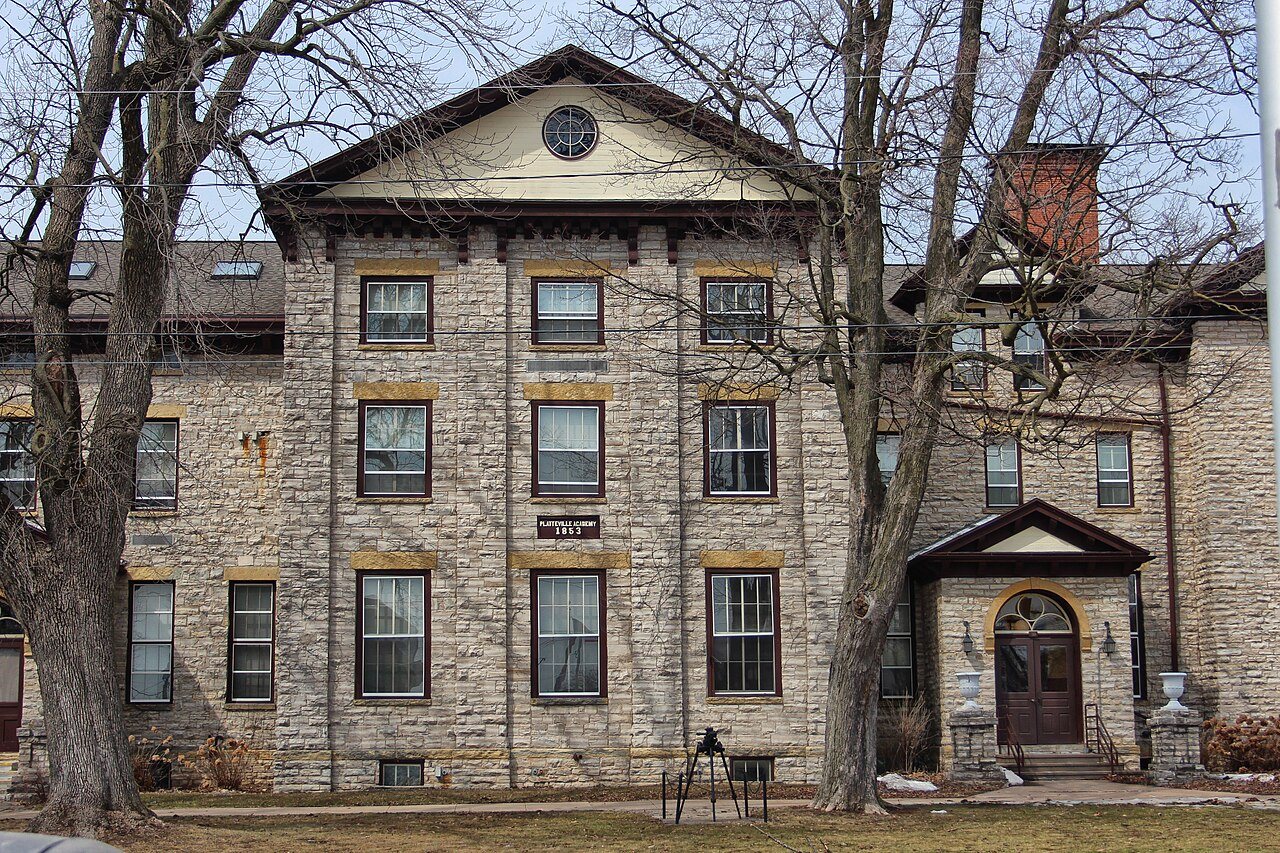
Platteville’s post office opened in 1828, and 21% of its homes were built before 1940
More historic than 93% of U.S. towns · #23 of 362 in Wisconsin. What drives it
18 places in town are on the National Register, among them four historic districts with 151 buildings between them. Below: maps from 1884 on and the census since 1870.
Founding year: the first Platteville post office (Blevins & Helbock, CC0).The full story ↓
History grade
What drives Platteville’s History grade
On its age, its old homes and the National Register, Platteville is more historic than 93% of U.S. towns, #23 of 362 in Wisconsin. All 3 inputs are above most U.S. towns; its National Register listings ranks highest and its share of homes from before 1940 lowest.
A
HistoryA character grade: shown, never part of Platteville’s overall grade.
Wisconsin towns list more on the Register than most of the country (a typical Wisconsin town has 3.0 per 10,000 residents, the U.S. 2.4), so Platteville’s 147 sits above most of its state (96% of Wisconsin towns have fewer) while its 169 historic buildings outnumber those of 92% of U.S. towns.
How sure. Graded on any two of the three inputs instead, the letter would range from A− to A. The pre-1940 share is a Census survey estimate (±4.7 points). The founding year is the first post office, not a stated founding date.
Founding year: the first post office (other dates in Quick answers). Homes: Census ACS 2020–24. National Register: National Park Service, May 2026 list; each listing counted once (boundary changes and added documentation belong to their listing), and a historic district counts its contributing buildings. How TownRatings grades history →
What stands out about Platteville’s past
Read from the archive, the National Register and the record. The page puts what stands out first.
Platteville was settled by pioneers and early lead miners; along inlets and flat groves of The Rountree Branch and Little Platte River. Part of the Platte River shed; these rivers flow into the greater Upper Mississippi River system. More specifically located in the Driftless Region of Southwestern Wisconsin. Due to its geographic location; areas of town are carved by ridges, narrow valleys, and steep hills. The influence of geography can also be seen in the irregularity of the streets in the community. As the town grew, roads were given odd routes, to avoid the steep ravines and mining shafts strewn about the locality.
Passages that mention Platteville, cut from the printed page as they were published.
History of Grant County Wisconsin1900 · page 476Read the page →
Read the text
In Januarj', 1867, Hanmer Robbins introduced a bill into the legis¬ lature, authorizing the citizens of Platteville, Lima, and Harrison, to vote aid to the Platteville & Calamine Railroad on condition that the cars should be running through to Platteville by September 1, 1868, In August, 1867, the people of Platteville, Elk Grove, and Kendall subscribed for $270,000 stock in the road, and grading was begun.
Text read by machine from the scan; it may contain errors.
[History of Grant County, Wisconsin, preceded by a history of Wisconsin1881 · page 694Read the page →
Read the text
After the war, the village grew gradually, and improvements succeeded the rude structures improvised in the early days of the settlement for business and residence purposes. In 1849, the precinct of Platteville was changed into the town of Platteville, with Benjamin C. Eastman Chairman ; railroad enterprises were projected upon numerous occasions, having Platteville for their base of operations or objective point, but all proved failures, and nothing more than speculation was indulged by enterprising citizens until 1867. In that year, individuals subscribed stock to the amount of $50,000, which was supplemented by subscriptions to the extent of $60,000, made by the town for the construction of a railroad from Calamine. In 1869, the
Text read by machine from the scan; it may contain errors.
[History of Grant County, Wisconsin, preceded by a history of Wisconsin1881 · page 182Read the page →
Read the text
The Dubuque, Platteville & Milwaukee railroad was completed in July, 1870, and extends from Calamine, a point on the Mineral Point railroad, to the village of Platteville, eighteen miles, and is operated by the Mineral Point railroad company Madison & Portage Railroad.
Text read by machine from the scan; it may contain errors.
History of Grant County Wisconsin1900 · page 520Read the page →
Read the text
By act of the legislature approved February 19, 1841, the village of Potosi was incorporated (this and Platteville, incorporated the same day, being the first incorporated villages in the county) embrac-. ing the settlement called “the Head of the Hollow,” Van Buren, and Lafayette, the first election to be held at the house of C. Kaltenbach.
Text read by machine from the scan; it may contain errors.
Scans and text from the Internet Archive. Books published in 1930 or earlier, which are in the public domain.
Timeline
Platteville, 1828 to 1971
Woven from the archive, old maps, post office records, the National Register and the people born here.
Every edition of the U.S. Geological Survey’s map of Platteville. Tap a year, or press play to watch the town change.
1902Mineral Point sheet · 1:125,000
U.S. Geological Survey historical topographic maps (public domain), via Esri’s collection of the scans. The red ring marks the center of Platteville.
Every building
Platteville, building by building, 1884–1915
Fire insurance maps drew every building, what it was made of and what it was used for, so insurers could price the risk of fire. Pick a year, then a sheet.
Platteville’s post office has been open since 1828.
Gone or out of use
First Methodist Episcopal ChurchchurchHomestead MinemineWilson-Cunningham Hospitalhospital
2cemeteries and burying grounds inside Platteville
GreenwoodHillside
US Post Offices dataset (Blevins & Helbock, CC0). Places and cemeteries from the USGS Geographic Names Information System (2021).
Questions about Platteville’s history
What year was Platteville founded?
The Platteville post office opened in 1828, the earliest record of the town by name (U.S. post office records).
How does Platteville rank for history?
Platteville is more historic than 93% of U.S. towns, #23 of 362 in Wisconsin. The History grade combines the town’s founding era, the share of homes built before 1940 and its National Register listings. It’s a character grade, so it isn’t part of the overall grade. How it works.
What is on the National Register in Platteville?
18 listings: 14 buildings, among them the Mitchell-Rountree House (listed 1972, the first), and 4 historic districts with 151 contributing buildings. 169 historic buildings in all.
How old are the homes in Platteville?
21% of Platteville’s homes were built before 1940 (Census estimate, ±4.7 points), against a typical 12% for a Wisconsin town; the median home was built in 1971.
Founding dates: Wikidata, Wikipedia, the U.S. post office records of Blevins & Helbock (CC0) and the Census. Homes by year built: Census ACS 2020–24. National Register of Historic Places: National Park Service (list of May 22, 2026). Old photos, postcards and papers: Wikimedia Commons, the Library of Congress and other public archives, credited on each item’s page. Maps: U.S. Geological Survey historical topographic maps (via Esri) and Sanborn fire-insurance maps (Library of Congress). History text and census tables: Wikipedia (CC BY-SA 4.0). Places that used to be: USGS Geographic Names Information System (2021).
From Wikidata (6), the National Register of Historic Places (18), Wikipedia, Wikidata and Wikipedia for famous people, U.S. Geological Survey historical maps, U.S. Census counts (via Wikipedia), the US Post Offices dataset (Blevins & Helbock), the USGS Geographic Names Information System, Sanborn fire insurance maps (Library of Congress) and old county and town histories (Internet Archive). Archive images are copied here with their credits and licenses, shown on each photo’s page. Refreshed monthly.