Founding year: the first Marathon City post office (Blevins & Helbock, CC0).
History grade
What drives Marathon City’s History grade
On its age, its old homes and the National Register, Marathon City is more historic than 54% of U.S. towns. Its National Register listings hold the grade up; its age pulls it down.
B−
HistoryA character grade: shown, never part of Marathon City’s overall grade.
Wisconsin towns list more on the Register than most of the country (a typical Wisconsin town has 3.0 per 10,000 residents, the U.S. 2.4), so Marathon City’s 7.0 sits above most of its state (70% of Wisconsin towns have fewer) while its 1 listings outnumber those of 51% of U.S. towns.
How sure. Graded on any two of the three inputs instead, the letter would range from C+ to B+. The pre-1940 share is a Census survey estimate (±4.3 points). The founding year is the first post office, not a stated founding date.
Founding year: the first post office (other dates in Quick answers). Homes: Census ACS 2020–24. National Register: National Park Service, May 2026 list; each listing counted once (boundary changes and added documentation belong to their listing), and a historic district counts its contributing buildings. How TownRatings grades history →
What stands out about Marathon City’s past
Read from the archive, the National Register and the record. The page puts what stands out first.
Every edition of the U.S. Geological Survey’s map of Marathon City. Tap a year, or press play to watch the town change.
1902Marathon sheet · 1:125,000
U.S. Geological Survey historical topographic maps (public domain), via Esri’s collection of the scans. The red ring marks the center of Marathon City.
The story so far
Marathon City, in brief
Wikipedia doesn’t have a history of Marathon City yet. The photos, dates and memories neighbors add here are how it gets written.
Marathon is a town in Marathon County, Wisconsin, United States. It is part of the Wausau, Wisconsin, Metropolitan Statistical Area. The population was 995 at the 2020 census. The village of Marathon City was incorporated from a part of the town's original area.
Its first post office opened in 1864. Between the 2010 and 2020 censuses its population grew from 1,524 to 1,576 (+3%).
Intro from Wikipedia. Population: U.S. Census Bureau.
From the old history books
What they wrote about Marathon City in 1913
Passages that mention Marathon City, cut from the printed page as they were published.
History of Marathon County, Wisconsin1913 · page 575Read the page →
Read the text
The town of Cassel was created November 12, 1891, and in the ensuing election John Werner was elected the first chairman and representative of the town in the county board. This town was settled by the Pittsburg settlers' club as much as the town of Marathon. The village of Marathon City was laid out on the east boundary line of this town, and when the settlers came, they located south and west of the proposed village. Eully as many of the first settlers located in the present town of Cassel, if not more, than in the town of Marathon. One look at the plat of this town shows the names
Text read by machine from the scan; it may contain errors.
History of Marathon County, Wisconsin1913 · page 552Read the page →
Read the text
that city, where he had followed the occupation of a "ladies' tailor." When asked how he came to go so far from every settlement, he said he had bought his land in Pittsburg, from speculators, and was shown a plat representing the city of Marathon City, showing the steamboat landing, church, schoolhouse, market square, and was told that the country was well settled, and more settlers streaming into that territory; that Ijelieving in these statements, he did not wish to be too close to the city, because he wanted to keep cattle and expected to have more pasture room some distance away from Marathon
Text read by machine from the scan; it may contain errors.
Scans and text from the Internet Archive. Books published in 1930 or earlier, which are in the public domain.
Timeline
Marathon City, 1864 to 1929
Woven from the archive, old maps, post office records, the National Register and the people born here.
The Marathon City post office opened in 1864, the earliest record of the town by name (U.S. post office records).
How does Marathon City rank for history?
Marathon City is more historic than 54% of U.S. towns. The History grade combines the town’s founding era, the share of homes built before 1940 and its National Register listings. It’s a character grade, so it isn’t part of the overall grade. How it works.
What is on the National Register in Marathon City?
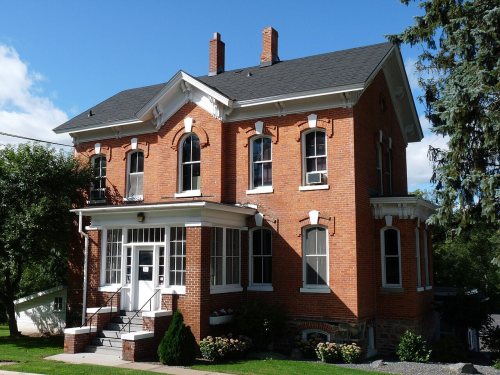
One place: the Fricke-Menzner House (listed 1992).
How old are the homes in Marathon City?
15% of Marathon City’s homes were built before 1940 (Census estimate, ±4.3 points), against a typical 12% for a Wisconsin town; the median home was built in 1974.
Founding dates: Wikidata, Wikipedia, the U.S. post office records of Blevins & Helbock (CC0) and the Census. Homes by year built: Census ACS 2020–24. National Register of Historic Places: National Park Service (list of May 22, 2026). Old photos, postcards and papers: Wikimedia Commons, the Library of Congress and other public archives, credited on each item’s page. Maps: U.S. Geological Survey historical topographic maps (via Esri) and Sanborn fire-insurance maps (Library of Congress). History text and census tables: Wikipedia (CC BY-SA 4.0). Places that used to be: USGS Geographic Names Information System (2021).
From the Library of Congress (1), the National Register of Historic Places (1), Wikidata and Wikipedia for famous people, U.S. Geological Survey historical maps, the US Post Offices dataset (Blevins & Helbock), the USGS Geographic Names Information System and old county and town histories (Internet Archive). Archive images are copied here with their credits and licenses, shown on each photo’s page. Refreshed monthly.



 Date?