Howard dates to 1835, and 1 of its places is on the National Register
More historic than 49% of U.S. towns · #214 of 362 in Wisconsin. What drives it
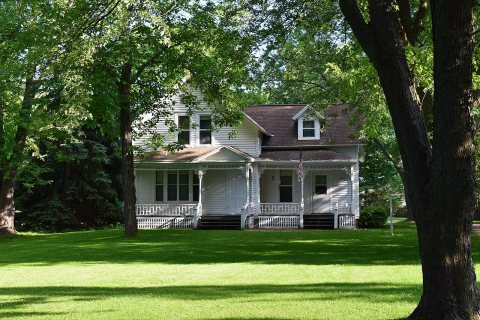
Most of Howard was built recently: 2% of its homes predate 1940 and the median home dates from 1995. Its Register listing is the Angeline Champeau Rioux House. Below: maps from 1954 on and the census since 1960.
On its age, its old homes and the National Register, Howard is more historic than 49% of U.S. towns, #214 of 362 in Wisconsin. Its age holds the grade up; its share of homes from before 1940 pulls it down.
B−
HistoryA character grade: shown, never part of Howard’s overall grade.
Wisconsin towns list more on the Register than most of the country (a typical Wisconsin town has 3.0 per 10,000 residents, the U.S. 2.4), so Howard’s 0.5 sits near the middle of its state (57% of Wisconsin towns have fewer) while its 1 listings outnumber those of 51% of U.S. towns.
NoteThe founding year comes from Wikidata alone; no second source gives 1835.
How sure. Graded on any two of the three inputs instead, the letter would range from C to B+. The pre-1940 share (±1.2 points) is firm at this size.
Founding year: Wikidata (other dates in Quick answers). Homes: Census ACS 2020–24. National Register: National Park Service, May 2026 list; each listing counted once (boundary changes and added documentation belong to their listing), and a historic district counts its contributing buildings. How TownRatings grades history →
What stands out about Howard’s past
Read from the archive, the National Register and the record. The page puts what stands out first.
The Green Bay area was first explored by Europeans in 1634, when Jean Nicolet, a French voyager, arrived in the area. The Town of Howard was established in 1835 and slowly developed along Duck Creek as a center for mail delivery, farming, quarrying and lumbering. By 1848, there were three major railroads that converged in Howard, the Chicago & North Western (C&NW), the SOO Line (SOO) And the Milwaukee Road (MILW). It was named for Brigadier General Benjamin Howard, an officer in the War of 1812.
By 1856, a school was operating and the Town of Howard became known for its Duck Creek stone quarries; of which there were four. The last of the quarries were shut down in 2002.
Passages that mention Howard, cut from the printed page as they were published.
History of Brown County, Wisconsin, past and present1913 · page 472Read the page →
Read the text
Felix E. Poels, successfully engaged in business as a brick manufacturer of Howard township, is one of the worthy native sons and esteemed citizens of Brown county. His birth occurred in the town of Howard on the 29th of December, 1864, his parents being Frank and Jane (Roscom) Poels, both of whom were natives of Belgium, the former born in 1843 and the latter in 1840. Frank Poels came to Wisconsin and took up his abode in the town of Howard in 1857, cleared a tract of land, built a log cabin and continued to reside therein for ten years. Throughout his
Text read by machine from the scan; it may contain errors.
History of Brown County, Wisconsin, past and present1913 · page 19Read the page →
Read the text
Benjamin Tonnon, a worthy native son and representative agriculturist of Brown county, follows farming in Howard township and makes a specialty of dairying. His birth occurred in the town of Howard on the 4th of June, 1878, his parents being Leo and Mary Tonnon, both of whom were natives of Belgium, born in the years 1850 and 1855 re~ spectively. When a lad of eleven years Leo Tonnon accompanied his parents on their emigration to the United States, the family home being established in Howard township, this county. For about five years he
Text read by machine from the scan; it may contain errors.
Scans and text from the Internet Archive. Books published in 1930 or earlier, which are in the public domain.
In 1835, according to Wikidata. Howard’s post office opened in 1837, and the census of 1960 counted 3,485 people here.
How does Howard rank for history?
Howard is more historic than 49% of U.S. towns, #214 of 362 in Wisconsin. The History grade combines the town’s founding era, the share of homes built before 1940 and its National Register listings. It’s a character grade, so it isn’t part of the overall grade. How it works.
What is on the National Register in Howard?
One place: the Angeline Champeau Rioux House (listed 1994).
How old are the homes in Howard?
2% of Howard’s homes were built before 1940 (Census estimate, ±1.2 points), against a typical 12% for a Wisconsin town; the median home was built in 1995.
Founding dates: Wikidata, Wikipedia, the U.S. post office records of Blevins & Helbock (CC0) and the Census. Homes by year built: Census ACS 2020–24. National Register of Historic Places: National Park Service (list of May 22, 2026). Old photos, postcards and papers: Wikimedia Commons, the Library of Congress and other public archives, credited on each item’s page. Maps: U.S. Geological Survey historical topographic maps (via Esri) and Sanborn fire-insurance maps (Library of Congress). History text and census tables: Wikipedia (CC BY-SA 4.0). Places that used to be: USGS Geographic Names Information System (2021).
From Wikimedia Commons (7), Wikidata (1), the National Register of Historic Places (1), Wikipedia, Wikidata and Wikipedia for famous people, U.S. Geological Survey historical maps, U.S. Census counts (via Wikipedia), the US Post Offices dataset (Blevins & Helbock), the USGS Geographic Names Information System and old county and town histories (Internet Archive). Archive images are copied here with their credits and licenses, shown on each photo’s page. Refreshed monthly.


 2020
 2016
 2012
 2010
 2010
 2010
 2008


