Olympia’s post office opened in 1850, and 12% of its homes were built before 1940
More historic than 70% of U.S. towns · #25 of 285 in Washington. What drives it
38 places in town are on the National Register, among them three historic districts with 538 buildings between them. Below: 17 old photos and papers, maps from 1884 on, and the census since 1870.
Founding year: the first Olympia post office (Blevins & Helbock, CC0). Wikidata: 1859.The full story ↓
History grade
What drives Olympia’s History grade
On its age, its old homes and the National Register, Olympia is more historic than 70% of U.S. towns, #25 of 285 in Washington. Its National Register listings hold the grade up; its age pulls it down.
B+
HistoryA character grade: shown, never part of Olympia’s overall grade.
Few Washington towns list much on the Register (a typical Washington town has 0.1 per 10,000 residents, the U.S. 2.4), so Olympia’s 102 sits above most of its state (96% of Washington towns have fewer) while its 572 historic buildings outnumber those of 98% of U.S. towns.
How sure. Graded on any two of the three inputs instead, the letter would range from C+ to A−. The pre-1940 share (±1.8 points) is firm at this size. The founding year is the first post office, not a stated founding date; Wikidata’s 1859 falls in the same era, so the grade doesn’t depend on which one is used.
Founding year: the first post office (other dates in Quick answers). Homes: Census ACS 2020–24. National Register: National Park Service, May 2026 list; each listing counted once (boundary changes and added documentation belong to their listing), and a historic district counts its contributing buildings. How TownRatings grades history →
What stands out about Olympia’s past
Read from the archive, the National Register and the record. The page puts what stands out first.
National Park Service, National Register of Historic Places. Photos from Wikimedia Commons, credited on each place’s page.
Every building
Olympia, building by building, 1884–1924
Fire insurance maps drew every building, what it was made of and what it was used for, so insurers could price the risk of fire. Pick a year, then a sheet.
For thousands of years, the site of Olympia has been home to the Lushootseed-speaking people known as the Stechass (Lushootseed: st̕əč̓asəbš), who are today part of the Squaxin Island Tribe. Other Native Americans regularly visited the head of Budd Inlet, including the other ancestral tribes of the Squaxin, as well as the Nisqually, Puyallup, Chehalis, Suquamish, and Duwamish. The peninsula on which Olympia was built was named bəsčətxʷəd, meaning 'black bear place,' and a Stechass village was located at the site of Olympia. The modern city of Olympia has come to be called st̕č̓as in the Lushootseed language; originally the name referred to all Budd Inlet.
Passages that mention Olympia, cut from the printed page as they were published.
Early history of Thurston County, Washington1916 · page 38Read the page →
Read the text
The town of Olympia was incorporated January 29, 1859. the election to be held in April following. The Act designated G. A. Barnes, T. F. McElroy, Jas. Tilton, Jos. Cushman and Elwood Evans as Trustees. Jos. Cushman was elected President of the Board.
Text read by machine from the scan; it may contain errors.
Early history of Thurston County, Washington1916 · page 47Read the page →
Read the text
legislative halls made a very lively town out of the Capital, then a village of 500. So bitter was the feeling that personal encounters were frequent in the saloons and about the town of Olympia. The Marshville bridge to the Westside was completed this year.
Text read by machine from the scan; it may contain errors.
Scans and text from the Internet Archive. Books published in 1930 or earlier, which are in the public domain.
Timeline
Olympia, 1845 to 1937
Woven from the archive, old maps, post office records, the National Register and the people born here.
The Olympia post office opened in 1850, the earliest record of the town by name (U.S. post office records). Wikidata gives 1859.
How does Olympia rank for history?
Olympia is more historic than 70% of U.S. towns, #25 of 285 in Washington. The History grade combines the town’s founding era, the share of homes built before 1940 and its National Register listings. It’s a character grade, so it isn’t part of the overall grade. How it works.
What is on the National Register in Olympia?
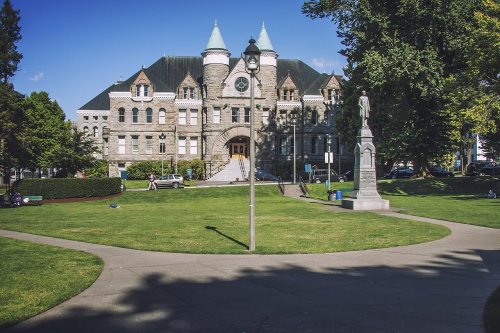
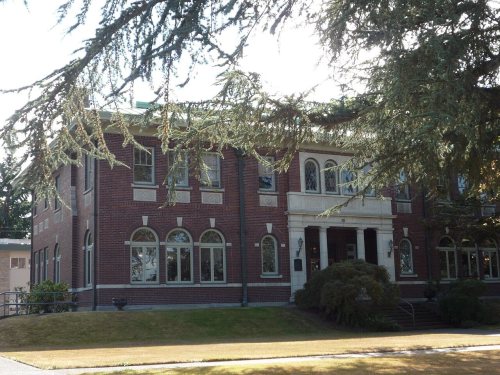
38 listings: 31 buildings, among them the Old Capitol Building (listed 1975, the first), 3 historic districts, the Washington State Capitol Historic District, the Olympia Downtown Historic District and the South Capitol Neighborhood Historic District, with 538 contributing buildings, 1 site, and 3 structures. 572 historic buildings in all.
How old are the homes in Olympia?
12% of Olympia’s homes were built before 1940 (Census estimate, ±1.8 points), against a typical 4.3% for a Washington town; the median home was built in 1982.
Founding dates: Wikidata, Wikipedia, the U.S. post office records of Blevins & Helbock (CC0) and the Census. Homes by year built: Census ACS 2020–24. National Register of Historic Places: National Park Service (list of May 22, 2026). Old photos, postcards and papers: Wikimedia Commons, the Library of Congress and other public archives, credited on each item’s page. Maps: U.S. Geological Survey historical topographic maps (via Esri) and Sanborn fire-insurance maps (Library of Congress). History text and census tables: Wikipedia (CC BY-SA 4.0). Places that used to be: USGS Geographic Names Information System (2021).
From Wikimedia Commons (17), Wikidata (1), the National Register of Historic Places (38), Wikipedia, U.S. Geological Survey historical maps, U.S. Census counts (via Wikipedia), the US Post Offices dataset (Blevins & Helbock), the USGS Geographic Names Information System, Sanborn fire insurance maps (Library of Congress) and old county and town histories (Internet Archive). Archive images are copied here with their credits and licenses, shown on each photo’s page. Refreshed monthly.






 1853
 1854
 1854
 1857
 c. 1860
 1860
 1863
 1863
 1864
 1868
 1868
 1868
 1872


