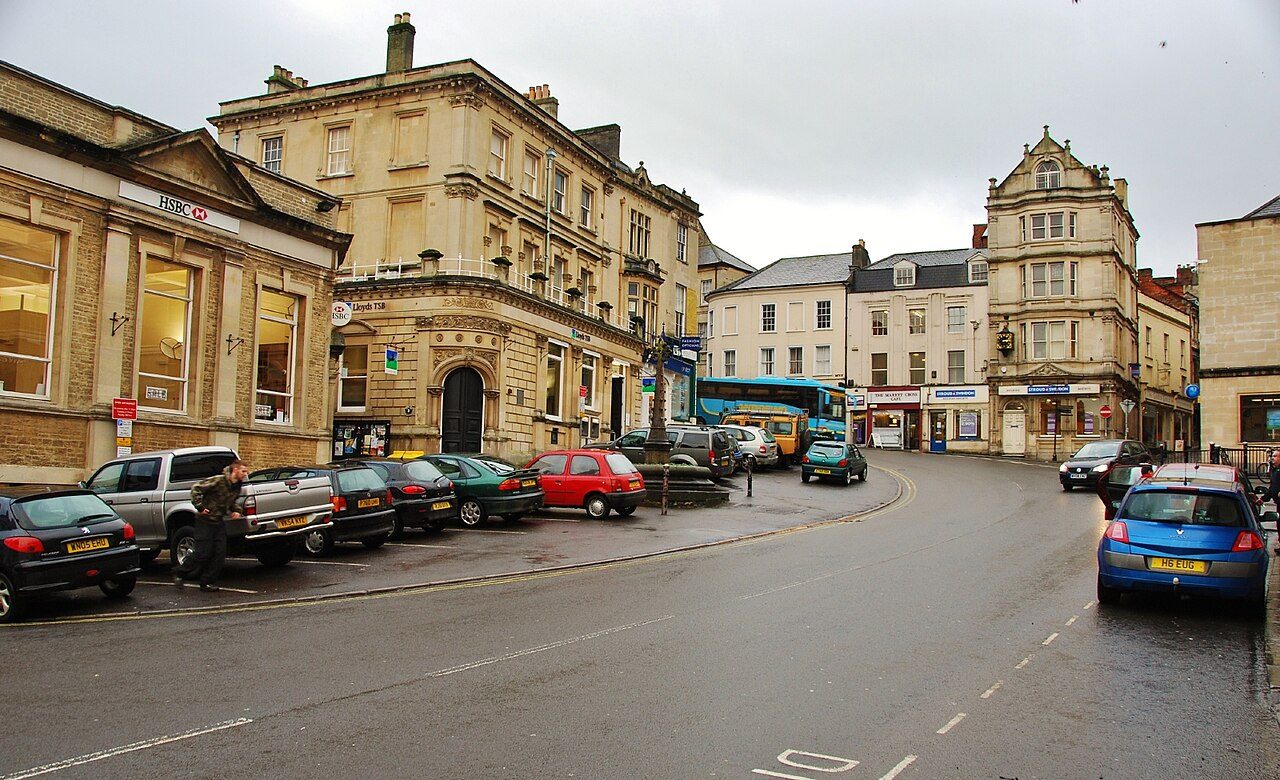
 Photo: Mr Eugene Birchall · CC BY-SA 2.0
Jobless benefit claims are higher in Frome than in 77% of UK towns
4,937 residents leave for work each working day, and 2,717 people travel in. Jobless benefit claims cover 3.3% of working-age residents, against 2.7% in the typical UK town. Frome grades C+ for jobs and income against UK towns, #27 of 49 in Somerset.
Work in Frome, in a few figures
Fewer jobs than working residents
7,875 jobs are based in Frome for 13,672 working residents; the typical UK town has 0.7 jobs per resident in work. Shops, education and restaurants, cafés and pubs make up 43% of them. Jobs based here ↓
More benefit claims than most towns
The typical UK town: 2.7%; England and Wales: 4% so far in 2026. Benefits over time ↓
Written from the data on this page: ONS Census 2021 and BRES, DWP claimant counts via Nomis, and ONS household income.
Frome grades C+ for jobs and income
Better than 35% of UK towns across four measures: #27 of 49 in Somerset.
Its strongest measure is getting to jobs without a car; its weakest, the claimant rate.
How the grade works
Each input is ranked against every UK town of 1,000 or more (higher income and job access are better; fewer claimants and less employment deprivation are better), the four ranks are averaged, and the average is ranked again. A town needs three of the four.
Jobless claims in the Somerset council area are below England and Wales’ rate
Somerset’s rate was about 2.2% in 2019, peaked at 5.1% in August 2020 and has averaged 2.6% in 2026, against 4% across England and Wales. Claims everywhere stay higher than before the pandemic, partly because Universal Credit counts more people on low pay as looking for work.
The chart is the whole council area of Somerset, which Nomis publishes monthly; the figures above the line are for Frome’s built-up area. Claimant count: people claiming Jobseeker’s Allowance, or Universal Credit while required to look for work. Employment deprivation counts people out of work on Jobseeker’s Allowance, Employment and Support Allowance, Incapacity Benefit, Severe Disablement Allowance, Carer’s Allowance or the Universal Credit equivalents (English Indices of Deprivation 2025). The “most deprived tenth” compares areas within England only.
Claimant rate since 2015: people claiming Jobseeker’s Allowance or Universal Credit while looking for work, as a share of residents aged 16 to 64 (DWP, via Nomis).
The daily tide in Frome runs outward
13,672 residents were in work at the 2021 Census; 11,399 people worked in Frome.
For every person who comes in to work, about 2 residents travel out. 33% of residents who travel to a workplace stay in the town; in the typical UK town of 2,500+ it’s 14%.
The middle of each bar is the same people: residents who work in the town or from home.
Frome’s commuters work from Bath to Wells
- Countryside519
- Trowbridge180
- Westbury171
- Warminster164
- Shepton Mallet125
- Bath100
- Coleford87
- Radstock85
- Wells62
- Midsomer Norton60
- Countryside1,788
- Bath465
- Trowbridge235
- Warminster172
- Shepton Mallet139
- Westbury123
- Midsomer Norton112
- Wells107
- Radstock92
- Street87
67% of residents who travel to a workplace work outside Frome; Bath takes the most (465). Coming the other way, Trowbridge sends the most (180).
The ten places that send the most workers into Frome, and the ten where its residents most often work (Census 2021, by home and workplace). Line width is the number of people.
7,875 jobs, one in five in retail
0.6 for every working resident; the typical UK town has 0.7.
BRES counts jobs, not people (a part-time job and a second job count once each), so it runs above the Census count of people working here (11,399). Small areas are shared out to the town by where their Census 2021 workers were based; kinds of work are BRES industry divisions (SIC 2007), rounded. England’s towns: all jobs in its built-up areas.
Jobs at workplaces in Frome (employees and working owners, ONS Business Register and Employment Survey 2024).
Before tax, households in Frome average £54,910
Higher than 58% of UK towns of 2,500+; the typical town is £52,385. The whole council area of Mendip averages £53,048.
The town figure is ONS’s neighbourhood (MSOA) estimates shared out by where the town’s residents live.
Total household income before tax, mean, year to March 2023 (ONS small-area estimates).
Across Frome, household incomes range from £49K to £58K
Mean household income before tax in each of the 3 neighbourhoods (MSOAs) mostly inside the town: the highest is 1.2 times the lowest.
Each dot is a neighbourhood (MSOA, about 8,000 people) mostly inside Frome; names from the House of Commons Library. ONS gives each a 95% range of roughly ±£7K to ±£10K, so neighbourhoods close together on the strip may not really differ.
Walking, cycling, the bus or the train: 20% of Frome’s commuters
Median journey 7.2 km; typical UK town 8.4 km.
44% of journeys to work are under 5 km (3 miles), against 45% across England’s towns, and 10% are 30 km or more. Frome grades A− for walkability: the share of commuters who walk, cycle or take public transport, against UK towns.
ONS Census 2021, TS061 (method of travel) and TS058 (distance, straight line from home to workplace), output areas summed. Census day fell in the third lockdown, so fewer people travelled than usual.
How residents who travel to work get there, and how far they go (Census 2021, not counting those working mainly at home).
What adults in Frome do: 61% are in work
ONS Census 2021, tables TS066 (economic activity) and TS063 (occupation), output areas summed to the built-up area. England’s towns: everyone living in its built-up areas.
Everyone 16 and over, by what they were doing the week before the 2021 Census, and the jobs of those in work.
Ranked on jobs and income, Frome is 136th among 238 UK towns of 20,000 to 38,000
| # | Town | People | Jobs per worker | Work in own town | Claimants | Income | Grade |
|---|---|---|---|---|---|---|---|
| 1 | Harpenden Hertfordshire | 30,964 | 0.8 | 30% | 1.5% | £92K | A+ |
| 2 | Sevenoaks Kent | 26,474 | 1.2 | 34% | 1.6% | £84K | A+ |
| 3 | Sandhurst Berkshire | 20,220 | 0.5 | 16% | 1.6% | £74K | A+ |
| … | |||||||
| 31 | Portishead Somerset | 26,351 | 0.8 | 28% | 1.5% | £66K | A |
| … | |||||||
| 79 | Clevedon Somerset | 21,084 | 0.7 | 29% | 2.1% | £54K | B |
| … | |||||||
| 134 | Felixstowe Suffolk | 24,218 | 1.2 | 50% | 2.7% | £50K | C+ |
| 135 | Northfleet Kent | 29,892 | 0.8 | 17% | 5% | £54K | C+ |
| 136 | Frome Somerset | 27,904 | 0.6 | 33% | 3.3% | £55K | C+ |
| 137 | Coalville Leicestershire | 21,975 | 1.1 | 27% | 2.8% | £50K | C |
| 138 | Horwich Greater Manchester | 20,703 | 1.8 | 25% | 3.2% | £46K | C |
| … | |||||||
| 238 | Skegness Lincolnshire | 20,701 | 1.1 | 53% | 6.1% | £33K | D− |
Jobs & income letters rank against every UK town of 1,000 or more; the order here is context only.
Ordered by Jobs & income Grade: the top three, the towns either side of Frome, and others in Somerset.
Neighbouring places to Frome, compared
| Town | People | Jobs | Work in own town | Claimants | Grade |
|---|---|---|---|---|---|
| Frome | 27,904 | 7,875 | 33% | 3.3% | C+ |
| Beckington | 1,001 | 550 | 8% | 2% | B |
| Dilton Marsh | 1,958 | 381 | 4% | 1.4% | B+ |
| Norton St Philip | 1,004 | 324 | 3% | 1.8% | B |
| Coleford | 2,235 | 258 | 4% | 2.4% | C |
| Southwick | 1,856 | 297 | 3% | 1.9% | A− |
| Westbury | 16,394 | 4,438 | 18% | 2.5% | B− |
| Warminster | 18,018 | 8,034 | 39% | 2.3% | B− |
Jobs based in each place, commuters who stay in their own town, and the claimant rate.
What this data can and can’t tell you
- The Census was taken in lockdown. Census day was 21 March 2021, during the third national lockdown: many people were furloughed or working from home, so fewer travelled to work, and journeys were shorter, than before the pandemic or since. The flows on this page show where people worked that spring.
- At home and no fixed place are one figure. In the workplace flows, ONS puts people who mainly worked at home and people with no fixed workplace (drivers, builders, care workers on rounds) at their home address, so the two can’t be told apart there.
- Towns are built-up areas. Frome here is ONS’s built-up area: the town as built, not its council district. A workplace on an estate or farm outside every built-up area counts as “outside any built-up area”.
- Jobs are counted where they are. BRES counts jobs at each workplace (employees and working owners, rounded by ONS), so a town with a hospital, university or big employer can have more jobs than working residents. Small areas are shared out to towns by where their Census workers were based.
- The benefits chart is the council area. Nomis publishes the claimant count monthly for councils back to 2013, so the line is Somerset as a whole; the claimant rate elsewhere on this page is Frome’s built-up area, from small areas.
Questions about work in Frome
Where do people in Frome work?
At the 2021 Census, 33% of Frome’s residents who travelled to work worked in the town itself; the most common other places were Bath (465), Trowbridge (235) and Warminster (172). 45% of working residents worked mainly at home or had no fixed workplace; the Census was taken in lockdown, so home working was unusually high.
How many people commute into Frome?
2,717 people who lived elsewhere worked in Frome at the 2021 Census, 24% of its 11,399 workers. The most came from Trowbridge (180), Westbury (171) and Warminster (164). 4,937 residents travelled out the other way.
How many jobs are there in Frome?
About 7,880 jobs (employees and working owners) were based in Frome in 2024, on ONS’s Business Register and Employment Survey: 0.6 for every resident in work, against 0.7 in the typical UK town. The biggest kinds of work are shops (about 1,640), education (about 990) and restaurants, cafés and pubs (about 920).
Is Frome a good place to find work?
Frome earns a C+ for jobs and income, better than 35% of UK towns on household income, the claimant rate, employment deprivation and access to jobs together. Mean household income £54,910; 3.3% of 16 to 64s claim unemployment benefits.
How do people in Frome get to work?
77% of commuters go by car or van, 16% walk, 2% cycle and 2% take the bus or train; 44% travel under 5 km. Census 2021, taken during lockdown.
What is the average household income in Frome?
Mean household income before tax was £54,910 in the year to March 2023 (ONS), against £52,385 in the typical UK town. By neighbourhood it runs from £49,216 in Frome North West to £57,668 in Frome North East.
How does Frome compare with Bath for jobs?
Frome has 0.6 jobs per working resident against Bath’s 1.5, a 3.3% claimant rate against 2.1%, and mean household income of £54,910 against £60,909.
Sources: ONS Census 2021 origin-destination data, place of work (ODWP01EW), output areas summed to the ONS 2022 built-up area · ONS Census 2021 tables TS058 (distance), TS061 (method of travel), TS063 (occupation) and TS066 (economic activity) · ONS Business Register and Employment Survey via Nomis (open access), by industry division · ONS small-area income estimates (financial year ending 2023); House of Commons Library MSOA names · DWP claimant count via Nomis (towns January to August 2026; councils, regions and England and Wales monthly since January 2015) · MHCLG English Indices of Deprivation 2025 · DfT Transport Connectivity Metric (employment) · TownRatings grades: our own summary of the data, ranked against UK towns only. All under the Open Government Licence v3.0.
Contains public sector information licensed under the Open Government Licence v3.0. Contains HM Land Registry data © Crown copyright and database right 2026. Contains OS data © Crown copyright and database right 2026 (ONS boundaries). Northern Ireland: Source: NISRA; contains Land & Property Services data and Ordnance Survey of Northern Ireland information, © Crown copyright, licensed under the Open Government Licence v3.0. Scotland: contains National Records of Scotland data, Registers of Scotland data and SEPA data, © Crown copyright / © SEPA 2025, licensed under the Open Government Licence v3.0.