 I
Cathedral · listed 1949Chelmsford CathedralOn the list as Cathedral Church of St Mary the VirginPhoto: Petepetepete · CC BY-SA 3.0
 Shire Hall · Photo: Stuart166axe · Public domain
B−History Grade
History of Chelmsford · Historic England
231 listed buildings, 3 of them Grade I
On the Historic England list, all of them stand inside Chelmsford’s built-up area, 21 for every 10,000 residents. It also has 1 scheduled monument. 6.4% of its homes were built before 1919. We have photos of 10 of its listed buildings and 6 old views of the town. Chelmsford grades B− for history: #34 of 81 in Essex.
Listed buildings
231
21 per 10,000 residents
Grade I
3
exceptional interest
Grade II*
9
more than special interest
Scheduled monuments
1
1 registered park or garden
Homes built before 1919
6.4%
typical UK town 15%
In pictures
Chelmsford in 17 photos and old views
Nearly every Grade I and II* building, photographed, and the town before 1950. Tap a photo to step through them full screen.
 Cathedral Church of St Mary the VirginGrade I listed
 New HallGrade I listed
 Maltings on West Side of Courtyard at No 7Grade II listed
 Gatehouse to Coval LodgeGrade II listed
 The Bay Horse Public HouseGrade II listed+12See all photos
Photos from Wikimedia Commons and Geograph, copied to our own server, each credited to its photographer with its licence; names open the building’s page or its official list entry.
Through time
Chelmsford from 1903 to 1910
6 old photos and postcards, in date order. All public domain, made before 1950.
 1903
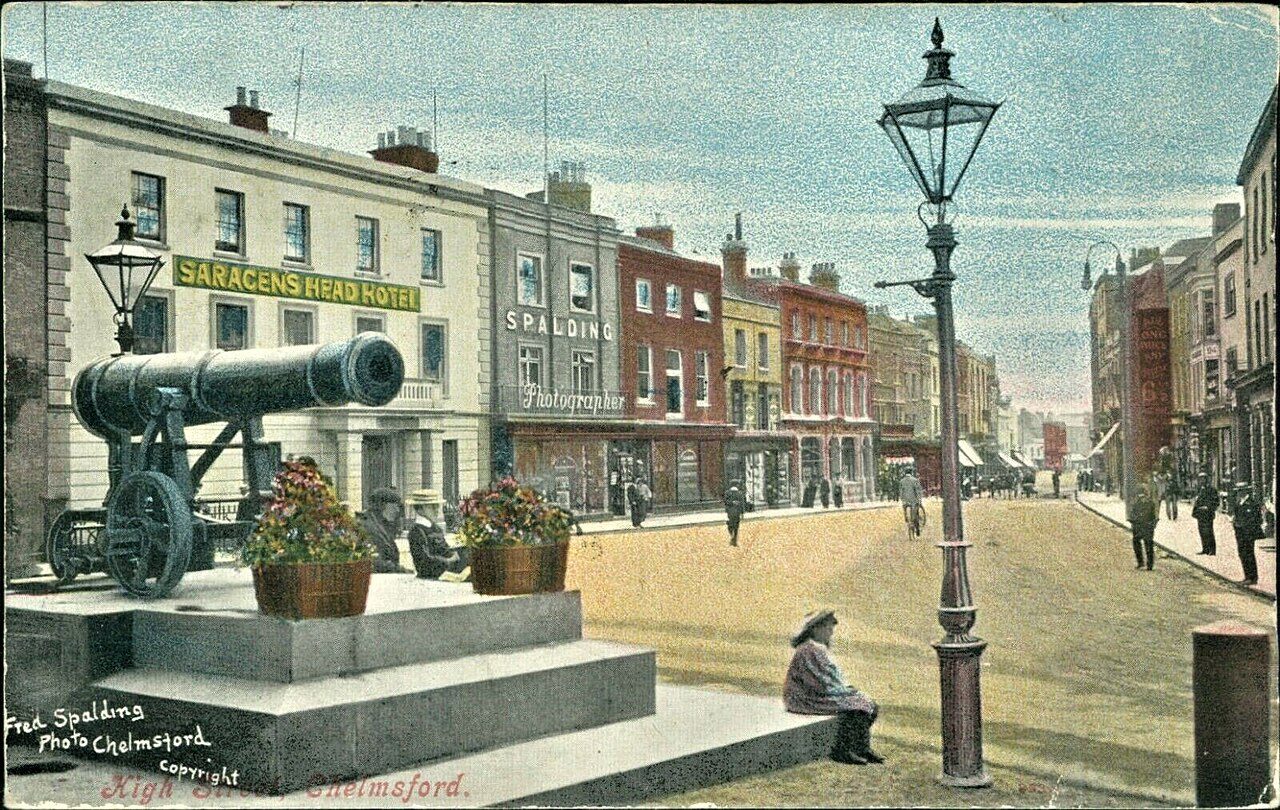 1906
 c. 1910


Public domain, from Wikimedia Commons, copied to our own server. Each credit opens the image’s page with its full description and history.
The map
Where Chelmsford’s history is
Every Grade I and II* building, monument and historic park, over the age of each neighbourhood’s homes.
Grade IGrade II*Scheduled monumentPark or garden
Homes built before 1919, by neighbourhoodunder 10%10–25%25–50%50%+
0 of 74neighbourhoods have mostly pre-1919 homes; in the oldest, 49% were built before 1919.
Hover a dot for its name; tap one with a photo to open it.
231 listed buildings by grade
3 Grade I9 Grade II*219 Grade II
Historic England lists buildings in three grades: Grade I for buildings of exceptional interest (about 2.5% of all listed buildings), Grade II* for particularly important buildings of more than special interest (about 5.8%), and Grade II for buildings of special interest (about 91.7%). Listing protects the whole building, inside and out.
Every entry on the National Heritage List for England whose point lies inside the ONS 2022 built-up-area boundary. One list entry can cover a terrace or a group of buildings. Neighbourhood dots: the population-weighted centre of each Census 2021 output area, coloured by its neighbourhood’s (LSOA’s) share of homes built before 1919 (Valuation Office Agency, March 2025).
Grade I
The 3 Grade I listed buildings in Chelmsford
Buildings of exceptional interest, about 2.5% of all listed buildings. Every one is photographed. Each opens its own page, with the official list entry.
 I
Public · listed 1952Palace of BeaulieuOn the list as New HallPhoto: Amaibrown · CC BY 3.0
 I
Church · listed 1967Church of St MaryPhoto: John Salmon · CC BY-SA 2.0
Grade II*
The 9 Grade II* listed buildings in Chelmsford
Particularly important buildings of more than special interest. 4 are photographed.
 II*
Public · listed 1949Shire HallPhoto: Stuart166axe · Public domain
 II*
House · listed 1975Chobbing's FarmhousePhoto: Robin Webster · CC BY-SA 2.0
 II*
Church · listed 1949All Saints Church, SpringfieldOn the list as Church of All SaintsPhoto: Robert Edwards · CC BY-SA 2.0
 II*
Church · listed 1967Church of St AndrewPhoto: John Salmon · CC BY-SA 2.0
House · listed 1949The Old Rectory
House · listed 1975The VicarageOn the list as The Old Vicarage
House · listed 1967The Rectory
House · listed 194926, High Street
House · listed 196766 and 68, High Street
Historic streets
High Street has the most listed buildings
Streets by the listed entries with an address on them. One entry can be a whole terrace, so long rows count once.
High Street14 listed · 2 II*
Moulsham Street13 listed
Duke Street6 listed
New London Road5 listed
Springfield Road5 listed
Of the 231 entries, 60 are named by a street address; the rest are named buildings such as churches, halls and bridges.
What’s protected
Most of Chelmsford’s listed buildings are homes
Every listed building sorted by what its list name says it is.
Houses, terraces & villas160
Inns, shops & warehouses22
Public & civic buildings20
Walls, gates & bridges11
Memorials, crosses & tombs9
Churches, chapels & priories8
Street furniture1
160 entries (69%) are houses, terraces and villas. 8 are churches, chapels and priories, including 2 of the 3 Grade I buildings.
Buildings are sorted by words in each entry’s name (church, gate, inn, memorial…): the list’s open data has no building type. An entry named only by its address counts as a house.
Grade II
219 Grade II listed buildings
Most listed buildings are in this grade, which covers buildings of special interest. Open any building to read its official list entry.
The first 150 of 219 Grade II listed buildings, A to Z
AdstocksBaddow CourtBaddow HouseBaddow PlaceBancroft HouseBanstreets the MunnionsBarnBarn Immediately to South of Belsteads FarmhouseBarn at Bulls LodgeBarn at Chobbings FarmBarn at Holders FarmBarnes MillBarnes Mill HouseBeauchamp HouseBeech HouseBellefieldBelsteads FarmhouseBlock BS3/SR4 on East Side of Courtyard at No 7Blocks C and D, County HallBowers FarmBrick WallsBrook HouseBulls LodgeCarew TerraceChain Home tower at Great BaddowChannels FarmhouseChelmsford ClubChurch of St John the EvangelistChurch of St MaryChurch of the Holy TrinityCopliesCottage East of the Post OfficeCottage Immediately North of Writtle WickCottages at Dairy FarmCoval HallCoval LodgeCrompton's Arc WorksCrown Court OfficeCrows FarmhouseCuton HallDairy Farm CottagesDuffield MemorialEast Barn at Old Lodge FarmEbeneezer TerraceEbenezer Strict Baptist ChapelEdward HouseFormer Barnes FarmhouseFormer Chaplains House Hm PrisonFormer barn at east edge of yard to the former Barnes farmhouseFriars HallGarden HouseGarden Wall to the West of Numbers 18 and 22Gatehouse to Coval LodgeGates and Gate Piers to the Graveyard of the Cathedral Church of St Mary the VirginGeneralsGoat HallGoldlay HouseGowersGranary Block SR5 at North End of No 7Granary at Chobbings FarmGravestone to Joseph Freeman, New London Road CemeteryGuy HarlingsHamlet TerraceHill Farm CottageHop Kiln and Office and Store at No 7HoughtonsJefferey's HouseK6 Telephone Kiosk (on the Forecourt of The New London Public House)K6 Telephone Kiosk adjacent to 6 Duke Street, ChelmsfordLaburnham CottageLathcotesLaw LibraryLodge House to Friends' CemeteryMaltings on West Side of Courtyard at No 7Manor House, Manor Place and Manor LodgeMarconi's First Radio FactoryMarconisMason VillasMausoleum, East of East End of Cathedral Commemorating John Wallinger and I Arnold WallingerMaynetreesMeadow ViewMeadsMemorial Cross 18 Yards North of Iron Gates, Commemorating H F Johnson, D D Archdeacon of ColchesterMill HouseMill HouseMole HatchMonument 34 Yards East of Chancel, Commemorating Members of the Gilson FamilyMonument, 19 Yards North of North Aisle, Commemorating William Baker and Garrad BakerMonument, 9 Yards North of North Transept to Viscountess FalklandMoulsham Corn MillMoulsham LodgeMoulsham Mill HouseMoulsham War MemorialNew BridgeNo. 5, SPRINGFIELD ROADNo. 91, HIGH STREETNos 1 and 2 Springfield Dukes CottagesNos. 13 AND 14, HIGH STREETOaklands HouseObelisk, North East of Chancel Commemorating George Wray and Ann WrayOld Lodge FarmhouseOlsparOsborne PlaceOutbuilding west of Sandon PlacePart of Boundary Wall at Hm Prison, Namely Approximately 130 Metres of North East Facing Wall Fronting Sandford Road, And Approximately 50 and 40 Metres of North West Facing Wall Fronting Springfield RoadPart of Midland BankPease HallPost Office the ForgePound HousePrentices FarmRegent TheatreRose CottageRussell's BarnSandon PlaceSarcophagus, 13 Yards West of West Entrance. Commemorating E E Parker, E C Parker and J D ParkerSextons ShedSheepcotes CottagesSouth East Barn at Old Lodge FarmSouth West Barn at Old Lodge FarmSouthborough HouseSpring CottageSpringfield DukesSpringfield HallSpringfield LyonsSpringfield Mill HouseSpringfield PlaceSpringfield TerraceSpringfield Water MillSt John's TerraceSt John's TerraceStable Building Off North West Corner of Courtyard at No 7Stable/Granary Building at Old Lodge FarmStatue of Sir Nicholas Conyngham TindalStone BridgeThe Anchor Public HouseThe Bay Horse Public HouseThe Bishop Wilson Memorial LibraryThe Chelmsford InstituteThe Coachhouse Springfield PlaceThe CottageThe Crown InnThe Endeavour Public HouseThe LimesThe Nag's Head Public HouseThe Old Police StationThe RectoryThe Saracen's Head HotelThe Star and Garter Public HouseThe Tulip Public HouseThe Two Brewers Public House
Conservation areas
11 conservation areas cover 4.5% of Chelmsford
Areas the council protects as a whole: demolition and changes to how buildings look need consent, and trees are protected.
Chelmer and Blackwater Navigation 199127 ha
Chelmsford New London Road 198123 ha
Great Baddow 196915 ha
Springfield Green 198210 ha
Chelmsford West End 198310 ha
Chelmsford Central 19719 ha
Chelmsford Moulsham Street 19737 ha
Sandon 19735 ha
Chelmsford Baddow Road and River Can 19784 ha
Chelmsford St John's Hospital 20033 ha
Chelmsford John Keene Memorial Homes 20081 ha
115 hain conservation areas, of 2,556 ha inside the built-up area.
The first, Great Baddow, was designated in 1969; the newest, Chelmsford John Keene Memorial Homes, in 2008. 156 of the 231 listed buildings stand in one.
Historic England’s conservation areas layer, supplied by councils (incomplete in places, so a page fact, never graded). Hectares are the part of each area inside the built-up area.
How the list grew
87 of Chelmsford’s 231 listed buildings were added in 1978
The year each building now on the list was first listed.
1978 · 871975 · 451949 · 20
19501960197019801990200020102020
The first 20 entries were listed in 1949, 1 of the 3 Grade I buildings among them. 87 came in 1978, in the national resurvey of the 1970s and 80s. Only 6 have been added in the last 15 years.
Monuments & landscapes
Monuments, parks and gardens
Designations that overlap the town by a tenth of their area or half a hectare.
1 scheduled monument
Nationally important archaeological sites and monuments, protected by law; work on them needs consent from the Secretary of State, advised by Historic England.

1 registered park or garden
New Hall, BorehamGrade II
History Grade
Chelmsford grades B− for history
Protected heritage and the age of the town’s homes, against all UK towns.
Protected heritage, for its size and in all (249 points, 23 per 10,000 residents)More than 65% of UK towns
Homes built before 1919 (6.4%)More than 14% of UK towns
Two measures, each ranked against every UK town of 1,000 or more, with protected heritage counting twice as much as the age of homes. Protected heritage counts each listed building by its grade (Grade I three points, II* two, II one), each scheduled monument and battlefield two, and each registered park or garden by its grade; it is ranked both per 10,000 residents and as a total, so a village with one fine church doesn’t outrank a historic city. The second measure is the share of homes built before 1919, from the Valuation Office Agency’s council tax records. History is a character grade: it describes the town and isn’t part of the overall grade.
Homes by age
6.4% of Chelmsford’s homes were built before 1919
Every home by when it was built, from council tax records, against England & Wales (the dark tick).
3.4%
Before 1900
3%
1900–18
4.4%
1919–29
6.9%
1930s
8.9%
1945–54
13%
1955–64
11%
1965–72
11%
1973–82
11%
1983–92
4.6%
1993–99
9.2%
2000–08
3.7%
2009–15
10%
2016–25
ChelmsfordEngland & Wales
3.4% of homes are Victorian or older, against 16% across England and Wales. The busiest period since was 1955–64, which added 13% of today’s homes.
Valuation Office Agency, council tax stock of properties by build period, 31 March 2025, for the neighbourhoods (LSOAs) that make up the town, split by where their residents live. Homes with no recorded build period (43 here) are left out; 1939–44 is not a period in the data.
Born here
25 notable people born in Chelmsford before 1900
The 20 best known on one timeline, earliest first.
Philemon Holland
William Pynchon
William Maldon
Joseph Strutt
Nicholas Conyngham Tindal
Robert Livermore
William Calcraft
William Norcott
Frederic Carrington
George Percy Badger
Arthur John Strutt
George Clift King
Cuthbert Christy
Alfred George Gardiner
Maud Bodkin
Massey Poyntz
Armstrong Gibbs
Ursula Bloom
Joseph Dixon
Jas Dadley
155016001650170017501800185019001950
AG
Armstrong Gibbs1889–1960 · English composer

Joseph Strutt1749–1802 · British engraver, artist, antiquary and writer (1749-1802)

Philemon Holland1552–1637 · English schoolmaster, physician, and Classics translator

Alfred George Gardiner1865–1946 · British journalist and writer

William Pynchon1590–1662 · Founder of Springfield, Massachusetts 1590-1662
GB
George Percy Badger1815–1888 · Anglican missionary and scholar

Robert Livermore1799–1858 · English-born, early California settler

William Calcraft1800–1879 · English hangman
Everyone born in Chelmsford → Birthplaces from Wikidata; portraits from Wikimedia Commons.
Neighbours
Listed buildings in the places around Chelmsford
| Town | People | Listed | Grade I | History |
|---|---|---|---|---|
| Chelmsford | 110,612 | 231 | 3 | B− |
| Writtle | 4,703 | 44 | 1 | B+ |
| Broomfield | 3,491 | 26 | 0 | C+ |
| Galleywood | 6,410 | 8 | 0 | D |
| Boreham | 3,561 | 18 | 1 | C+ |
| Little Waltham | 1,038 | 34 | 0 | B+ |
| Danbury | 6,196 | 60 | 1 | B+ |
| Stock | 1,573 | 42 | 1 | A |
In brief
Chelmsford in brief
Chelmsford has 231 listed buildings, 3 of them Grade I, including Chelmsford Cathedral. High Street alone has 14 listed buildings. Its older streets lie in 11 conservation areas, the first designated in 1969. Of the whole list, 69% are houses, terraces and villas.
Of the 25 people born here before 1900, the best known include Armstrong Gibbs (1889), Joseph Strutt (1749) and Philemon Holland (1552). Its homes are mostly newer: 6.4% were built before 1919, against 15% in the typical UK town. Otherwise the figures are ordinary: it has 3 Grade I buildings, about typical for a town its size (the middle one has 2); per resident it sits near the middle of UK towns; and it also has a scheduled monument.
Questions about Chelmsford’s history
How many listed buildings are there in Chelmsford?
Historic England lists 231 buildings inside Chelmsford’s built-up area: 3 Grade I, 9 Grade II* and 219 Grade II.
What are the Grade I listed buildings in Chelmsford?
3, including Cathedral Church of St Mary the Virgin, Church of St Mary and New Hall.
Which street in Chelmsford has the most listed buildings?
High Street (14), Moulsham Street (13) and Duke Street (6) have the most listed entries named by an address. One entry can be a whole terrace.
Are there scheduled monuments in Chelmsford?
Yes, 1 scheduled monument, including Moulsham Bridge.
How many conservation areas are there in Chelmsford?
11, covering about 115 hectares of the town. The largest are Chelmer and Blackwater Navigation and Chelmsford New London Road.
When were Chelmsford’s buildings listed?
The first in 1949; the most, 87, in 1978.
Are there old photos of Chelmsford?
Yes: 6 public-domain photos and postcards from 1903 to 1910, all on this page.
Who was born in Chelmsford?
Among people born before 1900: Armstrong Gibbs (1889), Joseph Strutt (1749), Philemon Holland (1552), Alfred George Gardiner (1865) and William Pynchon (1590).
How old are the homes in Chelmsford?
6.4% of homes were built before 1919 and 18% before 1940, from the Valuation Office Agency’s council tax records (March 2025).
© Historic England 2026. Contains Ordnance Survey data © Crown copyright and database right 2026. The National Heritage List for England is the official, up-to-date register of all nationally protected historic buildings and sites in England; check an entry on Historic England’s website before relying on it.
Sources: Historic England, National Heritage List for England (listed buildings, scheduled monuments, registered parks and gardens, battlefields, World Heritage Sites), October 2026, inside the ONS 2022 built-up-area boundary · Valuation Office Agency, Council Tax: stock of properties by build period (31 March 2025) · TownRatings grades: our own summary of the data, ranked against UK towns only · Historic England conservation areas (supplied by local planning authorities; October 2026). All under the Open Government Licence v3.0.
Contains public sector information licensed under the Open Government Licence v3.0. Contains HM Land Registry data © Crown copyright and database right 2026. Contains OS data © Crown copyright and database right 2026 (ONS boundaries). Northern Ireland: Source: NISRA; contains Land & Property Services data and Ordnance Survey of Northern Ireland information, © Crown copyright, licensed under the Open Government Licence v3.0. Scotland: contains National Records of Scotland data, Registers of Scotland data and SEPA data, © Crown copyright / © SEPA 2025, licensed under the Open Government Licence v3.0.