

 II*
House · listed 1951Docton HousePhoto: Ian Capper · CC BY-SA 2.0
 Photo: Derek Voller · CC BY-SA 2.0
A+History Grade
History of Appledore · Historic England
Appledore: 45% of homes built before 1919
The typical town has 15%: Appledore has 3 times the share. Historic England lists 116 buildings inside Appledore’s built-up area, 678 for every 10,000 residents. It also has 1 scheduled monument. Appledore grades A+ for history.
Listed buildings
116
678 per 10,000 residents
Grade I
0
exceptional interest
Grade II*
2
more than special interest
Scheduled monuments
1
nationally important sites
Homes built before 1919
45%
typical UK town 15%
In pictures
Landmarks of Appledore
Nearly every Grade I and II* building, photographed. Tap a photo to step through them full screen.
Photos from Wikimedia Commons and Geograph, copied to our own server, each credited to its photographer with its licence; names open the building’s page or its official list entry.
The map
Where Appledore’s history is
Every Grade I and II* building, monument and historic park.
Grade II*Scheduled monument
Hover a dot for its name; tap one with a photo to open it.
116 listed buildings by grade
0 Grade I2 Grade II*114 Grade II
Historic England lists buildings in three grades: Grade I for buildings of exceptional interest (about 2.5% of all listed buildings), Grade II* for particularly important buildings of more than special interest (about 5.8%), and Grade II for buildings of special interest (about 91.7%). Listing protects the whole building, inside and out.
Every entry on the National Heritage List for England whose point lies inside the ONS 2022 built-up-area boundary. One list entry can cover a terrace or a group of buildings.
Grade II*
The 2 Grade II* listed buildings in Appledore
Particularly important buildings of more than special interest. Every one is photographed. Each opens its own page, with the official list entry.
 II*
House · listed 1987Richmond DockPhoto: Chris Allen · CC BY-SA 2.0
Historic streets
Market Street has the most listed buildings
Streets by the listed entries with an address on them. One entry can be a whole terrace, so long rows count once.
Market Street16 listed
Bude Street14 listed
Irsha Street10 listed
Meeting Street9 listed
The Quay8 listed
Myrtle Street3 listed
Of the 116 entries, 66 are named by a street address; the rest are named buildings such as churches, halls and bridges.
What’s protected
Most of Appledore’s listed buildings are homes
Every listed building sorted by what its list name says it is.
Houses, terraces & villas102
Inns, shops & warehouses6
Churches, chapels & priories3
Public & civic buildings3
Memorials, crosses & tombs1
Street furniture1
102 entries (88%) are houses, terraces and villas. 3 are churches, chapels and priories.
Buildings are sorted by words in each entry’s name (church, gate, inn, memorial…): the list’s open data has no building type. An entry named only by its address counts as a house.
Grade II
114 Grade II listed buildings
Most listed buildings are in this grade, which covers buildings of special interest. Open any building to read its official list entry.
All 114 Grade II listed buildings, A to Z
AnchorageAppledore War MemorialArk CottageBank HouseBeechcroftBidnaBradbourne HouseBristol HouseBude HouseBude HouseChurch of St MaryCoach and HorsesCongregational ChapelCounty Library and No 8Darracott CourtDock CottageDoras HouseFerriwaisHomeside TerraceK6 Telephone Kiosk 14m east of No. 73 Irsha StreetK6 telephone kiosk adjacent to the Seagate HotelKoh-I-NoorLilian GalleryLittle Staddon StaddonLondon HouseMagowrney CottageMarshford (Near Junction of Pitt Lane)Methodist ChurchMyrtle CottageNational Westminster BankNo. 4, together with part of 4a (Odun Cottage), Odun Road, AppledoreOdun HousePost OfficeQuayside House, Irsha Street and Waters Reach, 71, Irsha StreetRoborough HouseRock CottageRock HouseRosalind and ClaremontRoyal George InnRoyal HotelSeagate HotelSeamen's MissionThe MyrtlesTrinity Buoy StoresWest FarmWest HavenWillesdeneYe Champion of Wales1 and 1A, One End Street1, Meeting Street1, Pitt Court10 and 10A Bude Street10, Meeting Street10, The Quay10-18, Market Street106 and 108, Irsha Street11 and 13, Meeting Street11, Market Street11, The Quay110 and 110A, Irsha Street12 and 13, Myrtle Street12 and 13, The Quay12, Bude Street12, Meeting Street13 and 15, Bude Street13-19, Irsha Street14, Bude Street14, The Quay14-17, Myrtle Street15 and 15A, The Quay15, Meeting Street16 and 17, The Quay16-32a, Irsha Street17, Market Street18 and 19, Meeting Street18-22, Bude Street19, Market Street2, Meeting Street2-11, Pitt Hill20-22, Meeting Street22-32, Market Street23 and 25, Bude Street23, Market Street25, Market Street26, Bude Street27-31, Market Street29, Bude Street2B and 4, Bude Street3 and 4, Meeting Street3, The Quay33, Bude Street34, Market Street35, Market Street36-42, Market Street37 and 39, Market Street4, Marine Parade4, The Quay41-47, Irsha Street41-47, Market Street44-48, Market Street44-50, Irsha Street5, Bude Street5, together with part of 4A, (Odun Cottage), Odun Road, Appledore6, Bude Street6, Market Street6-8, Marine Parade68, Irsha Street7, Bude Street70, Irsha Street72A, Irsha Street73, Irsha Street8 and 9, Myrtle Street8, Market Street9 and 9A, Bude Street
Conservation areas
1 conservation area covers 17% of Appledore
Areas the council protects as a whole: demolition and changes to how buildings look need consent, and trees are protected.
Appledore 196913 ha
13 hain conservation areas, of 80 ha inside the built-up area.
112 of the 116 listed buildings stand in one.
Historic England’s conservation areas layer, supplied by councils (incomplete in places, so a page fact, never graded). Hectares are the part of each area inside the built-up area.
How the list grew
More than half of Appledore’s listed buildings were added in one year, 1973
The year each building now on the list was first listed.
1973 · 941951 · 17
19501960197019801990200020102020
The first 17 entries were listed in 1951. 94 came in 1973, in the national resurvey of the 1970s and 80s. Only 3 have been added in the last 15 years.
Monuments & landscapes
Monuments, parks and gardens
Designations that overlap the town by a tenth of their area or half a hectare.
1 scheduled monument
Nationally important archaeological sites and monuments, protected by law; work on them needs consent from the Secretary of State, advised by Historic England.
History Grade
Appledore grades A+ for history
Protected heritage and the age of the town’s homes, against all UK towns.
Protected heritage, for its size and in all (120 points, 701 per 10,000 residents)More than 94% of UK towns
Homes built before 1919 (45%)More than 96% of UK towns
Two measures, each ranked against every UK town of 1,000 or more, with protected heritage counting twice as much as the age of homes. Protected heritage counts each listed building by its grade (Grade I three points, II* two, II one), each scheduled monument and battlefield two, and each registered park or garden by its grade; it is ranked both per 10,000 residents and as a total, so a village with one fine church doesn’t outrank a historic city. The second measure is the share of homes built before 1919, from the Valuation Office Agency’s council tax records. History is a character grade: it describes the town and isn’t part of the overall grade.
Homes by age
45% of Appledore’s homes were built before 1919
Every home by when it was built, from council tax records, against England & Wales (the dark tick).
43%
Before 1900
2%
1900–18
2.9%
1919–29
3.8%
1930s
9.7%
1945–54
2.1%
1955–64
12%
1965–72
3%
1973–82
6%
1983–92
5.4%
1993–99
4.2%
2000–08
1.8%
2009–15
4.1%
2016–25
AppledoreEngland & Wales
43% of homes are Victorian or older, against 16% across England and Wales. The busiest period since was 1965–72, which added 12% of today’s homes.
Valuation Office Agency, council tax stock of properties by build period, 31 March 2025, for the neighbourhoods (LSOAs) that make up the town, split by where their residents live. Homes with no recorded build period (14 here) are left out; 1939–44 is not a period in the data.
Born here
3 notable people born in Appledore before 1900
Their lives on one timeline, earliest first.
Edward Calvert
William Reardon Smith
William Tatem, 1st Baron Glanely
175017751800182518501875190019251950
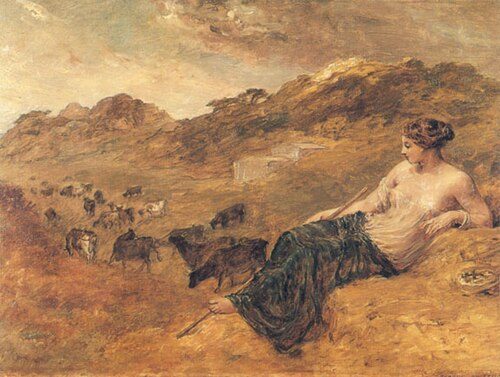
Edward Calvert1799–1883 · British artist (1799-1883)
WG
William Tatem, 1st Baron Glanely1868–1942 · British racehorse owner (1868-1942)
WS
William Reardon Smith1856–1935 · British shipowner
Everyone born in Appledore → Birthplaces from Wikidata; portraits from Wikimedia Commons.
Neighbours
Listed buildings in the places around Appledore
| Town | People | Listed | Grade I | History |
|---|---|---|---|---|
| Appledore | 1,711 | 116 | 0 | A+ |
| Northam | 5,191 | 33 | 1 | B+ |
| Westward Ho! | 3,468 | 1 | 0 | D |
| Bideford | 19,493 | 253 | 1 | A |
| Fremington | 5,229 | 29 | 0 | C+ |
| Chivenor and Wrafton | 1,953 | 6 | 0 | C− |
| Braunton | 6,610 | 40 | 1 | B+ |
| Bickington | 2,105 | 6 | 0 | C− |
In brief
Appledore in brief
For its size, Appledore has more listed heritage than 94% of UK towns. All told, the list holds 116 listed buildings. Of its homes, 45% were built before 1919, against 15% in the typical UK town. On Market Street alone there are 16 listed buildings.
A conservation area has protected part of it since 1969. Most entries on the list, 88%, are houses, terraces and villas. Edward Calvert (1799), William Tatem, 1st Baron Glanely (1868) and William Reardon Smith (1856) were all born here before 1900. Otherwise the figures are ordinary: like most towns its size, it has no Grade I building; and it also has a scheduled monument.
Questions about Appledore’s history
How many listed buildings are there in Appledore?
Historic England lists 116 buildings inside Appledore’s built-up area: 0 Grade I, 2 Grade II* and 114 Grade II.
Which street in Appledore has the most listed buildings?
Market Street (16), Bude Street (14) and Irsha Street (10) have the most listed entries named by an address. One entry can be a whole terrace.
Are there scheduled monuments in Appledore?
Yes, 1 scheduled monument, including Civil War Fieldwork on Staddon Hill.
How many conservation areas are there in Appledore?
1, covering about 13 hectares of the town. The largest is Appledore.
When were Appledore’s buildings listed?
The first in 1951; the most, 94, in 1973.
Who was born in Appledore?
Among people born before 1900: Edward Calvert (1799), William Tatem, 1st Baron Glanely (1868) and William Reardon Smith (1856).
How old are the homes in Appledore?
45% of homes were built before 1919 and 52% before 1940, from the Valuation Office Agency’s council tax records (March 2025).
© Historic England 2026. Contains Ordnance Survey data © Crown copyright and database right 2026. The National Heritage List for England is the official, up-to-date register of all nationally protected historic buildings and sites in England; check an entry on Historic England’s website before relying on it.
Sources: Historic England, National Heritage List for England (listed buildings, scheduled monuments, registered parks and gardens, battlefields, World Heritage Sites), October 2026, inside the ONS 2022 built-up-area boundary · Valuation Office Agency, Council Tax: stock of properties by build period (31 March 2025) · TownRatings grades: our own summary of the data, ranked against UK towns only · Historic England conservation areas (supplied by local planning authorities; October 2026). All under the Open Government Licence v3.0.
Contains public sector information licensed under the Open Government Licence v3.0. Contains HM Land Registry data © Crown copyright and database right 2026. Contains OS data © Crown copyright and database right 2026 (ONS boundaries). Northern Ireland: Source: NISRA; contains Land & Property Services data and Ordnance Survey of Northern Ireland information, © Crown copyright, licensed under the Open Government Licence v3.0. Scotland: contains National Records of Scotland data, Registers of Scotland data and SEPA data, © Crown copyright / © SEPA 2025, licensed under the Open Government Licence v3.0.