Founding year: Wikidata. First post office: 1871.The full story ↓
History grade
What drives Steelton’s History grade
On its age, its old homes and the National Register, Steelton is more historic than 53% of U.S. towns, #707 of 1,035 in Pennsylvania. Its share of homes from before 1940 holds the grade up; its National Register listings pull it down.
B−
HistoryA character grade: shown, never part of Steelton’s overall grade.
Pennsylvania towns list about as much on the Register as the country (a typical Pennsylvania town has 2.1 per 10,000 residents, the U.S. 2.4), so Steelton’s 0.0 sits below most of its state (25% of Pennsylvania towns have fewer) while its 0 listings outnumber those of 23% of U.S. towns.
How sure. Graded on any two of the three inputs instead, the letter would range from C− to B+. The pre-1940 share is a Census survey estimate (±8.1 points). Two sources give 1866.
Founding year: Wikidata (other dates in Quick answers). Homes: Census ACS 2020–24. National Register: National Park Service, May 2026 list; each listing counted once (boundary changes and added documentation belong to their listing), and a historic district counts its contributing buildings. How TownRatings grades history →
What stands out about Steelton’s past
Read from the archive, the National Register and the record. The page puts what stands out first.
Fire insurance maps drew every building, what it was made of and what it was used for, so insurers could price the risk of fire. Pick a year, then a sheet.
After initial habitation by Susquehannock Indians and subsequent nearby Harrisburg establishment, the area was owned by the Kelker family of Harrisburg by the 1800s. The 100-acre area was chosen in 1866 by Samuel Morse Felton Sr., president of the Pennsylvania Steel Company, to begin construction of a steel mill. This particular site was favored because of the location's proximity to the Pennsylvania Railroad, the Pennsylvania Canal, and the nearby iron mine in Cornwall, Lebanon County. The land was purchased from owners Henry A. and Rudolph F. Kelker; then, steel pioneer Alexander Lyman Holley was chosen to build the mill along the Susquehanna River, which was completed by 1867 (along with a mansion for Felton), and began operation on May 15, 1868. Originally named "Baldwin" after Matthias W. Baldwin, founder of the Baldwin Locomotive Works, by 1871 it had changed to "Steel Works" afte…
Passages that mention Steelton, cut from the printed page as they were published.
History of Dauphin County, Pennsylvania1907 · page 462Read the page →
Read the text
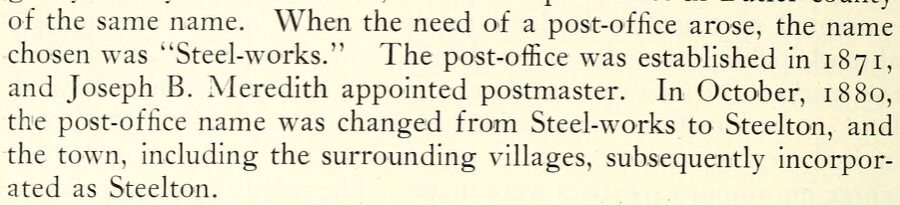
of the same name. When the need of a post-office arose, the name chosen was "Steel-works." The post-office was established in 187 1, and Joseph B. Meredith appointed postmaster. In October, 1880, the post-office name was changed from Steel-works to Steelton, and the town, including the surrounding villages, subsequently incorporated as Steelton.
Text read by machine from the scan; it may contain errors.
History of Dauphin County, Pennsylvania1907 · page 460Read the page →
Read the text
In 1866, within the territory now comprising the boundaries of the flourishing town of Steelton, there were only six families residing. The Pennsylvania Steel Company were organizing and prospecting for a site for their contemplated works. The board of directors came by a special train and quietly examined the land now occupied by them. The object of their visit was not surmised. A few weeks afterwards Rudolph F. Kelker and Henry A. Kelker were approached and solicited tomake sale of the land. The land was cov-
Text read by machine from the scan; it may contain errors.
Scans and text from the Internet Archive. Books published in 1930 or earlier, which are in the public domain.
Timeline
Steelton, 1866 to 1977
Woven from the archive, old maps, post office records, the National Register and the people born here.
Nothing in the archives for these yearsWeddings on Main Street, storms, parades, school pictures, the old store. If it’s in your family album, it belongs here.
Nothing in the archives for these yearsWeddings on Main Street, storms, parades, school pictures, the old store. If it’s in your family album, it belongs here.
In 1866, according to Wikidata. Steelton’s post office opened in 1871, and the census of 1880 counted 2,447 people here.
How does Steelton rank for history?
Steelton is more historic than 53% of U.S. towns, #707 of 1,035 in Pennsylvania. The History grade combines the town’s founding era, the share of homes built before 1940 and its National Register listings. It’s a character grade, so it isn’t part of the overall grade. How it works.
How old are the homes in Steelton?
39% of Steelton’s homes were built before 1940 (Census estimate, ±8.1 points), against a typical 18% for a Pennsylvania town; the median home was built in 1949.
Founding dates: Wikidata, Wikipedia, the U.S. post office records of Blevins & Helbock (CC0) and the Census. Homes by year built: Census ACS 2020–24. National Register of Historic Places: National Park Service (list of May 22, 2026). Old photos, postcards and papers: Wikimedia Commons, the Library of Congress and other public archives, credited on each item’s page. Maps: U.S. Geological Survey historical topographic maps (via Esri) and Sanborn fire-insurance maps (Library of Congress). History text and census tables: Wikipedia (CC BY-SA 4.0). Places that used to be: USGS Geographic Names Information System (2021).
From Wikimedia Commons (15), Wikipedia, Wikidata and Wikipedia for famous people, U.S. Geological Survey historical maps, U.S. Census counts (via Wikipedia), the US Post Offices dataset (Blevins & Helbock), the USGS Geographic Names Information System, Sanborn fire insurance maps (Library of Congress) and old county and town histories (Internet Archive). Archive images are copied here with their credits and licenses, shown on each photo’s page. Refreshed monthly.





 1917
 1917
 Date?
 2025
 2025
 2025
 2025
 2016
 2015
 2015
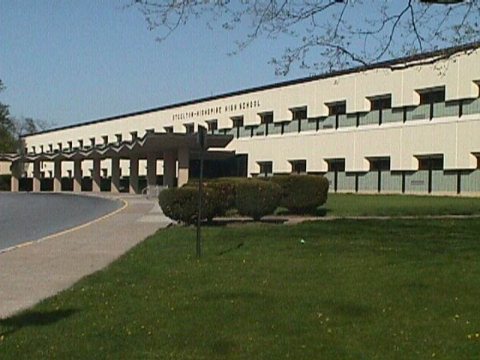 2012

