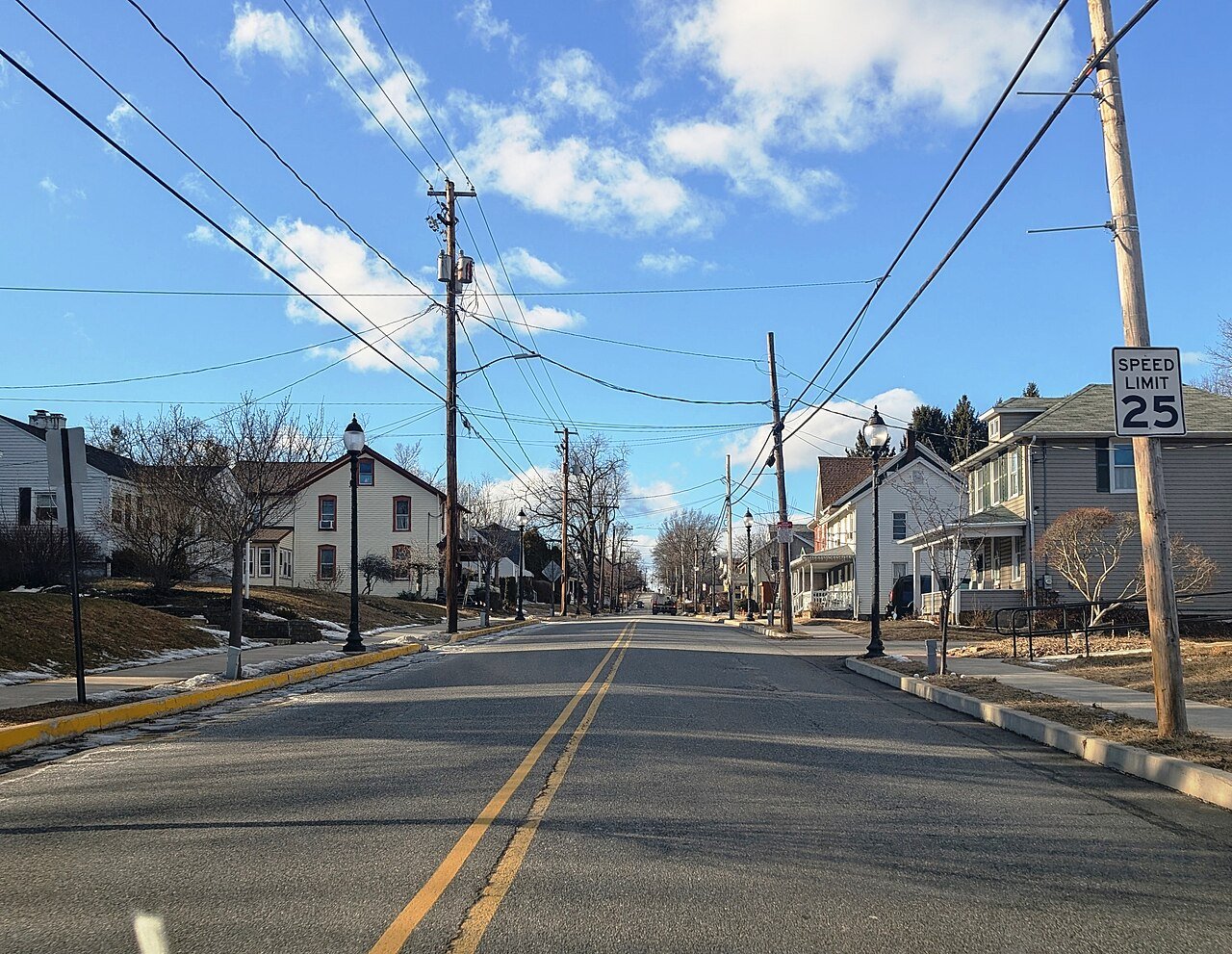
Photo: Mr. Matté (if there is an issue with this image, contact me using this image's Commons talk page, my Commons user talk page, or my English Wikipedia user talk page; I'll know about it a lot faster) · CC BY-SA 4.0
Quick answers
How Conyngham began
When was Conyngham founded?
1808
The Conyngham post office opened in 1808, the earliest record of the town by name. Wikidata gives 1921.
First census: 406 in 19102020 census: 1,825218 years
How historic is Conyngham?
B−
More historic than 53% of U.S. towns, on its age, its old homes and the National Register.
Founding year: the first Conyngham post office (Blevins & Helbock, CC0). Wikidata: 1921.The full story ↓
History grade
What drives Conyngham’s History grade
On its age, its old homes and the National Register, Conyngham is more historic than 53% of U.S. towns. Its age holds the grade up; its National Register listings pull it down.
B−
HistoryA character grade: shown, never part of Conyngham’s overall grade.
Pennsylvania towns list about as much on the Register as the country (a typical Pennsylvania town has 2.1 per 10,000 residents, the U.S. 2.4), so Conyngham’s 0.0 sits below most of its state (25% of Pennsylvania towns have fewer) while its 0 listings outnumber those of 23% of U.S. towns.
How sure. Graded on any two of the three inputs instead, the letter would range from C to B+. The pre-1940 share is a Census survey estimate (±7.1 points). The founding year is the first post office, not a stated founding date; Wikidata gives 1921.
Founding year: the first post office (other dates in Quick answers). Homes: Census ACS 2020–24. National Register: National Park Service, May 2026 list; each listing counted once (boundary changes and added documentation belong to their listing), and a historic district counts its contributing buildings. How TownRatings grades history →
What stands out about Conyngham’s past
Read from the archive, the National Register and the record. The page puts what stands out first.
The first settler of Conyngham was George Drum (in the late 1700s) who served in the American Revolution and was elected justice of the peace in 1811. George Drum was an entrepreneurial businessman and was a large landowner who also owned the Drums Hotel, a shoe shop, tavern, and the Drums Post Office. He and his family developed the adjacent village of Drums, of which the village is named after the family, along with helping the development of Conyngham. Drums is a sister village to Conyngham. The George Drum residence remains standing in impeccable condition on Conyngham's Main Street.
Passages that mention Conyngham, cut from the printed page as they were published.
History of Luzerne County, Pennsylvania, with biographical selections1893 · page 655Read the page →
Read the text
John Cawley erected the first sawmill, an early necessity in helping cut away the dark old forests. It was built in 1810 on Nescopeck creek. The first gristmill was erected in 1820 by George Koenig. Ten years previous to this (1815) they had built a church in the village of Conyngham. Benjamin Koenig built a gristmill at Seybertsville (called Frogtown) in 1815. The first bridge was the one crossing Nescopeck. Jacob Mace was the first blacksmith ; he lived and had his shop on the William Seiwell farm. A man named Law soon after had a blacksmith shop on the Black Creek road; George Rupert was the first shoemaker. His place was near the
Text read by machine from the scan; it may contain errors.
History of Luzerne County, Pennsylvania, with biographical selections1893 · page 611Read the page →
Read the text
In 1787 a road was laid out from Nescopeck falls to the Lehigh river, following afterward very nearly all the way by the turnpike that passed through the village of Conyngham, on its way to Hazleton. Evan Owens was the proprieter of Berwick, and to this day ypu will hear old men speak of the "Owens road." The first laud grant was the Campania tract, lying west of Big \\'apwallopen creek, surveyed to Daniel Grant in 1769; patented to George Campbell in 1773.
Text read by machine from the scan; it may contain errors.
A history of Wilkes-Barré, Luzerne County, Pennsylvania1909 · page 137Read the page →
Read the text
Conyngham Village was so named in honor of Captain Gustavus Conyngham, who commanded a privateer during the Revolution. The first settler within the village was George Drum. Next came George Woodring. The Mc]\[urtries were among the early settlers, though not within the village.
Text read by machine from the scan; it may contain errors.
Scans and text from the Internet Archive. Books published in 1930 or earlier, which are in the public domain.
The Conyngham post office opened in 1808, the earliest record of the town by name (U.S. post office records). Wikidata gives 1921.
How does Conyngham rank for history?
Conyngham is more historic than 53% of U.S. towns. The History grade combines the town’s founding era, the share of homes built before 1940 and its National Register listings. It’s a character grade, so it isn’t part of the overall grade. How it works.
How old are the homes in Conyngham?
13% of Conyngham’s homes were built before 1940 (Census estimate, ±7.1 points), against a typical 18% for a Pennsylvania town; the median home was built in 1966.
Founding dates: Wikidata, Wikipedia, the U.S. post office records of Blevins & Helbock (CC0) and the Census. Homes by year built: Census ACS 2020–24. National Register of Historic Places: National Park Service (list of May 22, 2026). Old photos, postcards and papers: Wikimedia Commons, the Library of Congress and other public archives, credited on each item’s page. Maps: U.S. Geological Survey historical topographic maps (via Esri) and Sanborn fire-insurance maps (Library of Congress). History text and census tables: Wikipedia (CC BY-SA 4.0). Places that used to be: USGS Geographic Names Information System (2021).
From Wikimedia Commons (6), Wikipedia, U.S. Geological Survey historical maps, U.S. Census counts (via Wikipedia), the US Post Offices dataset (Blevins & Helbock), the USGS Geographic Names Information System and old county and town histories (Internet Archive). Archive images are copied here with their credits and licenses, shown on each photo’s page. Refreshed monthly.


![Conyngham Village was so named in honor of Captain Gustavus Conyngham, who commanded a privateer during the Revolution. The first settler within the village was George Drum. Next came George Woodring. The Mc]\[urtries were among the early settlers, though not within the village.](https://images.townratings.com/story/15159/bk-6edd0664aafbb7a1-l.jpg)
 2025
 2025
 2025
 2025
 2025
 2025


