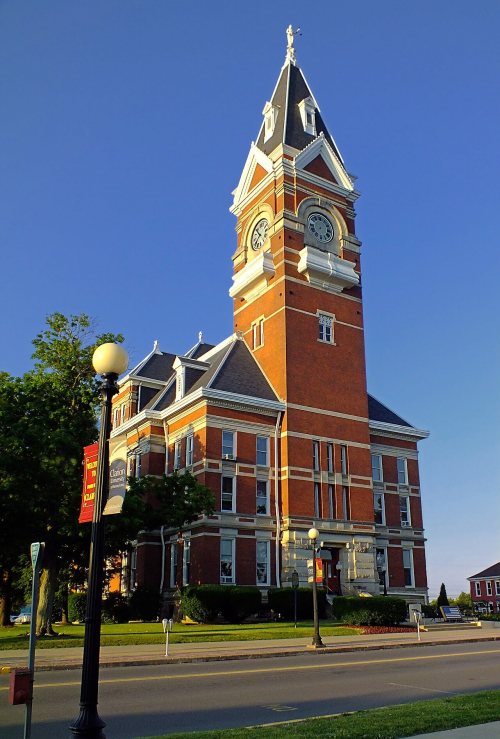
Clarion dates to 1839, and 28% of its homes were built before 1940
More historic than 88% of U.S. towns · #217 of 1,035 in Pennsylvania. What drives it
Its Register listings are the Clarion County Courthouse and Jail and the Sutton-Ditz House. Below: 3 old photos and papers, maps from 1887 on, and the census since 1850.
Founding year: Wikidata; Wikipedia’s history section gives the same year. First post office: 1840.
History grade
What drives Clarion’s History grade
On its age, its old homes and the National Register, Clarion is more historic than 88% of U.S. towns, #217 of 1,035 in Pennsylvania. All 3 inputs are above most U.S. towns; its share of homes from before 1940 ranks highest and its National Register listings lowest.
A
HistoryA character grade: shown, never part of Clarion’s overall grade.
Pennsylvania towns list about as much on the Register as the country (a typical Pennsylvania town has 2.1 per 10,000 residents, the U.S. 2.4), so Clarion’s 7.2 sits above most of its state (72% of Pennsylvania towns have fewer) while its 3 historic buildings outnumber those of 65% of U.S. towns.
How sure. Graded on any two of the three inputs instead, the letter would range from A− to A. The pre-1940 share is a Census survey estimate (±6.9 points). Two sources give 1839.
Founding year: Wikidata (other dates in Quick answers). Homes: Census ACS 2020–24. National Register: National Park Service, May 2026 list; each listing counted once (boundary changes and added documentation belong to their listing), and a historic district counts its contributing buildings. How TownRatings grades history →
What stands out about Clarion’s past
Read from the archive, the National Register and the record. The page puts what stands out first.
Fire insurance maps drew every building, what it was made of and what it was used for, so insurers could price the risk of fire. Pick a year, then a sheet.
Sanborn Map Company, via the Library of Congress. Editions published in 1930 or earlier, which are in the public domain.
People over time
Clarion, census by census
Peaked at 6,457 in 1990; 3,931 people lived here in 2020.
18 censuses, 1850–2020.
U.S. Census Bureau decennial counts, from the census table on Clarion’s Wikipedia page.
The story so far
Clarion, in brief
Wikipedia doesn’t have a history of Clarion yet. The photos, dates and memories neighbors add here are how it gets written.
Clarion is a borough in Clarion County, Pennsylvania, United States, and its county seat. The population was 3,931 at the 2020 census. It is located 77 miles (124 km) north-northeast of Pittsburgh along the Clarion River and is part of the Pittsburgh DMA. Clarion was settled in 1839 and incorporated in 1841. In the past, the surrounding area produced natural gas, oil, lumber and coal. It is home to the annual Autumn Leaf Festival and PennWest Clarion. The county courthouse was added to the National Register of Historic Places in 1979.
Clarion was established in 1839. Between the 2010 and 2020 censuses its population fell from 5,276 to 3,931 (-25%).
Intro from Wikipedia. Population: U.S. Census Bureau.
From the old history books
What they wrote about Clarion, 1887–1905
Passages that mention Clarion, cut from the printed page as they were published.
History of Clarion Co., Pennsylvania1887 · page 344Read the page →
Read the text
At an early period in the fifties the much wished for railroad through Clarion county was discussed. Prominent among the schemes afoot was the " Phillipsburg and Waterford Railroad." Later came the " Clarion County Railroad," which was to connect Clarion with some point on the Allegheny valley, and which finally materialized in the Sligo Branch.
Text read by machine from the scan; it may contain errors.
to America in 1 794, and landed in Philadelphia after a voyage of thirteen weeks and three days. From here they went to Westmoreland county, where Robert, one of the sons, died. They remained here until the spring of 1801, when they, with other families living in the same vicinity, moved into Armstrong county, now Clarion county, and settled not far from where the town of Clarion now stands, and which was then an unbroken wilderness. This family consisted of the mother and her three sons, James, Henry, and Cochran. On the 19th of March, 1805, James Fulton and Jane Templeton Reid were united in marriage. They had a family of twelve children — Cochran,
Text read by machine from the scan; it may contain errors.
A pioneer outline history of northwestern Pennsylvania, embracing the counties of Tioga, Potter, McKean, Warren, Crawford, Venango, Forest, Clarion, Elk, Jefferson, Cameron, Butler, Lawrence, and Mercer1905 · page 478Read the page →
Read the text
John Sloan plotted the town of Clarion in 1839, and but one house then stood on the present site. The pioneer sale of lots was in October, 1839. The court-house and jail were put under contract in the fall of 1839. The courthouse was not finished until 1843, and the upper story in the jail was used for court and church purposes until that time. The pioneer election for officers was held October 13, 1840. The following were chosen: James Hasson, for sheriff ; James Goe, for prothonotary, etc. ; John Reed, for coroner ; George L. Benn. Jacob Miller, and Gideon Richardson, for com-
Text read by machine from the scan; it may contain errors.
History of Clarion County, Pennsylvania1887 · page 495Read the page →
Read the text
The first railroad train entered Clarion December 4, 1877. The formal opening of the Emlenton, Shippenville and Clarion Railroad, on December 24, was a gala day for the good people of Clarion. About 400 excursionists, including notable railway officials and editors, were met at Edenburg by a delegation from the town, and on their arrival escorted to the music of several bands to the court-house, where they were addressed by Colonel Knox, and others. The guests were then dined, and a return excursion started for Emlenton, the other terminus, where the festivities concluded with a ball.
Text read by machine from the scan; it may contain errors.
Scans and text from the Internet Archive. Books published in 1930 or earlier, which are in the public domain.
Timeline
Clarion, 1839 to 1990
Woven from the archive, old maps, post office records, the National Register and the people born here.
Nothing in the archives for these yearsWeddings on Main Street, storms, parades, school pictures, the old store. If it’s in your family album, it belongs here.
In 1839, according to Wikidata and Wikipedia’s history of the town. Clarion’s post office opened in 1840, and the census of 1850 counted 719 people here.
How does Clarion rank for history?
Clarion is more historic than 88% of U.S. towns, #217 of 1,035 in Pennsylvania. The History grade combines the town’s founding era, the share of homes built before 1940 and its National Register listings. It’s a character grade, so it isn’t part of the overall grade. How it works.
What is on the National Register in Clarion?
Two places: the Clarion County Courthouse and Jail (listed 1979) and the Sutton-Ditz House (2004).
How old are the homes in Clarion?
28% of Clarion’s homes were built before 1940 (Census estimate, ±6.9 points), against a typical 18% for a Pennsylvania town; the median home was built in 1959.
Founding dates: Wikidata, Wikipedia, the U.S. post office records of Blevins & Helbock (CC0) and the Census. Homes by year built: Census ACS 2020–24. National Register of Historic Places: National Park Service (list of May 22, 2026). Old photos, postcards and papers: Wikimedia Commons, the Library of Congress and other public archives, credited on each item’s page. Maps: U.S. Geological Survey historical topographic maps (via Esri) and Sanborn fire-insurance maps (Library of Congress). History text and census tables: Wikipedia (CC BY-SA 4.0). Places that used to be: USGS Geographic Names Information System (2021).
From Wikimedia Commons (6), the National Register of Historic Places (2), Wikidata and Wikipedia for famous people, U.S. Geological Survey historical maps, U.S. Census counts (via Wikipedia), the US Post Offices dataset (Blevins & Helbock), the USGS Geographic Names Information System, Sanborn fire insurance maps (Library of Congress) and old county and town histories (Internet Archive). Archive images are copied here with their credits and licenses, shown on each photo’s page. Refreshed monthly.





 1896
 2009
 2009
 2008