Founding year: Wikipedia. First post office: 1852.The full story ↓
History grade
What drives Ashley’s History grade
On its age, its old homes and the National Register, Ashley is more historic than 66% of U.S. towns, #532 of 1,035 in Pennsylvania. Its share of homes from before 1940 holds the grade up; its National Register listings pull it down.
B+
HistoryA character grade: shown, never part of Ashley’s overall grade.
Pennsylvania towns list about as much on the Register as the country (a typical Pennsylvania town has 2.1 per 10,000 residents, the U.S. 2.4), so Ashley’s 0.0 sits below most of its state (25% of Pennsylvania towns have fewer) while its 0 listings outnumber those of 23% of U.S. towns.
NoteThe founding year comes from Wikipedia alone; no second source gives 1830.
How sure. Graded on two of the three inputs, so a change in either one moves the letter more than it would with three. The pre-1940 share is a Census survey estimate (±11.1 points).
Founding year: Wikipedia (other dates in Quick answers). Homes: Census ACS 2020–24. National Register: National Park Service, May 2026 list; each listing counted once (boundary changes and added documentation belong to their listing), and a historic district counts its contributing buildings. How TownRatings grades history →
What stands out about Ashley’s past
Read from the archive, the National Register and the record. The page puts what stands out first.
Every edition of the U.S. Geological Survey’s map of Ashley. Tap a year, or press play to watch the town change.
1891Wilkes-Barre sheet · 1:62,500
U.S. Geological Survey historical topographic maps (public domain), via Esri’s collection of the scans. The red ring marks the center of Ashley.
People over time
Ashley, census by census
Peaked at 7,093 in 1930; 2,596 people lived here in 2020.
15 censuses, 1880–2020.
U.S. Census Bureau decennial counts, from the census table on Ashley’s Wikipedia page.
Every building
Ashley, building by building, 1884–1911
Fire insurance maps drew every building, what it was made of and what it was used for, so insurers could price the risk of fire. Pick a year, then a sheet.
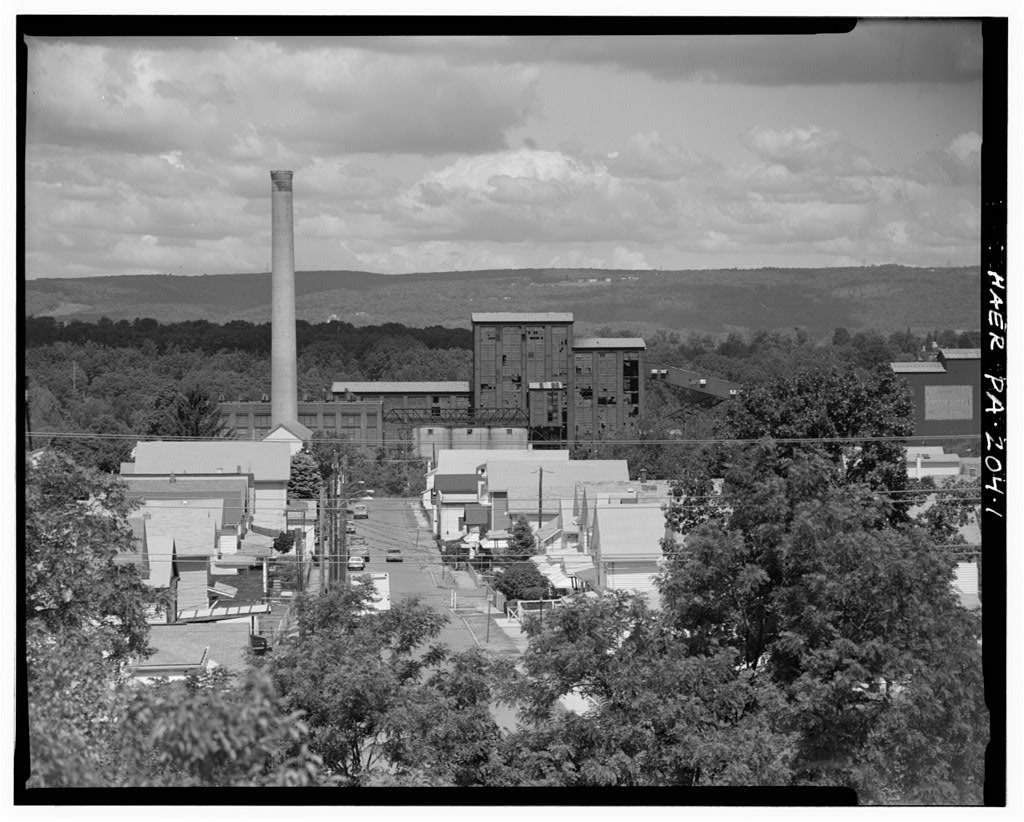
Ashley was first settled in 1830. Forty years later, in 1870, it was incorporated as a borough. It was a productive coal mining town well into the twentieth century, reaching its peak population of 7,039 in 1930. The Huber Breaker, built in 1939 to process coal from several local collieries, ceased operating in 1976, and was demolished in 2014.
Passages that mention Ashley, cut from the printed page as they were published.
History of Luzerne County, Pennsylvania, with biographical selections1893 · page 910Read the page →
Read the text
Daniel Frederick, one of Ashley's oldest and most respected citizens, was born in Northampton county, Pa., December 24, 1807, a sou of John and Christiana (Foglan) Frederick, natives of Pennsylvania and of German origin. His father, a farmer, came to Ashley in 1821, and for two years managed the " Red Tavern,'' and next engaged in farming, and afterward moved to the village of Ashley. The family consisted of six children, three of whom are living, viz. : Isaac, Millersville, 111. ; Daniel and Joseph, Hanover township. Our subject was educated in his native county and in Luzerne county, and then learned the carpenter's trade
Text read by machine from the scan; it may contain errors.
History of Luzerne County, Pennsylvania, with biographical selections1893 · page 532Read the page →
Read the text
Railroad Shops of the New Jersey Central are located at Ashley, and are the most imr)ortaut institution of the place. The day these located here it made the place fairly jump out of its "Hardscrabble " clothes and put on the full regalia of an important, thriving borough. The postoffice name of Hendricksburg was changed to Ashley, and the office and center of the hamlet moved to about its present place.
Text read by machine from the scan; it may contain errors.
A history of Wilkes-Barré, Luzerne County, Pennsylvania1909 · page 141Read the page →
Read the text
The population of Ashley in 1900 was 4,046 ; in 1910 it was 5.601 ; in 1920 it was 6,520. Ashley had 3,990 taxable inhabitants in 1926, and the assessed valuation of their property then was $6,750,319. In 1926 Arthur Kearney was burgess of Ashley.
Text read by machine from the scan; it may contain errors.
Scans and text from the Internet Archive. Books published in 1930 or earlier, which are in the public domain.
Timeline
Ashley, 1830 to 1934
Woven from the archive, old maps, post office records, the National Register and the people born here.
Nothing in the archives for these yearsWeddings on Main Street, storms, parades, school pictures, the old store. If it’s in your family album, it belongs here.
In 1830, according to Wikipedia’s history of the town. Ashley’s post office opened in 1852, and the census of 1880 counted 2,799 people here.
How does Ashley rank for history?
Ashley is more historic than 66% of U.S. towns, #532 of 1,035 in Pennsylvania. The History grade combines the town’s founding era, the share of homes built before 1940 and its National Register listings. It’s a character grade, so it isn’t part of the overall grade. How it works.
How old are the homes in Ashley?
41% of Ashley’s homes were built before 1940 (Census estimate, ±11.1 points), against a typical 18% for a Pennsylvania town; the median home was built in 1945.
Founding dates: Wikidata, Wikipedia, the U.S. post office records of Blevins & Helbock (CC0) and the Census. Homes by year built: Census ACS 2020–24. National Register of Historic Places: National Park Service (list of May 22, 2026). Old photos, postcards and papers: Wikimedia Commons, the Library of Congress and other public archives, credited on each item’s page. Maps: U.S. Geological Survey historical topographic maps (via Esri) and Sanborn fire-insurance maps (Library of Congress). History text and census tables: Wikipedia (CC BY-SA 4.0). Places that used to be: USGS Geographic Names Information System (2021).
From Wikimedia Commons (6), the Library of Congress (6), Wikipedia, Wikidata and Wikipedia for famous people, U.S. Geological Survey historical maps, U.S. Census counts (via Wikipedia), the US Post Offices dataset (Blevins & Helbock), the USGS Geographic Names Information System, Sanborn fire insurance maps (Library of Congress) and old county and town histories (Internet Archive). Archive images are copied here with their credits and licenses, shown on each photo’s page. Refreshed monthly.




 1923
 Date?
 Date?
 Date?
 Date?
 2026
 2026
 2011
 2010

