Founding year: the first Wilberforce post office (Blevins & Helbock, CC0).The full story ↓
History grade
What drives Wilberforce’s History grade
On its age, its old homes and the National Register, Wilberforce is more historic than 75% of U.S. towns. Its share of homes from before 1940 holds the grade up; its age pulls it down.
B+
HistoryA character grade: shown, never part of Wilberforce’s overall grade.
Ohio towns list about as much on the Register as the country (a typical Ohio town has 2.9 per 10,000 residents, the U.S. 2.4), so Wilberforce’s 25.6 sits above most of its state (83% of Ohio towns have fewer) while its 5 listings outnumber those of 70% of U.S. towns.
How sure. Graded on any two of the three inputs instead, the letter would range from B to A. The pre-1940 share is a Census survey estimate (±18.8 points). The founding year is the first post office, not a stated founding date.
Founding year: the first post office (other dates in Quick answers). Homes: Census ACS 2020–24. National Register: National Park Service, May 2026 list; each listing counted once (boundary changes and added documentation belong to their listing), and a historic district counts its contributing buildings. How TownRatings grades history →
What stands out about Wilberforce’s past
Read from the archive, the National Register and the record. The page puts what stands out first.
After Wilberforce University was established in 1856, the community was also named for the English statesman William Wilberforce, who worked for the abolition of slavery and achieved the end of the slave trade in the United Kingdom and its empire. The small community served as an important stop for refugee slaves on the Underground Railroad before the American Civil War, as it had seven stations.
The Ohio Historical Society operates the National Afro-American Museum and Cultural Center, which provides exhibits and learning opportunities for the regional community. The Association of African American Museums, also located in Wilberforce and supported by the private university, works to build professional capacity among smaller museums.
Passages that mention Wilberforce, cut from the printed page as they were published.
History of Greene County, Ohio1918 · page 951Read the page →
Read the text
the gospel ministry, in educational circles and in the marts of trade. Joshua C. Maxwell, the eldest son, was for years a grocer in the city of Xenia, where his last days were spent. The Rev. J. P. Maxwell, another son, long a resident of Wilberforce and formerly and for years secretary of Wilberforce University, is now the pastor of the African Methodist Episcopal church at Lancaster, Ohio. Another son, the Rev. George W. Maxwell, also entered the ministry and is now the presiding elder of the Cincinnati district of the African Methodist Episcopal church. He has for years made his home at
Text read by machine from the scan; it may contain errors.
In the varied activities of Wilberforce University there are few more prominent factors or more popular individuals than the Rev. Theophilus Gould Steward, chaplain and vice-president of the university and pastor of the African Methodist Episcopal church at Wilberforce, or than was his late wife. Dr. S. Maria Steward, formerly and for years resident physician and member of the faculty of the university, lecturer on hygiene and physiology before the girls' classes, and who also was engaged in general practice in and about Wilberforce. Doctor Steward, who died on March 7, 19 18,
Text read by machine from the scan; it may contain errors.
Scans and text from the Internet Archive. Books published in 1930 or earlier, which are in the public domain.
By decade
Wilberforce, decade by decade
One decade in the archive so far: the 1890s. Scroll each row; tap a photo for its story.
Nothing in the archives for these yearsWeddings on Main Street, storms, parades, school pictures, the old store. If it’s in your family album, it belongs here.
The Wilberforce post office opened in 1867, the earliest record of the town by name (U.S. post office records).
How does Wilberforce rank for history?
Wilberforce is more historic than 75% of U.S. towns. The History grade combines the town’s founding era, the share of homes built before 1940 and its National Register listings. It’s a character grade, so it isn’t part of the overall grade. How it works.
What is on the National Register in Wilberforce?
5 listings: 1 historic district, the Wilberforce University Historic District,.
How old are the homes in Wilberforce?
26% of Wilberforce’s homes were built before 1940 (Census estimate, ±18.8 points), against a typical 15% for an Ohio town; the median home was built in 1968.
Founding dates: Wikidata, Wikipedia, the U.S. post office records of Blevins & Helbock (CC0) and the Census. Homes by year built: Census ACS 2020–24. National Register of Historic Places: National Park Service (list of May 22, 2026). Old photos, postcards and papers: Wikimedia Commons, the Library of Congress and other public archives, credited on each item’s page. Maps: U.S. Geological Survey historical topographic maps (via Esri) and Sanborn fire-insurance maps (Library of Congress). History text and census tables: Wikipedia (CC BY-SA 4.0). Places that used to be: USGS Geographic Names Information System (2021).
From Wikimedia Commons (4), Wikidata (2), the National Register of Historic Places (1), Wikipedia, Wikidata and Wikipedia for famous people and old county and town histories (Internet Archive). Archive images are copied here with their credits and licenses, shown on each photo’s page. Refreshed monthly.


 1899
 2011
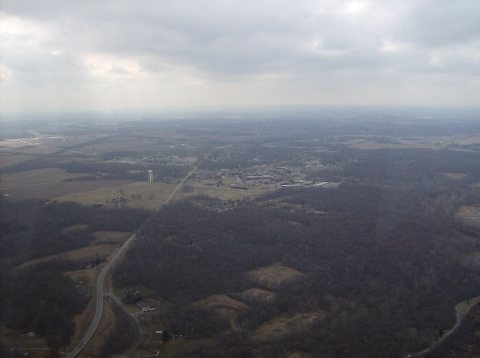 2008
 2004