Tiffin dates to 1812, and 35% of its homes were built before 1940
More historic than 97% of U.S. towns · #29 of 993 in Ohio. What drives it
33 places in town are on the National Register, among them four historic districts with 259 buildings between them. Below: 16 old photos and papers, maps from 1887 on, and the census since 1830.
Founding year: Wikidata. First post office: 1821.The full story ↓
History grade
What drives Tiffin’s History grade
On its age, its old homes and the National Register, Tiffin is more historic than 97% of U.S. towns, #29 of 993 in Ohio. All 3 inputs are above most U.S. towns; its National Register listings ranks highest and its age lowest.
A+
HistoryA character grade: shown, never part of Tiffin’s overall grade.
Ohio towns list about as much on the Register as the country (a typical Ohio town has 2.9 per 10,000 residents, the U.S. 2.4), so Tiffin’s 168 sits above most of its state (96% of Ohio towns have fewer) while its 299 historic buildings outnumber those of 95% of U.S. towns.
How sure. Graded on any two of the three inputs instead, the letter would range from A to A+. The pre-1940 share is a Census survey estimate (±3.6 points). Two sources give 1812.
Founding year: Wikidata (other dates in Quick answers). Homes: Census ACS 2020–24. National Register: National Park Service, May 2026 list; each listing counted once (boundary changes and added documentation belong to their listing), and a historic district counts its contributing buildings. How TownRatings grades history →
What stands out about Tiffin’s past
Read from the archive, the National Register and the record. The page puts what stands out first.
National Park Service, National Register of Historic Places. Photos from Wikimedia Commons, credited on each place’s page.
Every building
Tiffin, building by building, 1887–1914
Fire insurance maps drew every building, what it was made of and what it was used for, so insurers could price the risk of fire. Pick a year, then a sheet.
The bronze statue of "The Indian Maiden" on Frost Parkway near Miami Street, marks the site of Fort Ball, a military depot of the War of 1812. During a fighting engagement of that war, Erastus Bowe sighted the location where Tiffin later developed. In 1817, he returned to the site and built the Pan Yan Tavern on the North Sandusky River. Its name was likely derived from Penn Yan, New York. Early homesteaders followed soon after Bowe, and the settlement of Oakley sprang up around the Pan Yan on the north side of the river. The chief road of the area followed the path of the stagecoaches through Oakley, which was called Fort Ball after 1824.
Passages that mention Tiffin, cut from the printed page as they were published.
History of Seneca County, Ohio, containing a history of the county, its townships, towns, villages ... portraits of early settlers and prominent men1886 · page 478Read the page →
Read the text
Original Survey of Tiffin, and Additions. — Town of Tiffin, fractional Section 19, Town 2 north. Range 15 east, containing 118 lots 60x180 feet each, streets sixty-six feet wide and alleys sixteen and a half feet wide, with public grounds equal to three lots at the corner of Market and Washington Streets, extending to Rose Alley (later Virgin Alley), now Coiui Alley or Court Street, was platted November 28, 1821, for Josiah Hedges by his brother. Gen. James Hedges.
Text read by machine from the scan; it may contain errors.
History of Seneca County, Ohio1886 · page 478Read the page →
Read the text
Original Survey of Tiffin, and Additions. — Town of Tiffin, fractional Section 19, Town 2 north. Range 15 east, containing 118 lots 00x180 feet each, streets sixty-six feet wide and alleys sixteen and a half feet wide, with public grounds equal to three lots at the corner of Market and Washington Streets, extending to Rose Alley (later Virgin Alley), now Court Alley or Coiu-t Street, was platted November 28. 1821, for Josiah Hedges by his brother. Gen. James Hedges.
Text read by machine from the scan; it may contain errors.
History of Seneca County, Ohio, containing a history of the county, its townships, towns, villages ... portraits of early settlers and prominent men1886 · page 497Read the page →
Read the text
St. Mary's Catholic Church may be said to have been founded at Tiffin in 1826, but not for five years later was the district set off as a station. Father Moynahan and Bishop Fenwick visited Fort Ball and Tiffin in 1826, and there met John Julian and Jacob Bonar, old members of the church. In 1829 Bishop Fenwick purchased lands in rear of the present Ursuline Convent. On May 15, 1831, Rev. Edmund Quinn came here, and held services in Julian's house, near the old St. Mary' s Cemetery, and on the same day solemnized the marriage of John Nott and Hem-ietta Dickey, and baptized Henrietta Arnold,
Text read by machine from the scan; it may contain errors.
History of Seneca County, Ohio1886 · page 497Read the page →
Read the text
St. Mary's Cafholie Church may be said to have been founded at Tiffin in 1826, but not for five years later was the district set off as a station. Father Moynahan and Bishop Fenwick visited Fort Ball and Tiffin in 1826, and there met John Julian and Jacob Bonar, old members of the chiu-ch. In 1829 Bishop Fenwick pm-chased lands in rear of the present Ursuline Convent. On May 15. 1831, Rev. Edmund Quiun came here, and held services in Julian's houst', near the old St. Mai-y's Cemetery, and on the same day solemnized the mania;;e of John Nott and Henrietta Dickey, and baptized Hem-ietta Arnold,
Text read by machine from the scan; it may contain errors.
Scans and text from the Internet Archive. Books published in 1930 or earlier, which are in the public domain.
Timeline
Tiffin, 1812 to 1941
Woven from the archive, old maps, post office records, the National Register and the people born here.
Nothing in the archives for these yearsWeddings on Main Street, storms, parades, school pictures, the old store. If it’s in your family album, it belongs here.
In 1812, according to Wikidata. Tiffin’s post office opened in 1821, and the census of 1830 counted 248 people here.
How does Tiffin rank for history?
Tiffin is more historic than 97% of U.S. towns, #29 of 993 in Ohio. The History grade combines the town’s founding era, the share of homes built before 1940 and its National Register listings. It’s a character grade, so it isn’t part of the overall grade. How it works.
What is on the National Register in Tiffin?
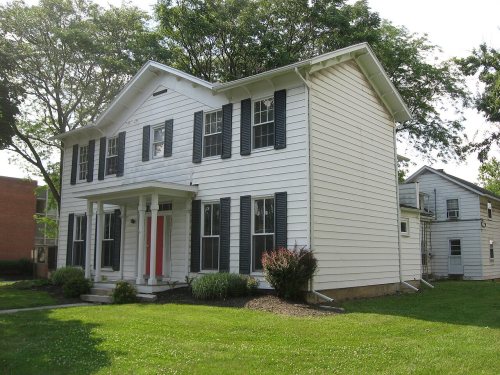
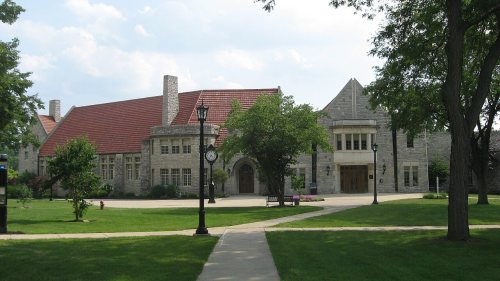
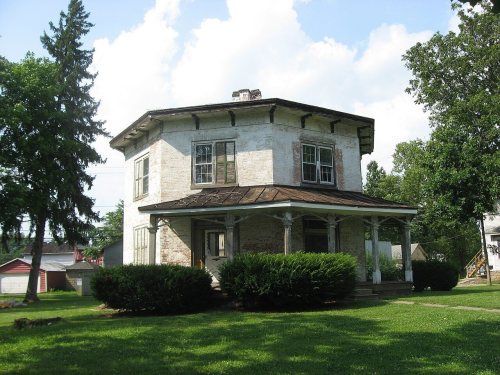
33 listings: 29 buildings, among them the Founders Hall, Heidelberg College (listed 1973, the first), and 4 historic districts with 259 contributing buildings. 299 historic buildings in all.
How old are the homes in Tiffin?
35% of Tiffin’s homes were built before 1940 (Census estimate, ±3.6 points), against a typical 15% for an Ohio town; the median home was built in 1956.
Founding dates: Wikidata, Wikipedia, the U.S. post office records of Blevins & Helbock (CC0) and the Census. Homes by year built: Census ACS 2020–24. National Register of Historic Places: National Park Service (list of May 22, 2026). Old photos, postcards and papers: Wikimedia Commons, the Library of Congress and other public archives, credited on each item’s page. Maps: U.S. Geological Survey historical topographic maps (via Esri) and Sanborn fire-insurance maps (Library of Congress). History text and census tables: Wikipedia (CC BY-SA 4.0). Places that used to be: USGS Geographic Names Information System (2021).
From Wikimedia Commons (6), the Library of Congress (10), Wikidata (1), the National Register of Historic Places (33), Wikipedia, Wikidata and Wikipedia for famous people, U.S. Geological Survey historical maps, U.S. Census counts (via Wikipedia), the US Post Offices dataset (Blevins & Helbock), the USGS Geographic Names Information System, Sanborn fire insurance maps (Library of Congress) and old county and town histories (Internet Archive). Archive images are copied here with their credits and licenses, shown on each photo’s page. Refreshed monthly.





 1905
 1905
 1905
 1905
 1905
 1905
 1905
 1905
 1907
 1907
 1907
 1907
 1907
 1907


