Founding year: Wikipedia. First post office: 1819.The full story ↓
History grade
What drives Ross’ History grade
On its age, its old homes and the National Register, Ross is more historic than 63% of U.S. towns, #505 of 993 in Ohio. Its age holds the grade up; its share of homes from before 1940 pulls it down.
B
HistoryA character grade: shown, never part of Ross’ overall grade.
Ohio towns list about as much on the Register as the country (a typical Ohio town has 2.9 per 10,000 residents, the U.S. 2.4), so Ross’ 15.4 sits above most of its state (79% of Ohio towns have fewer) while its 4 historic buildings outnumber those of 68% of U.S. towns.
How sure. Graded on any two of the three inputs instead, the letter would range from C+ to A−. The pre-1940 share is a Census survey estimate (±3.6 points). Two sources give 1817.
Founding year: Wikipedia (other dates in Quick answers). Homes: Census ACS 2020–24. National Register: National Park Service, May 2026 list; each listing counted once (boundary changes and added documentation belong to their listing), and a historic district counts its contributing buildings. How TownRatings grades history →
What stands out about Ross’ past
Read from the archive, the National Register and the record. The page puts what stands out first.
The settlement was laid out by Dr. Benjamin Franklin Clark on February 1, 1817, as Venus; the spelling later became corrupted as "Venice". Since there was already another post office in the state called Venice, near Lake Erie, this one was renamed in 1834 as Ross.
Passages that mention Ross, cut from the printed page as they were published.
a standard history of ross county ohio1917 · page 745Read the page →
Read the text
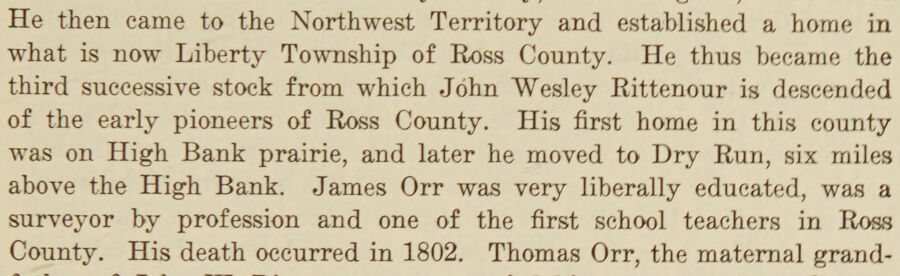
He then came to the Northwest Territory and established a home in what is now Liberty Township of Ross County. He thus became the third successive stock from which John Wesley Rittenour is descended of the early pioneers of Ross County. His first home in this county was on High Bank prairie, and later he moved to Dry Run, six miles above the High Bank. James Orr was very liberally educated, was a surveyor by profession and one of the first school teachers in Ross County. His death occurred in 1802. Thomas Orr, the maternal grand-
Text read by machine from the scan; it may contain errors.
a standard history of ross county ohio1917 · page 751Read the page →
Read the text
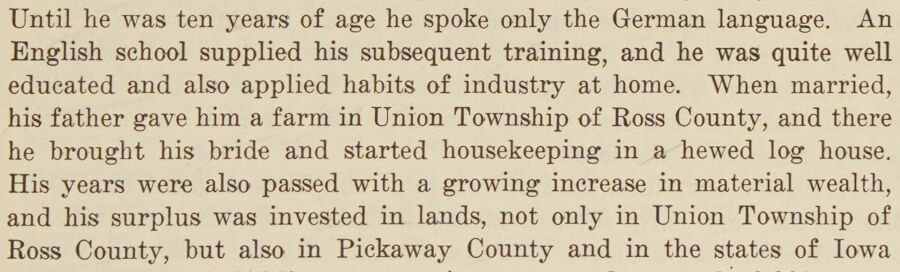
Until he was ten years of age he spoke only the German language. An English school supplied his subsequent training, and he was quite well educated and also applied habits of industry at home. When married, his father gave him a farm in Union Township of Ross County, and there he brought his bride and started housekeeping in a hewed log house. His years were also passed with a growing increase in material wealth, and his surplus was invested in lands, not only in Union Township of Ross County, but also in Pickaway County and in the states of Iowa
Text read by machine from the scan; it may contain errors.
Scans and text from the Internet Archive. Books published in 1930 or earlier, which are in the public domain.
By decade
No old photos in the archives yet
Weddings on Main Street, storms, parades, school pictures, the old store. If it’s in your family album, it belongs here.
Be the first to add onePhotograph a print flat, in daylight, no flash.
In 1817, according to Wikipedia’s history of the town. Ross’ post office opened in 1819.
How does Ross rank for history?
Ross is more historic than 63% of U.S. towns, #505 of 993 in Ohio. The History grade combines the town’s founding era, the share of homes built before 1940 and its National Register listings. It’s a character grade, so it isn’t part of the overall grade. How it works.
How old are the homes in Ross?
3% of Ross’ homes were built before 1940 (Census estimate, ±3.6 points), against a typical 15% for an Ohio town; the median home was built in 1972.
Founding dates: Wikidata, Wikipedia, the U.S. post office records of Blevins & Helbock (CC0) and the Census. Homes by year built: Census ACS 2020–24. National Register of Historic Places: National Park Service (list of May 22, 2026). Old photos, postcards and papers: Wikimedia Commons, the Library of Congress and other public archives, credited on each item’s page. Maps: U.S. Geological Survey historical topographic maps (via Esri) and Sanborn fire-insurance maps (Library of Congress). History text and census tables: Wikipedia (CC BY-SA 4.0). Places that used to be: USGS Geographic Names Information System (2021).
From Wikipedia, Wikidata and Wikipedia for famous people, U.S. Geological Survey historical maps and old county and town histories (Internet Archive). Archive images are copied here with their credits and licenses, shown on each photo’s page. Refreshed monthly.