3 places in town are on the National Register, among them a historic district with 30 buildings. Below: 1 old photo or paper from 1861 on and old-book passages.
Founding year: Wikidata. First post office: 1804.The full story ↓
History grade
What drives Poland’s History grade
On its age, its old homes and the National Register, Poland is more historic than 93% of U.S. towns. All 3 inputs are above most U.S. towns; its National Register listings ranks highest and its age lowest.
A
HistoryA character grade: shown, never part of Poland’s overall grade.
Ohio towns list about as much on the Register as the country (a typical Ohio town has 2.9 per 10,000 residents, the U.S. 2.4), so Poland’s 132 sits above most of its state (94% of Ohio towns have fewer) while its 31 historic buildings outnumber those of 82% of U.S. towns.
How sure. Graded on any two of the three inputs instead, the letter would range from A− to A. The pre-1940 share is a Census survey estimate (±4.9 points). Two sources give 1802.
Founding year: Wikidata (other dates in Quick answers). Homes: Census ACS 2020–24. National Register: National Park Service, May 2026 list; each listing counted once (boundary changes and added documentation belong to their listing), and a historic district counts its contributing buildings. How TownRatings grades history →
What stands out about Poland’s past
Read from the archive, the National Register and the record. The page puts what stands out first.
In 1796, Poland Township was surveyed and registered as township 1, range 1 of the Connecticut Western Reserve of the Connecticut Land Company. Turhand Kirtland was a member of a group of surveyors led by Moses Cleaveland, and is considered to have founded the community of Poland in 1798. The earliest settlers primarily originated from Connecticut and Pennsylvania. An early grist mill was built on the Yellow Creek in 1802 by Jonathan Fowler, whose family was the first to settle in the village.
Passages that mention Poland, cut from the printed page as they were published.
20th century history of Youngstown and Mahoning County, Ohio1907 · page 247Read the page →
Read the text
nace stood on the west side of Yellow creek, about one and a cjuarter miles from its junction with the Mahoning river, in the township of Poland, in Mahoning County. On the same stream, about three-fourths of a mile from its mouth, and on the fann on which was furnace of the Struthers Furnace Company, in the town of Struthers, another furnace was
Text read by machine from the scan; it may contain errors.
Twentieth century history of Youngstown and Mahoning County, Ohio1907 · page 246Read the page →
Read the text
nace stood on the west side of Yellow creek, about one and a quarter miles from its junction with the Mahoning river, in the township of Poland, in Mahoning County. On the same stream, about three-fourths of a mile from its mouth, and on llie farm on which was furnace of the Struthers Furnace Company, in the town of Struthers, another furnace was
Text read by machine from the scan; it may contain errors.
Twentieth century history of Youngstown and Mahoning County, Ohio1907Read the page →
Read the text
Mr. Heasley is a director 111 die J -"a niters' Deposit and Savings Rank of Poland. He is a niemlx-r of the Presby terian Church of the village of Poland.
Text read by machine from the scan; it may contain errors.
20th century history of Youngstown and Mahoning County, Ohio1907 · page 856Read the page →
Read the text
rence County and bought one located in Poland township, between Lowellville and Struthers. The father bought three separate farms in Poland and Coitsville townships, aggregating 300 acres of good land, and the family still retain two farms in Poland township and one in Coitsville, although they have disposed of some of the property, the Penn-
Text read by machine from the scan; it may contain errors.
Scans and text from the Internet Archive. Books published in 1930 or earlier, which are in the public domain.
Timeline
Poland, 1802 to 1969
Woven from the archive, old maps, post office records, the National Register and the people born here.
In 1802, according to Wikidata. Poland’s post office opened in 1804.
How does Poland rank for history?
Poland is more historic than 93% of U.S. towns. The History grade combines the town’s founding era, the share of homes built before 1940 and its National Register listings. It’s a character grade, so it isn’t part of the overall grade. How it works.
What is on the National Register in Poland?
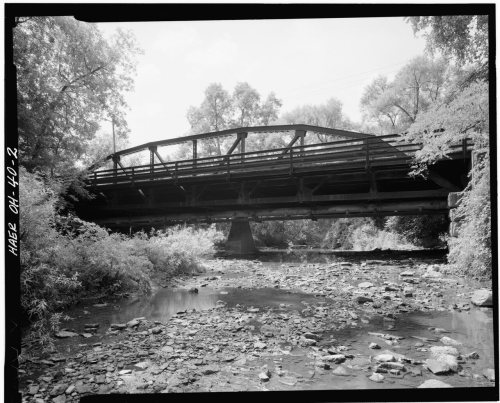
Three places: the White Bridge (listed 1983), the South Main Street District (1974) and the Jared P. Kirtland House (1976).
How old are the homes in Poland?
25% of Poland’s homes were built before 1940 (Census estimate, ±4.9 points), against a typical 15% for an Ohio town; the median home was built in 1952.
Founding dates: Wikidata, Wikipedia, the U.S. post office records of Blevins & Helbock (CC0) and the Census. Homes by year built: Census ACS 2020–24. National Register of Historic Places: National Park Service (list of May 22, 2026). Old photos, postcards and papers: Wikimedia Commons, the Library of Congress and other public archives, credited on each item’s page. Maps: U.S. Geological Survey historical topographic maps (via Esri) and Sanborn fire-insurance maps (Library of Congress). History text and census tables: Wikipedia (CC BY-SA 4.0). Places that used to be: USGS Geographic Names Information System (2021).
From Wikimedia Commons (6), the National Register of Historic Places (3), Wikipedia, Wikidata and Wikipedia for famous people, the US Post Offices dataset (Blevins & Helbock), the USGS Geographic Names Information System and old county and town histories (Internet Archive). Archive images are copied here with their credits and licenses, shown on each photo’s page. Refreshed monthly.





 2018
 2015
 2014
 2014
 2004