Founding year: Wikidata. First post office: 1838.The full story ↓
History grade
What drives Fort Loramie’s History grade
On its age, its old homes and the National Register, Fort Loramie is more historic than 84% of U.S. towns. All 2 inputs are above most U.S. towns; its National Register listings ranks highest and its share of homes from before 1940 lowest.
A−
HistoryA character grade: shown, never part of Fort Loramie’s overall grade.
Ohio towns list about as much on the Register as the country (a typical Ohio town has 2.9 per 10,000 residents, the U.S. 2.4), so Fort Loramie’s 27.3 sits above most of its state (83% of Ohio towns have fewer) while its 4 historic buildings outnumber those of 68% of U.S. towns.
NoteThe founding year comes from Wikidata alone; no second source gives 1769.
How sure. Graded on two of the three inputs, so a change in either one moves the letter more than it would with three. The pre-1940 share is a Census survey estimate (±6.2 points).
Founding year: Wikidata (other dates in Quick answers). Homes: Census ACS 2020–24. National Register: National Park Service, May 2026 list; each listing counted once (boundary changes and added documentation belong to their listing), and a historic district counts its contributing buildings. How TownRatings grades history →
What stands out about Fort Loramie’s past
Read from the archive, the National Register and the record. The page puts what stands out first.
Fort Loramie was established as a fur trading post in 1769 by Pierre-Louis de Lorimier (usually anglicized to Peter Loramie), a French-Canadian fur trader, British Indian agent and Shawnee agitator, and his father. The Shawnee used the trading post as a staging area for attacks against Americans during the Revolutionary War. During a raid on the Shawnee by George Rogers Clark in Nov. 1782, the trading post was attacked by a detachment of 150 men under Col. Benjamin Logan and burned to the ground. Lorimier escaped and fled west across the Mississippi. The site remained abandoned until 1795.
Passages that mention Fort Loramie, cut from the printed page as they were published.
History of Shelby County, Ohio1913 · page 616Read the page →
Read the text
Henry Ratermann was reared on the old farm and has heard his father say that when he settled there but one house had been built in what is now the busy and important town of Fort Loramie. He attended the Berlin district school and afterward continued his studies alone, purchasing books so that he could advance farther in general knowledge. After his marriage Henry Ratermann settled on the farm now occupied by his youngest son, clearing the land and making improvements and on that place his death occurred in 1881, at the age of forty-six years. Like his father before him he was a
Text read by machine from the scan; it may contain errors.
Students of history can easily recall the annals of Jhe French and Indian war and of the military maneuvres which made this section, in 1756, a battle ground and many yet living can remember the tales of their grandfathers of the building and occupancy of old Fort Loramie, which was situated less than one mile from the site of the present village of the name formerly known as Berlin, and later as Loramie, for which the name Fort Loramie has been recently substituted. This village was surveyed December 2, 1837, and all its lots are 4 by 8 rods except fractional ones. Its principal streets are Main,
Text read by machine from the scan; it may contain errors.
Scans and text from the Internet Archive. Books published in 1930 or earlier, which are in the public domain.
Timeline
Fort Loramie, 1769 to 1989
Woven from the archive, old maps, post office records, the National Register and the people born here.
National Park Service, National Register of Historic Places. Photos from Wikimedia Commons, credited on each place’s page.
People over time
Fort Loramie, census by census
Grew from 457 people in 1890 to 1,590 in 2020, 3 times over.
14 censuses, 1890–2020.
U.S. Census Bureau decennial counts, from the census table on Fort Loramie’s Wikipedia page.
Questions about Fort Loramie’s history
What year was Fort Loramie founded?
In 1769, according to Wikidata. Fort Loramie’s post office opened in 1838, and the census of 1890 counted 457 people here.
How does Fort Loramie rank for history?
Fort Loramie is more historic than 84% of U.S. towns. The History grade combines the town’s founding era, the share of homes built before 1940 and its National Register listings. It’s a character grade, so it isn’t part of the overall grade. How it works.
What is on the National Register in Fort Loramie?
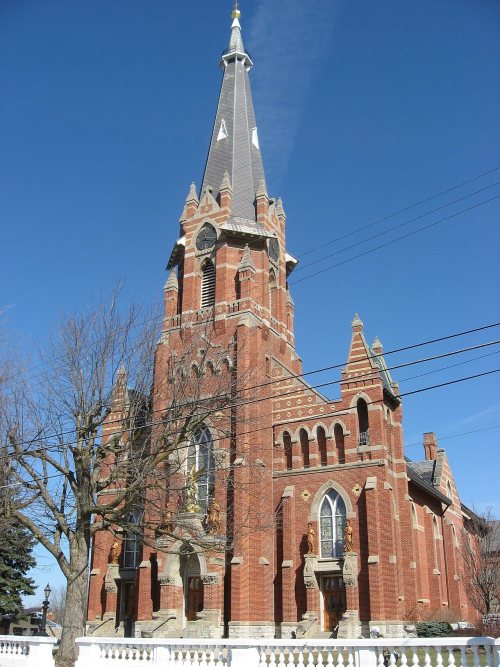
One place: the St. Michael Catholic Church Complex (listed 1979).
How old are the homes in Fort Loramie?
19% of Fort Loramie’s homes were built before 1940 (Census estimate, ±6.2 points), against a typical 15% for an Ohio town; the median home was built in 1982.
Founding dates: Wikidata, Wikipedia, the U.S. post office records of Blevins & Helbock (CC0) and the Census. Homes by year built: Census ACS 2020–24. National Register of Historic Places: National Park Service (list of May 22, 2026). Old photos, postcards and papers: Wikimedia Commons, the Library of Congress and other public archives, credited on each item’s page. Maps: U.S. Geological Survey historical topographic maps (via Esri) and Sanborn fire-insurance maps (Library of Congress). History text and census tables: Wikipedia (CC BY-SA 4.0). Places that used to be: USGS Geographic Names Information System (2021).
From Wikimedia Commons (4), Wikidata (1), the National Register of Historic Places (1), Wikipedia, Wikidata and Wikipedia for famous people, U.S. Geological Survey historical maps, U.S. Census counts (via Wikipedia), the US Post Offices dataset (Blevins & Helbock), the USGS Geographic Names Information System and old county and town histories (Internet Archive). Archive images are copied here with their credits and licenses, shown on each photo’s page. Refreshed monthly.


 2018
 2015
 2007
 2004