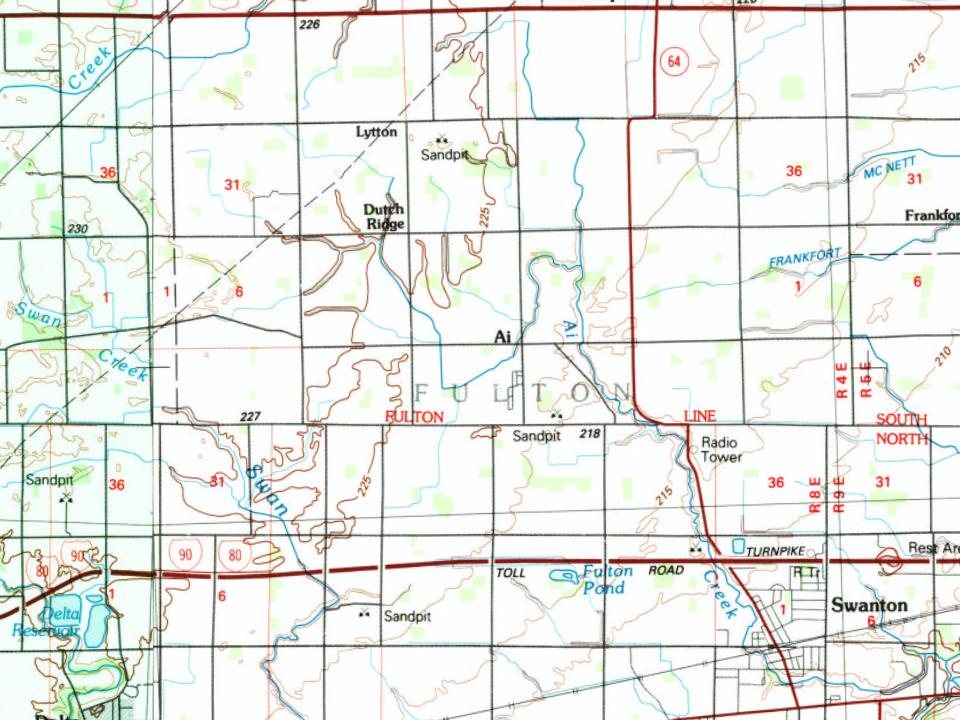
Ai was established around 1843. A post office was established at Ai in 1846, and remained in operation until it was discontinued in 1903. With the construction of the Northern Indiana Air Line railroad during the 1850s, business activity shifted to nearby Swanton and Ai's population dwindled.
The origin of the place's name has been a local controversy. Some say that it was named after the biblical city of Ai, while others believe that it was named after one of its founders, Ami Richards. The story continues Ami was a man, so others dropped the 'M' from his name to make the town's name more masculine.
Passages that mention Ai, cut from the printed page as they were published.
A standard history of Fulton County, Ohio, an authentic narrative of the past, with an extended survey of modern developments in the progress of town and county1920 · page 458Read the page →
Read the text
The Village of Ai Ai may be supposed to have had its origin in the establishment of a postoffice, under that name, in the log-house of David Springer, at that place, in 1843. Luther Dodge had quite a large store on his land, section 11, town 10 south, range 4 east, from 1839 to 1844, but the first store in Ai was built in 1849, by Thomas C. Berry, who sold in 1851 to Henry Haughton. In 1853 Isaac Springer bought a halfinterest, and in the following year Samuel Smout became his partner.
Text read by machine from the scan; it may contain errors.
A Standard History of Fulton County, Ohio1920 · page 250Read the page →
Read the text
Soon after the birth of his son George Henry he moved to the little community of Ai in Fulton Township of Fulton county. He was employed by the different owners of the ashery at Ai, and later bought land, his last home farm being on Dutch Ridge. He died there in 1901, after a long life of usefulness and at the age of eightysix. His widow passed away in 1913, aged eighty-five. They had a large family of children, a brief record of whom is as follows: Samantha, Mrs. Frank Beard, of Toledo; George Henry; Mary Jane,
Text read by machine from the scan; it may contain errors.
A standard history of Fulton County, Ohio, an authentic narrative of the past, with an extended survey of modern developments in the progress of town and county1920 · page 462Read the page →
Read the text
graded school with two teachers in charge. With the gradual decline of the Village of Ai, the school enumeration became gradually smaller, consequently the attendancee was not as large as could be conveniently accommodated. When, in the spring of 1903, the teacher of the adjoining district to the west, No. 3, resigned about two months before the school term was completed, the board of education made arrangements for the transportation of the pupils to the Ai school.”
Text read by machine from the scan; it may contain errors.
age and served for three years as company clerk in the regular army of Prussia. Although a soldier at the time of the Crimean war, he was not called into active service in that conflict. He emigrated to America by himself in 1857 and located at the village of Ai, Fulton county. In the spring of 1859 he went to Colorado and remained there engaged in mining until October, 1861, making the trip and returning to CHhio in a wagon. On this trip Mr. Plettner acted as hunter for a party of twenty-seven, en route to the gold fields. On May 1, when about eighty
Text read by machine from the scan; it may contain errors.
Scans and text from the Internet Archive. Books published in 1930 or earlier, which are in the public domain.
By decade
No old photos in the archives yet
Weddings on Main Street, storms, parades, school pictures, the old store. If it’s in your family album, it belongs here.
Be the first to add onePhotograph a print flat, in daylight, no flash.
Founding dates: Wikidata, Wikipedia, the U.S. post office records of Blevins & Helbock (CC0) and the Census. Homes by year built: Census ACS 2020–24. National Register of Historic Places: National Park Service (list of May 22, 2026). Old photos, postcards and papers: Wikimedia Commons, the Library of Congress and other public archives, credited on each item’s page. Maps: U.S. Geological Survey historical topographic maps (via Esri) and Sanborn fire-insurance maps (Library of Congress). History text and census tables: Wikipedia (CC BY-SA 4.0). Places that used to be: USGS Geographic Names Information System (2021). How TownRatings grades history →
From Wikipedia, U.S. Geological Survey historical maps and old county and town histories (Internet Archive). Archive images are copied here with their credits and licenses, shown on each photo’s page. Refreshed monthly.