Founding year: Wikipedia. First post office: 1794.The full story ↓
History grade
What drives Sag Harbor’s History grade
On its age, its old homes and the National Register, Sag Harbor is among the most historic 1% of U.S. towns, #5 of 758 in New York. All 3 inputs put Sag Harbor near the top nationally; its National Register listings ranks highest.
A+
HistoryA character grade: shown, never part of Sag Harbor’s overall grade.
New York towns list more on the Register than most of the country (a typical New York town has 12.3 per 10,000 residents, the U.S. 2.4), so Sag Harbor’s 4,399 sits above most of its state (100% of New York towns have fewer) while its 1,095 historic buildings outnumber those of 99% of U.S. towns.
NoteThe founding year comes from Wikipedia alone; no second source gives 1707.
How sure. Graded on any two of the three inputs instead, the letter would still be A+. The pre-1940 share is a Census survey estimate (±6.1 points).
Founding year: Wikipedia (other dates in Quick answers). Homes: Census ACS 2020–24. National Register: National Park Service, May 2026 list; each listing counted once (boundary changes and added documentation belong to their listing), and a historic district counts its contributing buildings. How TownRatings grades history →
What stands out about Sag Harbor’s past
Read from the archive, the National Register and the record. The page puts what stands out first.
Every edition of the U.S. Geological Survey’s map of Sag Harbor. Tap a year, or press play to watch the town change.
1903Sag Harbor sheet · 1:62,500
U.S. Geological Survey historical topographic maps (public domain), via Esri’s collection of the scans. The red ring marks the center of Sag Harbor.
Every building
Sag Harbor, building by building, 1885–1921
Fire insurance maps drew every building, what it was made of and what it was used for, so insurers could price the risk of fire. Pick a year, then a sheet.
1885Sheet 1 of 1
Edition
Sheets
BrickWoodStone
Sanborn Map Company, via the Library of Congress. Editions published in 1930 or earlier, which are in the public domain.
Sag Harbor was settled by English colonists sometime between 1707 and 1730. Many probably migrated from New England by water, as did other settlers on eastern Long Island. The first bill of lading to use the name "Sag Harbor" was recorded in 1730.
While some accounts say the village was named for the neighboring settlement of Sagaponack, which at the time was called Sagg, historians say Sagaponack and Sag Harbor both were named after a tuber cultivated by the local Pequot people and used as a staple crop. In their Algonquian language, they called the vegetable sagabon. It was one of the first crops colonists sent to England. The tuber-producing vine is now known as the Apios americana.
Passages that mention Sag Harbor, cut from the printed page as they were published.
...History of Suffolk county, New York1882 · page 36Read the page →
Read the text
Presbyterian church was built, which was dedicated May- 16th 1844, and is one of the finest churches on theisland. To assist the feeble church the town in 1767 voted that the Sag Harbor parish should have the use of certain meadows near Hog Neck; and a piece o( land was purchased of David Hand "at or near Sag Harbor meeting-house, as it is laid out and staked off for a burying place, to.be to the trustees of Southampton and their
Text read by machine from the scan; it may contain errors.
...History of Suffolk county, New York1882 · page 35Read the page →
Read the text
We have evidence that the Russell family was living on the neck in 1727. In 1745 Samuel Russell had a house -on the site of the railroad depot in Sag Harbor, and this ■so far as our knowledge extends was the first settlement made here. He is mentioned in 1751 as running a vessel, and about 1760 he sold his house to Nathan Fordham jr. This house was a noted resort in the early part •of the present century, when a tavern was kept there by
Text read by machine from the scan; it may contain errors.
Scans and text from the Internet Archive. Books published in 1930 or earlier, which are in the public domain.
By decade
Sag Harbor, decade by decade
5 decades in the archive, from the 1870s to the 1920s. Scroll each row; tap a photo for its story.
Nothing in the archives for these yearsWeddings on Main Street, storms, parades, school pictures, the old store. If it’s in your family album, it belongs here.
In 1707, according to Wikipedia’s history of the town. Sag Harbor’s post office opened in 1794, and the census of 1870 counted 1,723 people here.
How does Sag Harbor rank for history?
Sag Harbor is among the most historic 1% of U.S. towns, #5 of 758 in New York. The History grade combines the town’s founding era, the share of homes built before 1940 and its National Register listings. It’s a character grade, so it isn’t part of the overall grade. How it works.
What is on the National Register in Sag Harbor?
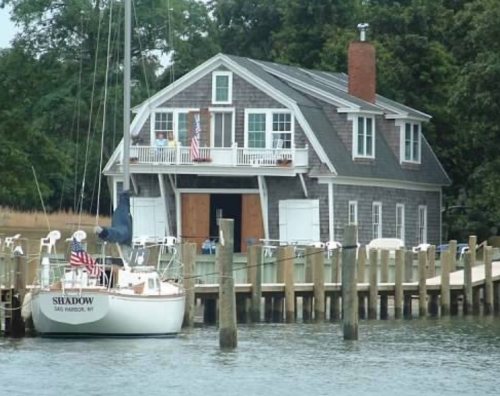
5 listings: 1 building, among them the Farnum, William A., Boathouse (listed 2017, the first). 1,095 historic buildings in all.
How old are the homes in Sag Harbor?
39% of Sag Harbor’s homes were built before 1940 (Census estimate, ±6.1 points), against a typical 27% for a New York town; the median home was built in 1958.
Founding dates: Wikidata, Wikipedia, the U.S. post office records of Blevins & Helbock (CC0) and the Census. Homes by year built: Census ACS 2020–24. National Register of Historic Places: National Park Service (list of May 22, 2026). Old photos, postcards and papers: Wikimedia Commons, the Library of Congress and other public archives, credited on each item’s page. Maps: U.S. Geological Survey historical topographic maps (via Esri) and Sanborn fire-insurance maps (Library of Congress). History text and census tables: Wikipedia (CC BY-SA 4.0). Places that used to be: USGS Geographic Names Information System (2021).
From Wikimedia Commons (12), the National Register of Historic Places (1), Wikipedia, Wikidata and Wikipedia for famous people, U.S. Geological Survey historical maps, U.S. Census counts (via Wikipedia), Sanborn fire insurance maps (Library of Congress) and old county and town histories (Internet Archive). Archive images are copied here with their credits and licenses, shown on each photo’s page. Refreshed monthly.


 1873
 1873
 1873
 1905
 1915
 1915
 1915