The Rose post office opened in 1834, the earliest record of the town by name. Four smaller post offices, Albion (1825), Valentine (1826) and Rose Valley (1829), opened inside today’s town and later closed.
First census: 1,641 in 18302020 census: 2,291192 years
How historic is Rose?
B+
More historic than 72% of U.S. towns, on its age, its old homes and the National Register.
Founding year: the first Rose post office (Blevins & Helbock, CC0).The full story ↓
History grade
What drives Rose’s History grade
On its age, its old homes and the National Register, Rose is more historic than 72% of U.S. towns. Its share of homes from before 1940 holds the grade up; its National Register listings pull it down.
B+
HistoryA character grade: shown, never part of Rose’s overall grade.
New York towns list more on the Register than most of the country (a typical New York town has 12.3 per 10,000 residents, the U.S. 2.4), so Rose’s 0.0 sits below most of its state (10% of New York towns have fewer) while its 0 listings outnumber those of 23% of U.S. towns.
How sure. Graded on any two of the three inputs instead, the letter would range from C+ to A+. The pre-1940 share is a Census survey estimate (±7.7 points). The founding year is the first post office, not a stated founding date.
Founding year: the first post office (other dates in Quick answers). Homes: Census ACS 2020–24. National Register: National Park Service, May 2026 list; each listing counted once (boundary changes and added documentation belong to their listing), and a historic district counts its contributing buildings. How TownRatings grades history →
What stands out about Rose’s past
Read from the archive, the National Register and the record. The page puts what stands out first.
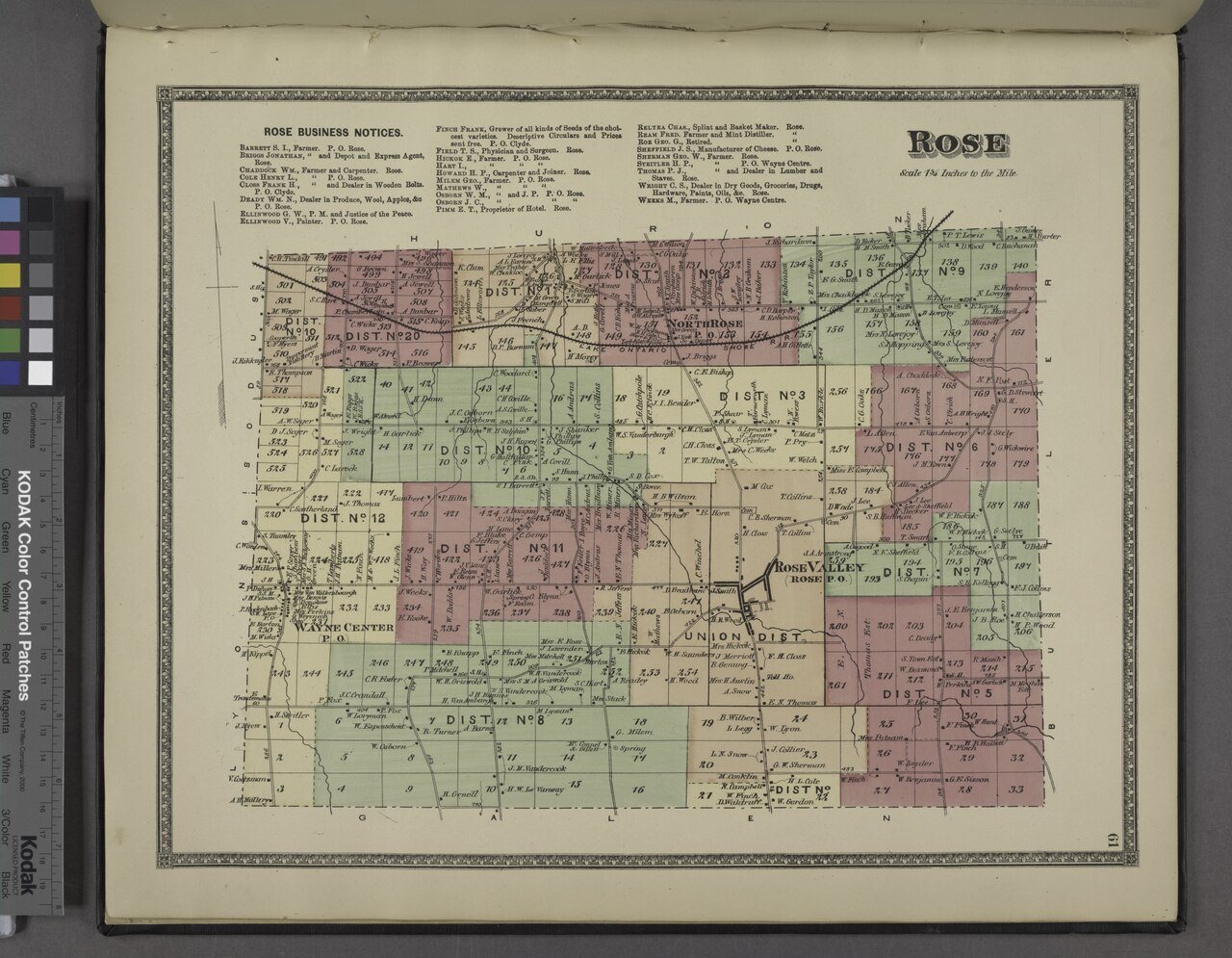
The Town of Rose was created in 1826 from the Town of Wolcott. About 1840 a mass delusion took over the local inhabitants, and they came to believe that a treasure of gold and jewels was buried within the town. In spite of many secret, nocturnal excavations, nothing was ever found.
Passages that mention Rose, cut from the printed page as they were published.
The rose garden. In two divisions. Division 1. Embracing the history of the rose, the formation of the rosarium, and a detailed account of the various practices adopted in the successful cultivation of this popular flower1848 · page 9Read the page →
Read the text
“ Around the station of Ghazeepore,” says this author, “there are about 300 beegahs, or about 150 acres, of ground laid out in small detached fields as Rose gardens, most carefully protected on all sides by high mud-walls and pricklypear fences, to keep out the cattle. These lands, which belong to Zemindars, are planted with Rose-trees, and are annually let out at so much per beegah* for the ground, and so much additional for the Rose-plants ;— generally five rupees per beegah, and twenty-five rupees for the Rose-trees, of which there are 1000 in each * A beegah is half an acre.
Text read by machine from the scan; it may contain errors.
The rose garden. In two divisions. Division 1. Embracing the history of the rose, the formation of the rosarium, and a detailed account of the various practices adopted in the successful cultivation of this popular flower1848 · page 17Read the page →
Read the text
The Damask Rose being the wild kind of Syria, it would hence appear that it was this gave rise to the Red Rose of the Lancastrians, and not the French Rose, as asserted by some. The White Rose was probably assumed by the Yorkists in contradistinction to the other.
Text read by machine from the scan; it may contain errors.
THE original Rosa odorata, or Blush Tea-scented Rose, has long been a favourite. This pretty variation of the China Rose was imported into England from China in 1810; hence it was sent to France, where, in combination with the Yellow China or Tea Rose, it has been the fruitful parent of all the splendid varieties we now possess. Mr.
Text read by machine from the scan; it may contain errors.
Tur Moss Ross, or Mossy Provence Ruse, is most probably an accidental sport or seminal variety of the common Provence Rose, as the Old Double Moss Rose, which was introduced to this country from Holland in 1596, is the only one mentioned by our early writers on gardening. If it had any claims to be ranked as a botanical species,* the Single-flowering Moss Rose would
Text read by machine from the scan; it may contain errors.
Scans and text from the Internet Archive. Books published in 1930 or earlier, which are in the public domain.
Timeline
Rose, 1823 to 1902
Woven from the archive, old maps, post office records, the National Register and the people born here.
The Rose post office opened in 1834, the earliest record of the town by name (U.S. post office records).
How does Rose rank for history?
Rose is more historic than 72% of U.S. towns. The History grade combines the town’s founding era, the share of homes built before 1940 and its National Register listings. It’s a character grade, so it isn’t part of the overall grade. How it works.
How old are the homes in Rose?
45% of Rose’s homes were built before 1940 (Census estimate, ±7.7 points), against a typical 27% for a New York town; the median home was built in 1951.
Founding dates: Wikidata, Wikipedia, the U.S. post office records of Blevins & Helbock (CC0) and the Census. Homes by year built: Census ACS 2020–24. National Register of Historic Places: National Park Service (list of May 22, 2026). Old photos, postcards and papers: Wikimedia Commons, the Library of Congress and other public archives, credited on each item’s page. Maps: U.S. Geological Survey historical topographic maps (via Esri) and Sanborn fire-insurance maps (Library of Congress). History text and census tables: Wikipedia (CC BY-SA 4.0). Places that used to be: USGS Geographic Names Information System (2021).
From Wikimedia Commons (5), Wikipedia, Wikidata and Wikipedia for famous people, U.S. Geological Survey historical maps, U.S. Census counts (via Wikipedia), the US Post Offices dataset (Blevins & Helbock), the USGS Geographic Names Information System and old county and town histories (Internet Archive). Archive images are copied here with their credits and licenses, shown on each photo’s page. Refreshed monthly.



 Date?
 Date?
 2014
 2014