Lockport’s post office opened in 1822, and 49% of its homes were built before 1940
More historic than 97% of U.S. towns · #85 of 758 in New York. What drives it
26 places in town are on the National Register, among them three historic districts with 232 buildings between them. Below: 8 old photos and papers, maps from 1886 on, and the census since 1860.
The Lockport post office opened in 1822, the earliest record of the town by name.
First census: 10,871 in 18602020 census: 20,876204 years
How did Lockport get its name?
Lockport’s name derives from a set of locks (Lock Numbers 34 and 35) in the Erie Canal within the city that were built to allow canal barges to traverse the sixty-foot (18 m) natural drop of the Niagara Escarpment.
How historic is Lockport?
A+
More historic than 97% of U.S. towns, on its age, its old homes and the National Register.
On its age, its old homes and the National Register, Lockport is more historic than 97% of U.S. towns, #85 of 758 in New York. All 3 inputs are above most U.S. towns; its share of homes from before 1940 ranks highest and its age lowest.
A+
HistoryA character grade: shown, never part of Lockport’s overall grade.
New York towns list more on the Register than most of the country (a typical New York town has 12.3 per 10,000 residents, the U.S. 2.4), so Lockport’s 125 sits above most of its state (78% of New York towns have fewer) while its 257 historic buildings outnumber those of 95% of U.S. towns.
How sure. Graded on any two of the three inputs instead, the letter would range from A to A+. The pre-1940 share is a Census survey estimate (±4.5 points). The founding year is the first post office, not a stated founding date.
Founding year: the first post office (other dates in Quick answers). Homes: Census ACS 2020–24. National Register: National Park Service, May 2026 list; each listing counted once (boundary changes and added documentation belong to their listing), and a historic district counts its contributing buildings. How TownRatings grades history →
What stands out about Lockport’s past
Read from the archive, the National Register and the record. The page puts what stands out first.
The indigenous Seneca people know the site of Lockport as Jodö:sho:t, literally 'springs there'.
The New York State Legislature authorized the Erie Canal's construction in April 1816. The route proposed by surveyors was to traverse an area in central Niagara County, New York, which was then free of European settlers. At the time, the nearest settlers were in nearby Cold Springs, New York. Following the announcement, land speculators began to buy large plots along and near the proposed route of the canal. By December 1820, when the exact location of the step locks had been determined, the area that would become Lockport was owned by only fifteen men, many of whom were Quakers.
Passages that mention Lockport, cut from the printed page as they were published.
History of Niagara county, N. Y., with illustrations descriptive of its scenery, private residences, public buildings, fine blocks, and important manufactories, and portraits of old pioneers and prominent residents1878 · page 265Read the page →
Read the text
I HE town of Lockport, although comparatively early settled and most numerously populated, was among the last to be organized in the county. It was not until February 2nd, 1824, that a special act was passed in the Legislature " to erect the town of Lockport," and for this purpose the eastern part of Cambria and the western portion of Royalton, including an area of
Text read by machine from the scan; it may contain errors.
Souvenir history of Niagara County, New York1902 · page 184Read the page →
Read the text
With the changes in the ownership and operation of the line to Buffalo and the line to Lockport new depot facilities were demanded, and this led to the construction of a depot at the corner of Falls and Second Street, the line from Lockport building the wing extending to the north, and the Buffalo line building a wing that extended east, but which has since been changed. The company that built the railroad to Lewiston was incorporated September 9, 1852,
Text read by machine from the scan; it may contain errors.
Souvenir history of Niagara County, New York1902 · page 150Read the page →
Read the text
The Lockport hotel, built by Samuel Jennings in 1821, was the first framed tavern here. It was situated on the western portion of ground now occupied by the Kenmore, and although only one story, was somewhat spacious for those days. A11 advertisement, dated December 7, 1821, in the Lockport Observatory, reads: “Samuel Jennings respectfully announces to the public that he has erected, in the Village of Lockport, on the west bank of the Grand Erie
Text read by machine from the scan; it may contain errors.
History of Niagara county, N. Y., with illustrations descriptive of its scenery, private residences, public buildings, fine blocks, and important manufactories, and portraits of old pioneers and prominent residents1878 · page 172Read the page →
Read the text
The opening of the railroad from Lockport to Niagara Falls, rude and imperfect as it was, did much toward giving an impetus to the business of Lockport and served to encourage further works of the kind. The construction of the Rochester, Lockport and Niagara Falls Railroad cast this primitive line into the shade, and afforded much greater facilities for intercourse and commerce. It was so far completed in the summer of 1852 that on the
Text read by machine from the scan; it may contain errors.
Scans and text from the Internet Archive. Books published in 1930 or earlier, which are in the public domain.
Timeline
Lockport, 1822 to 1957
Woven from the archive, old maps, post office records, the National Register and the people born here.
Nothing in the archives for these yearsWeddings on Main Street, storms, parades, school pictures, the old store. If it’s in your family album, it belongs here.
Fire insurance maps drew every building, what it was made of and what it was used for, so insurers could price the risk of fire. Pick a year, then a sheet.
The Lockport post office opened in 1822, the earliest record of the town by name (U.S. post office records).
How does Lockport rank for history?
Lockport is more historic than 97% of U.S. towns, #85 of 758 in New York. The History grade combines the town’s founding era, the share of homes built before 1940 and its National Register listings. It’s a character grade, so it isn’t part of the overall grade. How it works.
What is on the National Register in Lockport?
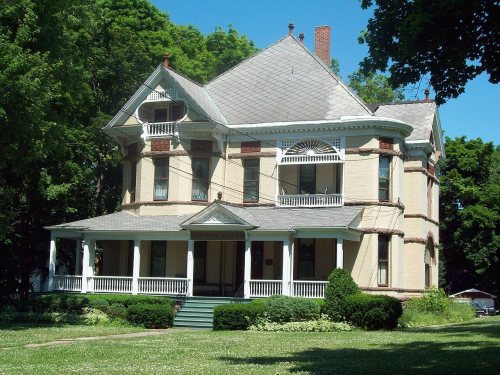
26 listings: 22 buildings, 3 historic districts, the Lowertown Historic District, the Lockport Industrial District and the High and Locust Streets Historic District, with 232 contributing buildings, and 1 structure. 257 historic buildings in all.
How old are the homes in Lockport?
49% of Lockport’s homes were built before 1940 (Census estimate, ±4.5 points), against a typical 27% for a New York town; the median home was built in 1941.
Founding dates: Wikidata, Wikipedia, the U.S. post office records of Blevins & Helbock (CC0) and the Census. Homes by year built: Census ACS 2020–24. National Register of Historic Places: National Park Service (list of May 22, 2026). Old photos, postcards and papers: Wikimedia Commons, the Library of Congress and other public archives, credited on each item’s page. Maps: U.S. Geological Survey historical topographic maps (via Esri) and Sanborn fire-insurance maps (Library of Congress). History text and census tables: Wikipedia (CC BY-SA 4.0). Places that used to be: USGS Geographic Names Information System (2021).
From the Library of Congress (8), Wikidata (4), the National Register of Historic Places (26), Wikipedia, Wikidata and Wikipedia for famous people, U.S. Geological Survey historical maps, U.S. Census counts (via Wikipedia), the US Post Offices dataset (Blevins & Helbock), the USGS Geographic Names Information System, Sanborn fire insurance maps (Library of Congress) and old county and town histories (Internet Archive). Archive images are copied here with their credits and licenses, shown on each photo’s page. Refreshed monthly.




 1905
 1905
 1905
 1905
 1905
 1905


