Guest, Sign inJoin

Post to Liverpool

We’ll email a one-tap link to publish your post. No password, and nothing is public until you click it.
Already a member? Sign in
AHistory
History · Liverpool

Liverpool’s post office opened in 1811, and 50% of its homes were built before 1940

More historic than 87% of U.S. towns. What drives it

2 places in town are on the National Register. Below: 1 old photo or paper, maps from 1895 on, and the census since 1870.

1811first post office
2on the National Register
50%homes built before 1940
1old photo or paper
9famous people
From Liverpool’s archive · credits on each photo
Quick answers

How Liverpool began

When was Liverpool founded?

1811

The Liverpool post office opened in 1811, the earliest record of the town by name.

First census: 1,555 in 18702020 census: 2,242215 years

How historic is Liverpool?

A

More historic than 87% of U.S. towns, on its age, its old homes and the National Register.

What drives the grade ↓
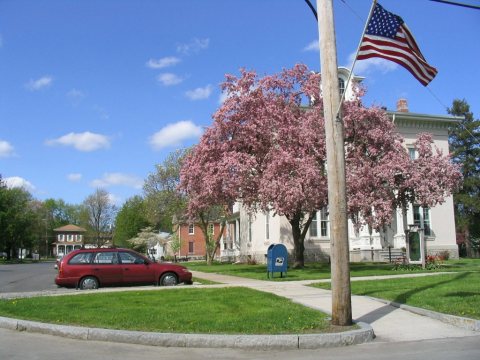
Founding year: the first Liverpool post office (Blevins & Helbock, CC0).The full story ↓
History grade

What drives Liverpool’s History grade

On its age, its old homes and the National Register, Liverpool is more historic than 87% of U.S. towns. All 3 inputs are above most U.S. towns; its share of homes from before 1940 ranks highest and its National Register listings lowest.

A
HistoryA character grade: shown, never part of Liverpool’s overall grade.
All U.S. towns we grade (21,289)Ahead of 87%
NewerOlder

New York towns list more on the Register than most of the country (a typical New York town has 12.3 per 10,000 residents, the U.S. 2.4), so Liverpool’s 7.4 sits near the middle of its state (41% of New York towns have fewer) while its 2 listings outnumber those of 60% of U.S. towns.

How sure. Graded on any two of the three inputs instead, the letter would range from B+ to A+. The pre-1940 share is a Census survey estimate (±8.9 points). The founding year is the first post office, not a stated founding date.

Founding year: the first post office (other dates in Quick answers). Homes: Census ACS 2020–24. National Register: National Park Service, May 2026 list; each listing counted once (boundary changes and added documentation belong to their listing), and a historic district counts its contributing buildings. How TownRatings grades history →

What stands out about Liverpool’s past

Read from the archive, the National Register and the record. The page puts what stands out first.

★ What stands out · Help out

Start Liverpool’s collection

The first neighbors to add old photos shape how Liverpool’s history is told.

Decades since 1900 with photos
00s10s20s30s40s50s60s70s80s90s
1 of 10 decades. The empty ones are waiting for someone’s album.
On the map

Liverpool on the map, 1895 to 1973

Every edition of the U.S. Geological Survey’s map of Liverpool. Tap a year, or press play to watch the town change.

Liverpool on the 1895 USGS mapLiverpool on the 1939 USGS mapLiverpool on the 1947 USGS mapLiverpool on the 1958 USGS mapLiverpool on the 1973 USGS map1895Syracuse sheet · 1:62,500

U.S. Geological Survey historical topographic maps (public domain), via Esri’s collection of the scans. The red ring marks the center of Liverpool.

The story

How Liverpool came to be

From Wikipedia’s history of Liverpool.

Read it all →

The area was originally inhabited by the Iroquois, starting in the 16th century. In the mid-17th century, Canadian French Jesuits visited the area, setting up missions. These were not permanent, however. An example of these missions is Sainte Marie among the Iroquois, on Onondaga Lake just outside the village. Once the (Erie Canal) and (Oswego Canal) were built, the area was settled by Irish canal workers, Yankee settlers, and, later, German immigrants. The early recorded name for the village was "Little Ireland".

The Lucius Gleason House and Liverpool Cemetery are listed on the National Register of Historic Places.

Text from Wikipedia, licensed CC BY-SA 4.0.

Timeline

Liverpool, 1895 to 1987

Woven from the archive, old maps, post office records, the National Register and the people born here.

  1. 19th century
  2. 1895On the mapFirst mapped by the U.S. Geological Survey
  3. 20th century
  4. 1933In the archiveFRONT ELEVATION - Jonathan Hicks House, 609 Vine Street
  5. 1960CensusPopulation peaks at 3,487
  6. 1961Born hereDoug Heveron is born here
  7. 1963Born hereTim Green is born here
  8. 1978Born hereKim Black is born here
  9. 1987Born hereJosh Ford is born here
By decade

Liverpool, decade by decade

One decade in the archive so far: the 1930s. Scroll each row; tap a photo for its story.

1940s–1990snothing yet
Nothing in the archives for these yearsWeddings on Main Street, storms, parades, school pictures, the old store. If it’s in your family album, it belongs here.
Add from your album
Every building

Liverpool, building by building, 1911–1915

Fire insurance maps drew every building, what it was made of and what it was used for, so insurers could price the risk of fire. Pick a year, then a sheet.

Liverpool fire insurance map, 1911, sheet 11911Sheet 1 of 7
Edition
BrickWoodStone

Sanborn Map Company, via the Library of Congress. Editions published in 1930 or earlier, which are in the public domain.

Then & now

Stand where they stood

No then-and-now pairs yet. Take a photo from the same spot as an old one and they appear here side by side.

FRONT ELEVATION - Jonathan Hicks House, 609 Vine Street
Retake this viewFRONT ELEVATION - Jonathan Hicks House, 609 Vine Street, 1933

Find the spot, match the angle, and add your photo. It becomes the first then-and-now pair on Liverpool’s page.

Retake this view · +15
On the National Register

2 historic places in Liverpool

The country’s official list of buildings and places worth saving.

places listed
2
National Historic Landmarks
0
none yet
historic buildings protected
2
each building in a district counts

National Park Service, National Register of Historic Places. Photos from Wikimedia Commons, credited on each place’s page.

People over time

Liverpool, census by census

05001,0001,5002,0002,5003,0003,50018801900192019401960198020002020Peak: 3,487

Peaked at 3,487 in 1960; 2,242 people lived here in 2020.

16 censuses, 1870–2020.

U.S. Census Bureau decennial counts, from the census table on Liverpool’s Wikipedia page.

Famous people

9 famous people were born in Liverpool

Writers, athletes, leaders and more, ranked by how widely they’re known.

See all →
Stories next door

History across the town line

Each neighbor’s History grade, on the same three inputs.

Questions about Liverpool’s history

What year was Liverpool founded?

The Liverpool post office opened in 1811, the earliest record of the town by name (U.S. post office records).

How does Liverpool rank for history?

Liverpool is more historic than 87% of U.S. towns. The History grade combines the town’s founding era, the share of homes built before 1940 and its National Register listings. It’s a character grade, so it isn’t part of the overall grade. How it works.

How old are the homes in Liverpool?

50% of Liverpool’s homes were built before 1940 (Census estimate, ±8.9 points), against a typical 27% for a New York town; the median home was built in 1938.

Memory lane

What the archives can’t tell you, neighbors can.

Town Square →
Start a conversation
Sources

Where this page comes from

Founding dates: Wikidata, Wikipedia, the U.S. post office records of Blevins & Helbock (CC0) and the Census. Homes by year built: Census ACS 2020–24. National Register of Historic Places: National Park Service (list of May 22, 2026). Old photos, postcards and papers: Wikimedia Commons, the Library of Congress and other public archives, credited on each item’s page. Maps: U.S. Geological Survey historical topographic maps (via Esri) and Sanborn fire-insurance maps (Library of Congress). History text and census tables: Wikipedia (CC BY-SA 4.0). Places that used to be: USGS Geographic Names Information System (2021).

From Wikimedia Commons (11), Wikidata (1), Wikipedia, Wikidata and Wikipedia for famous people, U.S. Geological Survey historical maps, U.S. Census counts (via Wikipedia) and Sanborn fire insurance maps (Library of Congress). Archive images are copied here with their credits and licenses, shown on each photo’s page. Refreshed monthly.