More historic than 26% of U.S. towns · #731 of 758 in New York. What drives it
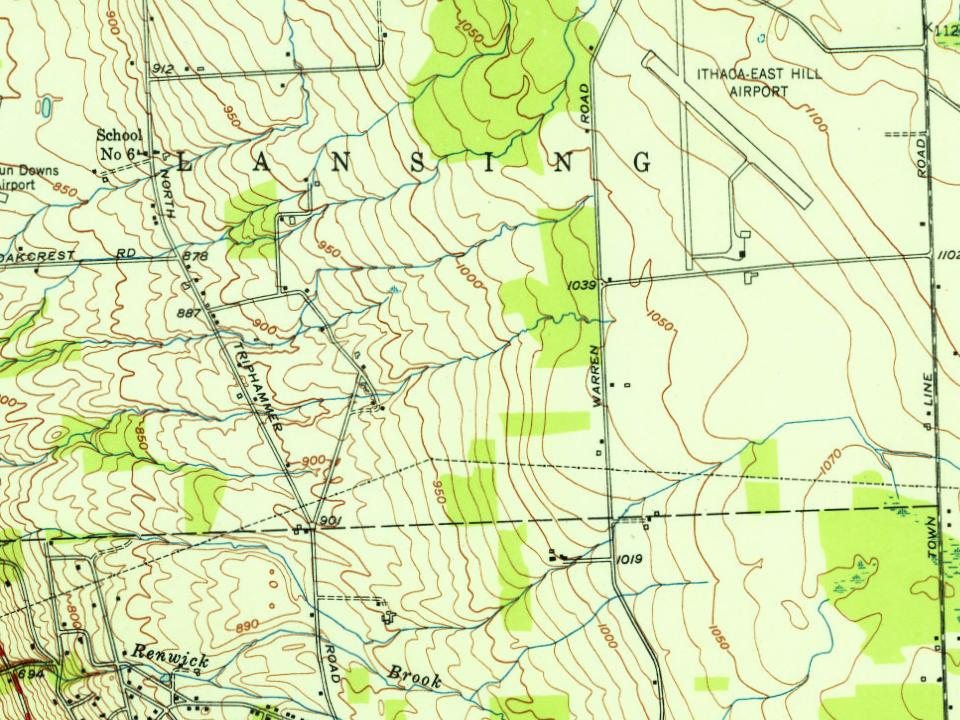
Most of Lansing was built recently: 0.8% of its homes predate 1940 and the median home dates from 1982. Below: 2 old photos and papers, maps from 1900 on, and the census since 1820.
Founding year: Wikidata. First post office: 1804.The full story ↓
History grade
What drives Lansing’s History grade
On its age, its old homes and the National Register, Lansing is more historic than 26% of U.S. towns, #731 of 758 in New York. Its age holds the grade up; its share of homes from before 1940 pulls it down.
C
HistoryA character grade: shown, never part of Lansing’s overall grade.
New York towns list more on the Register than most of the country (a typical New York town has 12.3 per 10,000 residents, the U.S. 2.4), so Lansing’s 0.0 sits below most of its state (10% of New York towns have fewer) while its 0 listings outnumber those of 23% of U.S. towns.
NoteThe founding year comes from Wikidata alone; no second source gives 1817.
How sure. Graded on any two of the three inputs instead, the letter would range from D− to C+. The pre-1940 share (±1.6 points) is firm at this size.
Founding year: Wikidata (other dates in Quick answers). Homes: Census ACS 2020–24. National Register: National Park Service, May 2026 list; each listing counted once (boundary changes and added documentation belong to their listing), and a historic district counts its contributing buildings. How TownRatings grades history →
What stands out about Lansing’s past
Read from the archive, the National Register and the record. The page puts what stands out first.
The Town of Lansing is located on the Eastern shore of Cayuga Lake in the Finger Lakes region of Upstate New York.
The area was formerly within the territory of the Cayuga tribe and, in 1780, became part of the Central New York Military Tract to compensate New York's soldiers after they participated in the Revolutionary War.
The first settlers came in 1781, and John Lemming Jr., secretary to general Philip Schuyler, was charged with granting the land. The Town of Lansing was formed in 1817 from the Town of Genoa, Cayuga County, when Tompkins County was founded.
Passages that mention Lansing, cut from the printed page as they were published.
Landmarks of Tompkins county, New York1894 · page 344Read the page →
Read the text
specting a site for a house of worship. It was locally known as the " Teetertown Church." When the name of the town was changed to Genoa, the name of the church was correspondingly changed, and the same course was followed when the town of Lansing was organized, it being then called the " Church of Lansing." It passed under the care of the Cjeneva Presbytery Januai-y 28, 180G, but was transferred to the Presbytery of Cayuga when that body was organized. Rev. Jahez Chadwick organized the church, and on February 2G, 1800, was in-
Text read by machine from the scan; it may contain errors.
Landmarks of Tompkins county, New York1894 · page 329Read the page →
Read the text
ton," and was erected January 27, 1789. On the 30th of February, 1802, the town of Locke was set off from Milton. On the Gth of April, 1808, the name was changed to Genoa, from the south part of which the town of Lansing was set off on the 7th of April, 1817, under the act that created Tompkins county. It retains its original limits and contains 38,808 acres, of which about 32,000 are improved. Settlements were made in what is now Lansing, of course, long before it became a civil organization. In March, 1791, Silas Ludlow, his brother Henry,
Text read by machine from the scan; it may contain errors.
Scans and text from the Internet Archive. Books published in 1930 or earlier, which are in the public domain.
Timeline
Lansing, 1801 to 2020
Woven from the archive, old maps, post office records, the National Register and the people born here.
In 1817, according to Wikidata. Lansing’s post office opened in 1804, and the census of 1820 counted 3,631 people here.
How does Lansing rank for history?
Lansing is more historic than 26% of U.S. towns, #731 of 758 in New York. The History grade combines the town’s founding era, the share of homes built before 1940 and its National Register listings. It’s a character grade, so it isn’t part of the overall grade. How it works.
How old are the homes in Lansing?
0.8% of Lansing’s homes were built before 1940 (Census estimate, ±1.6 points), against a typical 27% for a New York town; the median home was built in 1982.
Founding dates: Wikidata, Wikipedia, the U.S. post office records of Blevins & Helbock (CC0) and the Census. Homes by year built: Census ACS 2020–24. National Register of Historic Places: National Park Service (list of May 22, 2026). Old photos, postcards and papers: Wikimedia Commons, the Library of Congress and other public archives, credited on each item’s page. Maps: U.S. Geological Survey historical topographic maps (via Esri) and Sanborn fire-insurance maps (Library of Congress). History text and census tables: Wikipedia (CC BY-SA 4.0). Places that used to be: USGS Geographic Names Information System (2021).
From Wikimedia Commons (9), Wikipedia, U.S. Geological Survey historical maps, U.S. Census counts (via Wikipedia) and old county and town histories (Internet Archive). Archive images are copied here with their credits and licenses, shown on each photo’s page. Refreshed monthly.




 Date?
 2014
 2014
 2014
 2012
 2012
 2012
 2012


