Ithaca dates to 1888, and 43% of its homes were built before 1940
More historic than 85% of U.S. towns · #344 of 758 in New York. What drives it
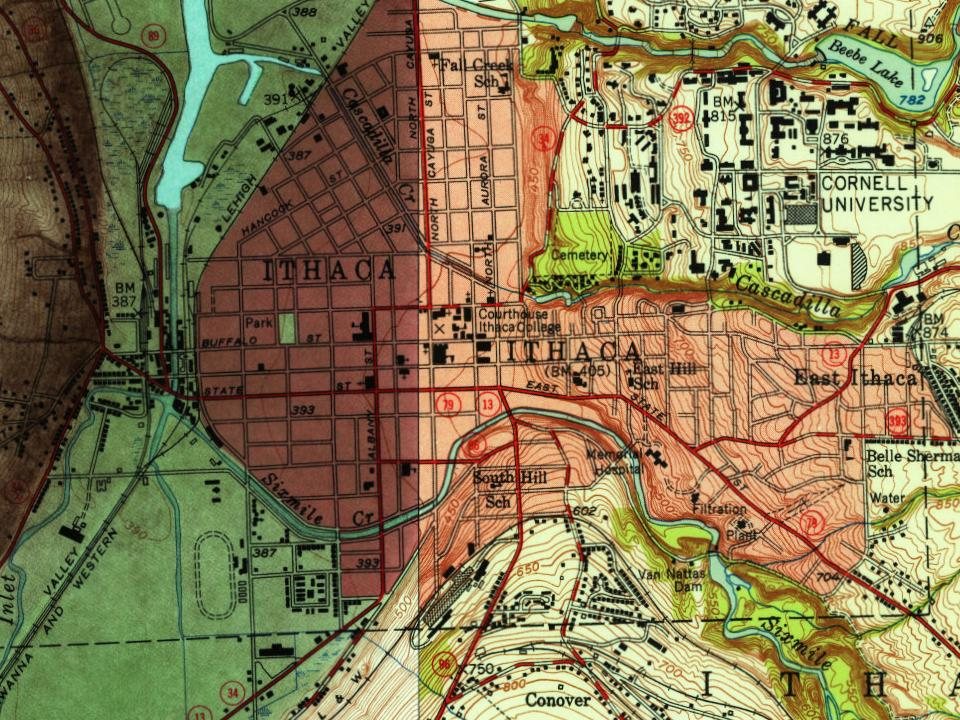
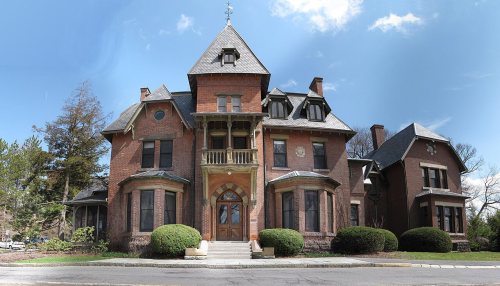
29 places in town are on the National Register, among them the Morrill Hall, Cornell University, a National Historic Landmark, and four historic districts with 322 buildings between them. Below: 10 old photos and papers, maps from 1888 on, and the census since 1870.
Founding year: Wikidata. First post office: 1821.The full story ↓
History grade
What drives Ithaca’s History grade
On its age, its old homes and the National Register, Ithaca is more historic than 85% of U.S. towns, #344 of 758 in New York. Its share of homes from before 1940 holds the grade up; its age pulls it down.
A
HistoryA character grade: shown, never part of Ithaca’s overall grade.
New York towns list more on the Register than most of the country (a typical New York town has 12.3 per 10,000 residents, the U.S. 2.4), so Ithaca’s 105 sits above most of its state (76% of New York towns have fewer) while its 345 historic buildings outnumber those of 96% of U.S. towns.
NoteThe founding year comes from Wikidata alone; no second source gives 1888.
How sure. Graded on any two of the three inputs instead, the letter would range from B to A+. The pre-1940 share is a Census survey estimate (±3.7 points).
Founding year: Wikidata (other dates in Quick answers). Homes: Census ACS 2020–24. National Register: National Park Service, May 2026 list; each listing counted once (boundary changes and added documentation belong to their listing), and a historic district counts its contributing buildings. How TownRatings grades history →
What stands out about Ithaca’s past
Read from the archive, the National Register and the record. The page puts what stands out first.
The country’s official list of buildings and places worth saving. One is a National Historic Landmark, the highest tier. Boundary changes and added documentation are counted with their listing.
National Park Service, National Register of Historic Places. Photos from Wikimedia Commons, credited on each place’s page.
Every building
Ithaca, building by building, 1888–1919
Fire insurance maps drew every building, what it was made of and what it was used for, so insurers could price the risk of fire. Pick a year, then a sheet.
Native Americans lived in this area for thousands of years. When reached by Europeans, this area was controlled by the Cayuga (Gayogo̱hó꞉nǫʼ), one of the five tribes comprising the Iroquois Confederacy (Haudenosaunee). Jesuit missionaries from New France in present-day Quebec had a mission to convert the Cayuga as early as 1657.
Passages that mention Ithaca, cut from the printed page as they were published.
Landmarks of Tompkins county, New York1894 · page 93Read the page →
Read the text
The town of Ithaca as a separate organization has come down from the original town of Ulysses, through the following changes : Ithaca was formed from Ulysses, which was erected as one of the original towns of Onondaga county, March 5, 1794. Its history is traced as Ulysses, Onondaga county, from March 5, 1794; as Ulysses, Cayuga county, from March 8, 1799; as Ulysses, Seneca county, from March 39, 1804; as Ulysses, Tompkins county, from April 17, 1817; and as Ithaca, Tompkins county, from March 10, 1821.
Text read by machine from the scan; it may contain errors.
Landmarks of Tompkins county, New York1894 · page 400Read the page →
Read the text
zens of Ovid, and an adequate endowment thereby secured for the college in some other proper locality. Therefore, I submit for your consideration, the following proi^osition. If you will locate the college at Ithaca, I will give you for that object a farm of three hundred acres of first quality of land, desirably located, overlooking the village of Ithaca and Cayuga Lake, and withui ten minutes' walk of the Cornell Library, the churches, the railroad station and st(;amboat landing. I will also erect on the farm suitable buildings for the use of the college, and give an additional sum of money to make up in the aggre-
Text read by machine from the scan; it may contain errors.
Scans and text from the Internet Archive. Books published in 1930 or earlier, which are in the public domain.
Timeline
Ithaca, 1821 to 1965
Woven from the archive, old maps, post office records, the National Register and the people born here.
Nothing in the archives for these yearsWeddings on Main Street, storms, parades, school pictures, the old store. If it’s in your family album, it belongs here.
In 1888, according to Wikidata. Ithaca’s post office opened in 1821, and the census of 1870 counted 8,462 people here.
How does Ithaca rank for history?
Ithaca is more historic than 85% of U.S. towns, #344 of 758 in New York. The History grade combines the town’s founding era, the share of homes built before 1940 and its National Register listings. It’s a character grade, so it isn’t part of the overall grade. How it works.
What is on the National Register in Ithaca?
29 listings: 24 buildings, among them the Morrill Hall, Cornell University (a National Historic Landmark since 1965), 4 historic districts with 322 contributing buildings, and 1 structure. 345 historic buildings in all.
How old are the homes in Ithaca?
43% of Ithaca’s homes were built before 1940 (Census estimate, ±3.7 points), against a typical 27% for a New York town; the median home was built in 1956.
Founding dates: Wikidata, Wikipedia, the U.S. post office records of Blevins & Helbock (CC0) and the Census. Homes by year built: Census ACS 2020–24. National Register of Historic Places: National Park Service (list of May 22, 2026). Old photos, postcards and papers: Wikimedia Commons, the Library of Congress and other public archives, credited on each item’s page. Maps: U.S. Geological Survey historical topographic maps (via Esri) and Sanborn fire-insurance maps (Library of Congress). History text and census tables: Wikipedia (CC BY-SA 4.0). Places that used to be: USGS Geographic Names Information System (2021).
From Wikimedia Commons (3), the Library of Congress (7), Wikidata (7), the National Register of Historic Places (29), Wikipedia, Wikidata and Wikipedia for famous people, U.S. Geological Survey historical maps, U.S. Census counts (via Wikipedia), the US Post Offices dataset (Blevins & Helbock), the USGS Geographic Names Information System, Sanborn fire insurance maps (Library of Congress) and old county and town histories (Internet Archive). Archive images are copied here with their credits and licenses, shown on each photo’s page. Refreshed monthly.


 ★ Landmark




 1890
 1900
 1900
 1901
 1901
 1905
 1905