Founding year: Wikipedia. First post office: 1792.The full story ↓
History grade
What drives Goshen’s History grade
On its age, its old homes and the National Register, Goshen is more historic than 94% of U.S. towns, #181 of 758 in New York. All 3 inputs are above most U.S. towns; its National Register listings ranks highest and its age lowest.
A
HistoryA character grade: shown, never part of Goshen’s overall grade.
New York towns list more on the Register than most of the country (a typical New York town has 12.3 per 10,000 residents, the U.S. 2.4), so Goshen’s 203 sits above most of its state (82% of New York towns have fewer) while its 117 historic buildings outnumber those of 90% of U.S. towns.
NoteThe founding year comes from Wikipedia alone; no second source gives 1788.
How sure. Graded on any two of the three inputs instead, the letter would still be A. The pre-1940 share is a Census survey estimate (±8.1 points).
Founding year: Wikipedia (other dates in Quick answers). Homes: Census ACS 2020–24. National Register: National Park Service, May 2026 list; each listing counted once (boundary changes and added documentation belong to their listing), and a historic district counts its contributing buildings. How TownRatings grades history →
What stands out about Goshen’s past
Read from the archive, the National Register and the record. The page puts what stands out first.
Fire insurance maps drew every building, what it was made of and what it was used for, so insurers could price the risk of fire. Pick a year, then a sheet.
European settlement began around 1714, although plans for this were made beginning about 1654. The town was established in 1788, after the American Revolutionary War and New York becoming a state. As population increased in the area, in 1830, part of Goshen was divided off to form the new Town of Hamptonburgh. In 1845, another part was used to form the Town of Chester.
Passages that mention Goshen, cut from the printed page as they were published.
An outline history of Orange County1846 · page 471Read the page →
Read the text
The tradition in this vicinity and among the family descendents of William Bull and Sarah Wells, from the earliest settlement of the town of Goshen down to this day, is that " Sarah Wells was the first civilized white woman, and Madam Denn the second, who placed a foot upon that part of the patent of Wawayanda, which laid in the town of Goshen !" How this came about we have now explained. We are aware that there is a tradition also, which has come
Text read by machine from the scan; it may contain errors.
After reaching his majority, until 1854, he carried on farming in Vernon, Bergen County, Wantage, and a second time in Vernon, N. J., when he purchased five hundred acres of land in the town of Goshen, a part of which he subsequently sold. In 1856 he purchased his present farm of one hundred and fifty acres, located within the corporate limits of the village of Goshen.
Text read by machine from the scan; it may contain errors.
History of Orange County, New York1881 · page 173Read the page →
Read the text
In 1753 he made a sale of land in Goshen to his son Solomon, and in 1715 he made a sale to John Carpenter, of Jamaica, L. I., of land in Goshen, and John Carpenter in 1779 sold land to his son John in the south division of the old town of Goshen.
Text read by machine from the scan; it may contain errors.
The history of Orange County, New York1908 · page 223Read the page →
Read the text
Long Island ; Samuel Staats, who came into record as a thirteenth shareholder in 1713; and John Everett and Samuel Clowes, who in 1714, acquired a tract equal to four of the thirteen shares. The township of Goshen came that year, and the precinct of Goshen, comprising the outlying settlements came later, and remained until 1788 when the township was expanded to take its place.
Text read by machine from the scan; it may contain errors.
Scans and text from the Internet Archive. Books published in 1930 or earlier, which are in the public domain.
Timeline
Goshen, 1788 to 1985
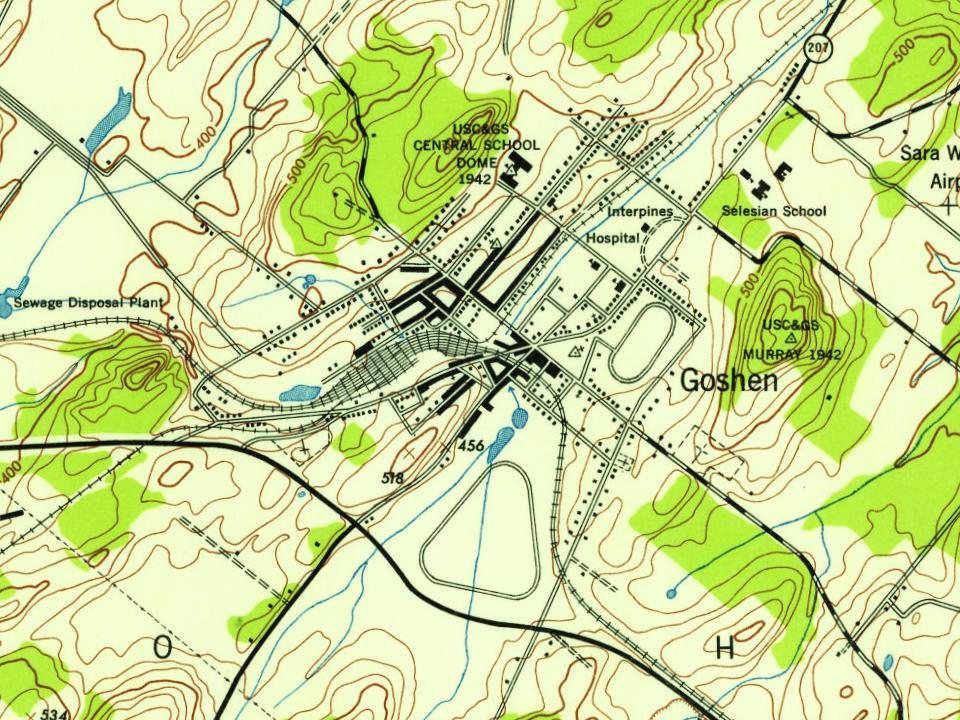
Woven from the archive, old maps, post office records, the National Register and the people born here.
In 1788, according to Wikipedia’s history of the town. Goshen’s post office opened in 1792, and the first U.S. census counted 2,448 people here in 1790.
How does Goshen rank for history?
Goshen is more historic than 94% of U.S. towns, #181 of 758 in New York. The History grade combines the town’s founding era, the share of homes built before 1940 and its National Register listings. It’s a character grade, so it isn’t part of the overall grade. How it works.
How old are the homes in Goshen?
29% of Goshen’s homes were built before 1940 (Census estimate, ±8.1 points), against a typical 27% for a New York town; the median home was built in 1968.
Founding dates: Wikidata, Wikipedia, the U.S. post office records of Blevins & Helbock (CC0) and the Census. Homes by year built: Census ACS 2020–24. National Register of Historic Places: National Park Service (list of May 22, 2026). Old photos, postcards and papers: Wikimedia Commons, the Library of Congress and other public archives, credited on each item’s page. Maps: U.S. Geological Survey historical topographic maps (via Esri) and Sanborn fire-insurance maps (Library of Congress). History text and census tables: Wikipedia (CC BY-SA 4.0). Places that used to be: USGS Geographic Names Information System (2021).
From Wikidata (1), Wikipedia, Wikidata and Wikipedia for famous people, U.S. Geological Survey historical maps, U.S. Census counts (via Wikipedia), Sanborn fire insurance maps (Library of Congress) and old county and town histories (Internet Archive). Archive images are copied here with their credits and licenses, shown on each photo’s page. Refreshed monthly.