Founding year: Wikidata. First post office: 1850.The full story ↓
History grade
What drives Binghamton’s History grade
On its age, its old homes and the National Register, Binghamton is more historic than 61% of U.S. towns, #590 of 758 in New York. Its age holds the grade up; its National Register listings pull it down.
B
HistoryA character grade: shown, never part of Binghamton’s overall grade.
New York towns list more on the Register than most of the country (a typical New York town has 12.3 per 10,000 residents, the U.S. 2.4), so Binghamton’s 2.2 sits below most of its state (26% of New York towns have fewer) while its 1 listings outnumber those of 51% of U.S. towns.
NoteThe founding year comes from Wikidata alone; no second source gives 1834.
How sure. Graded on any two of the three inputs instead, the letter would range from B− to B+. The pre-1940 share is a Census survey estimate (±5.0 points).
Founding year: Wikidata (other dates in Quick answers). Homes: Census ACS 2020–24. National Register: National Park Service, May 2026 list; each listing counted once (boundary changes and added documentation belong to their listing), and a historic district counts its contributing buildings. How TownRatings grades history →
What stands out about Binghamton’s past
Read from the archive, the National Register and the record. The page puts what stands out first.
The first known people of European descent to come to the area were the troops of the Sullivan Expedition in 1779, during the American Revolutionary War, who destroyed local villages of the Onondaga and Oneida tribes. The city was named after William Bingham, a wealthy Philadelphian who bought the 10,000 acre patent for the land in 1786, then consisting of parts of the towns of Union and Chenango. Joshua Whitney Jr., Bingham's land agent, chose land at the junction of the Chenango and Susquehanna Rivers to develop a settlement, then named Chenango Point. After being officially conveyed the land by Bingham on July 4, 1800, Whitney arranged for the construction of the settlement's first two streets, Court Street and Water Street, and the first residence was built later that year. Whitney continued to expand Chenango Point and sell plots to new settlers, and helped erect the first bridge i…
The town of Binghamton as originally established included the territory of the town now so called, the town of Dickinson, and the city of Binghamton ; but like many other important divisions of the county Binghamton was subsequently called upon to surrender much of its best territory to other formations. The village of Binghamton remained a part of the mother territory until 1867, when it became a chartered city, and therefore was entirely separated from the town, although almost entirely surrounded with the town's territory. In many
Text read by machine from the scan; it may contain errors.
On March 25, 1865, the legislature passed an act designating Jared D. Sessions, J. Stuart Wells and Francis T. Newell commissioners to negotiate for and purchase in behalf of the town of Binghamton all the lands, privileges and franchises of the Chenango Bridge company and the Binghamton Bridge company for the purpose of establishing free bridges across the Chenango in the village. The commissioners acted with commendable promptness and soon secured the property of the Chenango Bridge company, but not of the Binghamton Bridge com-
Text read by machine from the scan; it may contain errors.
Scans and text from the Internet Archive. Books published in 1930 or earlier, which are in the public domain.
Timeline
Binghamton, 1834 to 1971
Woven from the archive, old maps, post office records, the National Register and the people born here.
Fire insurance maps drew every building, what it was made of and what it was used for, so insurers could price the risk of fire. Pick a year, then a sheet.
In 1834, according to Wikidata. Binghamton’s post office opened in 1850, and the census of 1830 counted 1,203 people here.
How does Binghamton rank for history?
Binghamton is more historic than 61% of U.S. towns, #590 of 758 in New York. The History grade combines the town’s founding era, the share of homes built before 1940 and its National Register listings. It’s a character grade, so it isn’t part of the overall grade. How it works.
What is on the National Register in Binghamton?
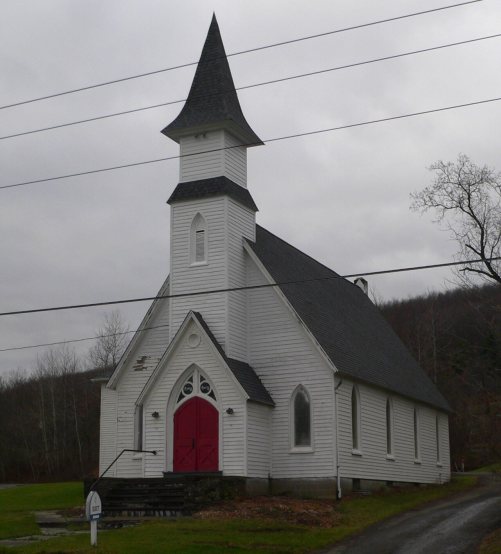
One place: the Hawleyton Methodist Episcopal Church, Old (listed 2006).
How old are the homes in Binghamton?
13% of Binghamton’s homes were built before 1940 (Census estimate, ±5.0 points), against a typical 27% for a New York town; the median home was built in 1966.
Founding dates: Wikidata, Wikipedia, the U.S. post office records of Blevins & Helbock (CC0) and the Census. Homes by year built: Census ACS 2020–24. National Register of Historic Places: National Park Service (list of May 22, 2026). Old photos, postcards and papers: Wikimedia Commons, the Library of Congress and other public archives, credited on each item’s page. Maps: U.S. Geological Survey historical topographic maps (via Esri) and Sanborn fire-insurance maps (Library of Congress). History text and census tables: Wikipedia (CC BY-SA 4.0). Places that used to be: USGS Geographic Names Information System (2021).
From Wikimedia Commons (10), the Library of Congress (1), Wikidata (1), the National Register of Historic Places (1), Wikipedia, Wikidata and Wikipedia for famous people, U.S. Geological Survey historical maps, U.S. Census counts (via Wikipedia), the US Post Offices dataset (Blevins & Helbock), the USGS Geographic Names Information System, Sanborn fire insurance maps (Library of Congress) and old county and town histories (Internet Archive). Archive images are copied here with their credits and licenses, shown on each photo’s page. Refreshed monthly.


 1876
 1876
 1876
 1876
 1876
 1876
 1876
 1876
 1876