Fort Lee’s post office opened in 1838, and 1 of its places is on the National Register
More historic than 47% of U.S. towns · #323 of 468 in New Jersey. What drives it
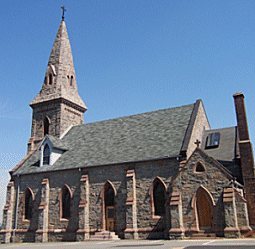
Most of Fort Lee was built recently: 5% of its homes predate 1940 and the median home dates from 1971. Its Register listing is the Church of the Madonna. Below: 8 old photos and papers, maps from 1897 on, and the census since 1880.
The Fort Lee post office opened in 1838, the earliest record of the town by name. Two smaller post offices, Coytesville (1902) and Palisade (1907), opened inside today’s town and later closed.
First census: 1,424 in 18802020 census: 40,191188 years
How historic is Fort Lee?
B−
More historic than 47% of U.S. towns, on its age, its old homes and the National Register.
Founding year: the first Fort Lee post office (Blevins & Helbock, CC0).The full story ↓
History grade
What drives Fort Lee’s History grade
On its age, its old homes and the National Register, Fort Lee is more historic than 47% of U.S. towns, #323 of 468 in New Jersey. Its age holds the grade up; its share of homes from before 1940 pulls it down.
B−
HistoryA character grade: shown, never part of Fort Lee’s overall grade.
New Jersey towns list more on the Register than most of the country (a typical New Jersey town has 3.7 per 10,000 residents, the U.S. 2.4), so Fort Lee’s 0.2 sits below most of its state (24% of New Jersey towns have fewer) while its 1 listings outnumber those of 51% of U.S. towns.
How sure. Graded on any two of the three inputs instead, the letter would range from C to B. The pre-1940 share (±1.1 points) is firm at this size. The founding year is the first post office, not a stated founding date.
Founding year: the first post office (other dates in Quick answers). Homes: Census ACS 2020–24. National Register: National Park Service, May 2026 list; each listing counted once (boundary changes and added documentation belong to their listing), and a historic district counts its contributing buildings. How TownRatings grades history →
What stands out about Fort Lee’s past
Read from the archive, the National Register and the record. The page puts what stands out first.
The Lenape peoples were inhabiting the area when Captain Henry Hudson was the first European to record the area in 1609. In 1756 Stephen Bourdette acquired 400 acres of land which included modern-day Fort Lee.
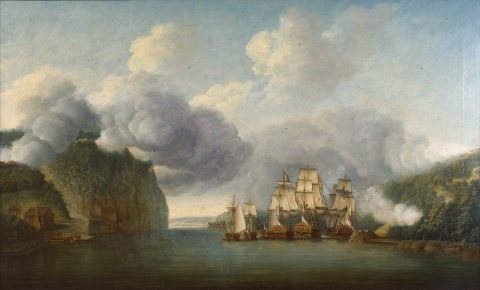
Originally known as Fort Constitution, Fort Lee was named for General Charles Lee after George Washington and his troops had camped at Mount Constitution overlooking Burdett's Landing, in defense of New York City. It was during Washington's retreat in November 1776 (beginning along a road which is now Main Street) that Thomas Paine composed his pamphlet, The American Crisis, which began with the recognized phrase, "These are the times that try men's souls." These events are recalled at Monument Park and Fort Lee Historic Park.
Passages that mention Fort Lee, cut from the printed page as they were published.
History of Bergen county, New Jersey1900 · page 496Read the page →
Read the text
deep and narrow ravine. Thence they approach so close to the water's edge that their columnar wall seems to rise nearly direct over the bed of the river. In the circular bend made by this change of position lies the older village of Fort Lee, formed by about fifty dwelling houses, an exceedingly uncomfortable schoolhouse, a shackly building that was once a piano manufactorv, a dilapidated barn, and four wharves that seem to have been erected about the time that Charles II gave to his brother that portion of the New Netherlands, now known as New
Text read by machine from the scan; it may contain errors.
History of Bergen county, New Jersey1900 · page 513Read the page →
Read the text
Joseph Schlosser, proprietor of the Fort Lee Club House, was born in Fort Lee in 1857. His father, Joseph Schlosser, was a native of Germany, but was in business in Leonia and Fort Lee the greater part of his life. He came to Leonia in 1855, and in 185') bought the property in Fort Lee, afterward converted into a hotel, but which was first used for a few years in part as a meat store. The interests in the last named business wire sold to his brother-in-law, Philip Hook, who moved across the street, and where he has been in business since that time.
Text read by machine from the scan; it may contain errors.
Scans and text from the Internet Archive. Books published in 1930 or earlier, which are in the public domain.
By decade
Fort Lee, decade by decade
6 decades in the archive, from the 1770s to the 1990s. Scroll each row; tap a photo for its story.
Nothing in the archives for these yearsWeddings on Main Street, storms, parades, school pictures, the old store. If it’s in your family album, it belongs here.
The Fort Lee post office opened in 1838, the earliest record of the town by name (U.S. post office records).
How does Fort Lee rank for history?
Fort Lee is more historic than 47% of U.S. towns, #323 of 468 in New Jersey. The History grade combines the town’s founding era, the share of homes built before 1940 and its National Register listings. It’s a character grade, so it isn’t part of the overall grade. How it works.
What is on the National Register in Fort Lee?
One place: the Church of the Madonna (listed 1976).
How old are the homes in Fort Lee?
5% of Fort Lee’s homes were built before 1940 (Census estimate, ±1.1 points), against a typical 15% for a New Jersey town; the median home was built in 1971.
Founding dates: Wikidata, Wikipedia, the U.S. post office records of Blevins & Helbock (CC0) and the Census. Homes by year built: Census ACS 2020–24. National Register of Historic Places: National Park Service (list of May 22, 2026). Old photos, postcards and papers: Wikimedia Commons, the Library of Congress and other public archives, credited on each item’s page. Maps: U.S. Geological Survey historical topographic maps (via Esri) and Sanborn fire-insurance maps (Library of Congress). History text and census tables: Wikipedia (CC BY-SA 4.0). Places that used to be: USGS Geographic Names Information System (2021).
From Wikimedia Commons (18), the National Register of Historic Places (1), Wikipedia, Wikidata and Wikipedia for famous people, U.S. Geological Survey historical maps, U.S. Census counts (via Wikipedia), the US Post Offices dataset (Blevins & Helbock), the USGS Geographic Names Information System, Sanborn fire insurance maps (Library of Congress) and old county and town histories (Internet Archive). Archive images are copied here with their credits and licenses, shown on each photo’s page. Refreshed monthly.




 1876
 1916
 2008
 2008
 2008
 2008
 2008
 2008
 2006
 2006
 2006
 2004