Butler’s post office opened in 1881, and 22% of its homes were built before 1940
More historic than 53% of U.S. towns · #290 of 468 in New Jersey. What drives it
Its Register listing is the New York Susquehanna & Western Railroad Station. Below: 12 old photos and papers, maps from 1891 on, and the census since 1910.
Founding year: the first Butler post office (Blevins & Helbock, CC0). Wikidata: 1901.The full story ↓
History grade
What drives Butler’s History grade
On its age, its old homes and the National Register, Butler is more historic than 53% of U.S. towns, #290 of 468 in New Jersey. Its share of homes from before 1940 holds the grade up; its age pulls it down.
B−
HistoryA character grade: shown, never part of Butler’s overall grade.
New Jersey towns list more on the Register than most of the country (a typical New Jersey town has 3.7 per 10,000 residents, the U.S. 2.4), so Butler’s 1.2 sits below most of its state (35% of New Jersey towns have fewer) while its 1 listings outnumber those of 51% of U.S. towns.
How sure. Graded on any two of the three inputs instead, the letter would range from C to B. The pre-1940 share is a Census survey estimate (±4.4 points). The founding year is the first post office, not a stated founding date; Wikidata gives 1901.
Founding year: the first post office (other dates in Quick answers). Homes: Census ACS 2020–24. National Register: National Park Service, May 2026 list; each listing counted once (boundary changes and added documentation belong to their listing), and a historic district counts its contributing buildings. How TownRatings grades history →
What stands out about Butler’s past
Read from the archive, the National Register and the record. The page puts what stands out first.
Every edition of the U.S. Geological Survey’s map of Butler. Tap a year, or press play to watch the town change.
1891Greenwood Lake sheet · 1:62,500
U.S. Geological Survey historical topographic maps (public domain), via Esri’s collection of the scans. The red ring marks the center of Butler.
Every building
Butler, building by building, 1901–1920
Fire insurance maps drew every building, what it was made of and what it was used for, so insurers could price the risk of fire. Pick a year, then a sheet.
Nothing in the archives for these yearsWeddings on Main Street, storms, parades, school pictures, the old store. If it’s in your family album, it belongs here.
The area now known as Butler was originally called "West Bloomingdale" and was sparsely populated. Water power brought manufacturing entities to the area. In 1857, The Pequannock Valley Paper Company moved from Bergen County and in 1868 the Newbrough Hard Rubber Company built a factory, both based along the Pequannock River. These were two significant economic entities that contributed to the growth of the borough. In 1871, the New Jersey Midland Railroad extended track through Butler from Paterson, making an important transportation connection for both passengers and freight. The northern terminus for the New York, Susquehanna and Western Railway's passenger service was located at Butler until 1966. The railroad still carries freight through Butler.
Passages that mention Butler, cut from the printed page as they were published.
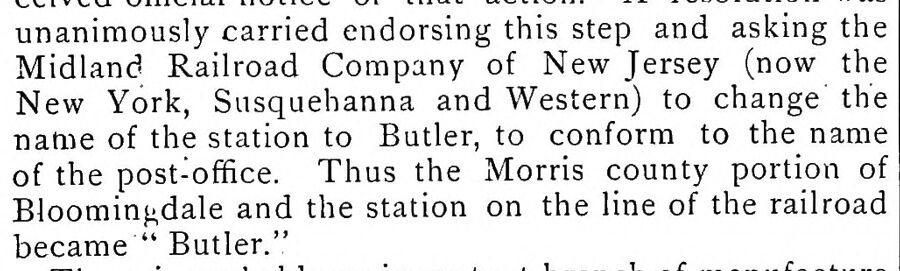
History of Morris County, New Jersey1882 · page 397Read the page →
Read the text
unanimously carried endorsing this step and asking the Midland Railroad Company of New Jersey (now the New York, Susquehanna and Western) to change' the name of the station to Butler, to conform to the name of the post-office. Thus the Morris county portion of Bloomin};,dale and the station on the line of the railroad became " Butler."
Text read by machine from the scan; it may contain errors.
A history of Morris County, New Jersey1914 · page 204Read the page →
Read the text
The village of Bloomingdale, on the Pequannock river, in Passaic county, overflowed across the stream, that part of the village being first known as West Bloomingdale. Later, a postoffice was established, known as Butler. Industries started here that attracted workers, the gain in population being such that on March 13, 1901, the borough of Butler was incorporated. The location is in the semi-mountainous region along the Pequannock, thirty-eight miles from New York, by the New York, Susquehanna and Western railroad, but twenty-seven miles as the crow flies. The health-
Text read by machine from the scan; it may contain errors.
A history of Morris County, New Jersey1914 · page 151Read the page →
Read the text
to 1539, which in 1880 had increased to 2239, the increase in manufacturing and improved railroad service inducing settlement. In 1890 the census showed 2862 ; in 1900 the population had risen to 3250 but the incorporation of Butler as a borough in 1901 so reduced it that in 1910 the census showed but 1921 inhabitants in the township. Butler reporting 2265, the combined figures (4186) showed a gain of 936 for the decade.
Text read by machine from the scan; it may contain errors.
History of Morris County, New Jersey1882 · page 280Read the page →
Read the text
ingdale on the east side. This new village contains perhaps sixty dwellings, with about 300 inhabitants, two stores and several shops. It has a post-office and has assumed the name of Butler. The Midland Railroad passes through it. A short distance above on Trout Brook is a saw-mill that was built many years ago and is one of the four in Pequannock now in use ; there is another near the west
Text read by machine from the scan; it may contain errors.
Scans and text from the Internet Archive. Books published in 1930 or earlier, which are in the public domain.
Timeline
Butler, 1881 to 1927
Woven from the archive, old maps, post office records, the National Register and the people born here.
The Butler post office opened in 1881, the earliest record of the town by name (U.S. post office records). Wikidata gives 1901.
How does Butler rank for history?
Butler is more historic than 53% of U.S. towns, #290 of 468 in New Jersey. The History grade combines the town’s founding era, the share of homes built before 1940 and its National Register listings. It’s a character grade, so it isn’t part of the overall grade. How it works.
What is on the National Register in Butler?
One place: the New York Susquehanna & Western Railroad Station (listed 2002).
How old are the homes in Butler?
22% of Butler’s homes were built before 1940 (Census estimate, ±4.4 points), against a typical 15% for a New Jersey town; the median home was built in 1962.
Founding dates: Wikidata, Wikipedia, the U.S. post office records of Blevins & Helbock (CC0) and the Census. Homes by year built: Census ACS 2020–24. National Register of Historic Places: National Park Service (list of May 22, 2026). Old photos, postcards and papers: Wikimedia Commons, the Library of Congress and other public archives, credited on each item’s page. Maps: U.S. Geological Survey historical topographic maps (via Esri) and Sanborn fire-insurance maps (Library of Congress). History text and census tables: Wikipedia (CC BY-SA 4.0). Places that used to be: USGS Geographic Names Information System (2021).
From Wikimedia Commons (4), the Library of Congress (8), the National Register of Historic Places (1), Wikipedia, Wikidata and Wikipedia for famous people, U.S. Geological Survey historical maps, U.S. Census counts (via Wikipedia), the US Post Offices dataset (Blevins & Helbock), the USGS Geographic Names Information System, Sanborn fire insurance maps (Library of Congress) and old county and town histories (Internet Archive). Archive images are copied here with their credits and licenses, shown on each photo’s page. Refreshed monthly.


 1905
 1905
 1906
 1906
 1906
 1906
 1906
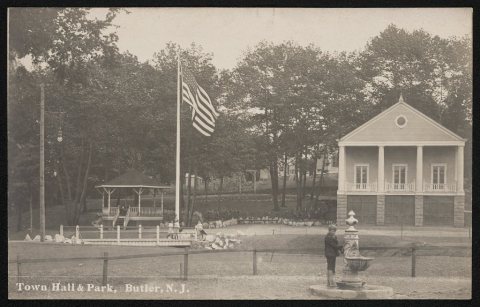 1906
 1906
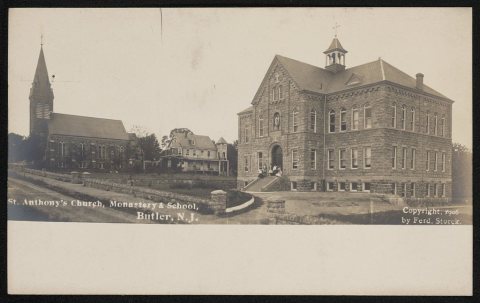 1906
 1906
 1906