Among the most historic 1% of U.S. towns. What drives it
2 places in town are on the National Register, among them a historic district with 219 buildings. Below: 8 old photos and papers, maps from 1888 on, and the census since 1900.
On its age, its old homes and the National Register, Allentown is among the most historic 1% of U.S. towns. All 2 inputs put Allentown near the top nationally; its National Register listings ranks highest.
A+
HistoryA character grade: shown, never part of Allentown’s overall grade.
New Jersey towns list more on the Register than most of the country (a typical New Jersey town has 3.7 per 10,000 residents, the U.S. 2.4), so Allentown’s 1,293 sits above most of its state (98% of New Jersey towns have fewer) while its 220 historic buildings outnumber those of 94% of U.S. towns.
How sure. Graded on two of the three inputs, so a change in either one moves the letter more than it would with three. The pre-1940 share is a Census survey estimate (±6.9 points).
Founding year: our sources. Homes: Census ACS 2020–24. National Register: National Park Service, May 2026 list; each listing counted once (boundary changes and added documentation belong to their listing), and a historic district counts its contributing buildings. How TownRatings grades history →
What stands out about Allentown’s past
Read from the archive, the National Register and the record. The page puts what stands out first.
Allentown was incorporated as a borough by an act of the New Jersey Legislature on January 29, 1889, from portions of Upper Freehold Township, based on the results of a referendum held that day. The borough was named for settler Robert Burnet's son-in-law, Nathan Allen or for William Allen, who served as Chief Justice of the Province of Pennsylvania.
Passages that mention Allentown, cut from the printed page as they were published.
History of Monmouth county, New Jersey ..1885 · page 110Read the page →
Read the text
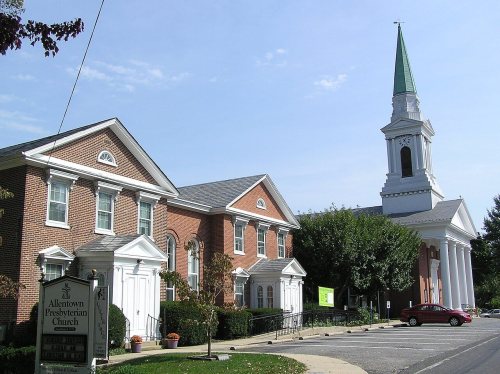
Imlay, Howell, postmaster of Prospertown, 1882, 638 Imlay, Isaac, first lieutenant. Continental Army, 1776, 232 Imlay, James, original member of Perseverance Fire Company, Allentown, 1818, 621 member of Allentown Presbyterian Church, appeared at Presbytery, 1 796, 626 trustee, Allentown Presbyterian Church, 1793, 629 postmaster, Allentown, 1804, 631
Text read by machine from the scan; it may contain errors.
History of Monmouth county, New Jersey ..1885 · page 27Read the page →
Read the text
Burlew, Rev. W.H., pastor Baptist Church of Allentown, 1878, 630 Burlinghame, James, superintendent cotton-factory, Allentown, 1814, 631 school trustee, Allentown, 1834, 631 Burlington, session of Assembly held at, 1704, 36 Burlington Path, Indian trail, description of, 50 part of township boundary-line, 1693, 103
Text read by machine from the scan; it may contain errors.
Scans and text from the Internet Archive. Books published in 1930 or earlier, which are in the public domain.
Timeline
Allentown, 1778 to 1986
Woven from the archive, old maps, post office records, the National Register and the people born here.
Nothing in the archives for these yearsWeddings on Main Street, storms, parades, school pictures, the old store. If it’s in your family album, it belongs here.
Fire insurance maps drew every building, what it was made of and what it was used for, so insurers could price the risk of fire. Pick a year, then a sheet.
Allentown is among the most historic 1% of U.S. towns. The History grade combines the town’s founding era, the share of homes built before 1940 and its National Register listings. It’s a character grade, so it isn’t part of the overall grade. How it works.
What is on the National Register in Allentown?
Two places: the Allentown Mill (listed 1978) and the Allentown Historic District (1982).
How old are the homes in Allentown?
33% of Allentown’s homes were built before 1940 (Census estimate, ±6.9 points), against a typical 15% for a New Jersey town; the median home was built in 1955.
Founding dates: Wikidata, Wikipedia, the U.S. post office records of Blevins & Helbock (CC0) and the Census. Homes by year built: Census ACS 2020–24. National Register of Historic Places: National Park Service (list of May 22, 2026). Old photos, postcards and papers: Wikimedia Commons, the Library of Congress and other public archives, credited on each item’s page. Maps: U.S. Geological Survey historical topographic maps (via Esri) and Sanborn fire-insurance maps (Library of Congress). History text and census tables: Wikipedia (CC BY-SA 4.0). Places that used to be: USGS Geographic Names Information System (2021).
From Wikimedia Commons (11), Wikidata (1), the National Register of Historic Places (2), Wikipedia, Wikidata and Wikipedia for famous people, U.S. Geological Survey historical maps, U.S. Census counts (via Wikipedia), the US Post Offices dataset (Blevins & Helbock), the USGS Geographic Names Information System, Sanborn fire insurance maps (Library of Congress) and old county and town histories (Internet Archive). Archive images are copied here with their credits and licenses, shown on each photo’s page. Refreshed monthly.




 1778
 1986
 1988
 1988
 Date?
 2018
 2018
 2017

