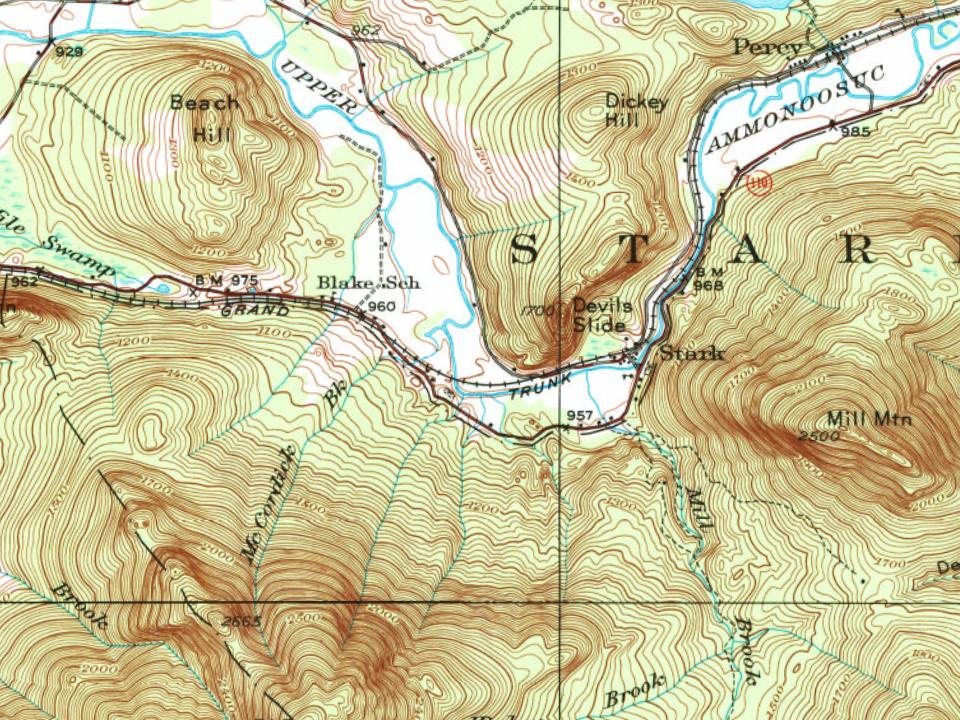
Granted in 1774, Stark was originally named "Percy", after Hugh Percy, 1st Duke of Northumberland. The town was incorporated in 1795, and renamed "Stark" in 1832, after General John Stark, who wrote the words that became New Hampshire's motto, "Live Free or Die".
In early 1944, the remains of a former Civilian Conservation Corps camp in the town were converted to form Camp Stark, which held about 250 German POWs. This was the only World War II POW camp located in New Hampshire. Most of the men in the camp performed hard labor in the nearby forests, supplying wood for the paper mills in Berlin, New Hampshire. Some of the men eventually came back to live in the United States and Canada after the war ended, and the camp was closed in 1946.
In 1795, according to Wikidata and Wikipedia’s history of the town. Stark’s post office opened in 1834, and the census of 1840 counted 349 people here.
What is on the National Register in Stark?
Two places: the Stark Covered Bridge (listed 1980) and the Stark Union Church (1983).
Founding dates: Wikidata, Wikipedia, the U.S. post office records of Blevins & Helbock (CC0) and the Census. Homes by year built: Census ACS 2020–24. National Register of Historic Places: National Park Service (list of May 22, 2026). Old photos, postcards and papers: Wikimedia Commons, the Library of Congress and other public archives, credited on each item’s page. Maps: U.S. Geological Survey historical topographic maps (via Esri) and Sanborn fire-insurance maps (Library of Congress). History text and census tables: Wikipedia (CC BY-SA 4.0). Places that used to be: USGS Geographic Names Information System (2021). How TownRatings grades history →
From Wikimedia Commons (16), the National Register of Historic Places (2), Wikipedia, U.S. Geological Survey historical maps, U.S. Census counts (via Wikipedia), the US Post Offices dataset (Blevins & Helbock) and the USGS Geographic Names Information System. Archive images are copied here with their credits and licenses, shown on each photo’s page. Refreshed monthly.


 2026
 2026
 2026
 2016
 2013
 2013
 2013
 2013
 2013
 2013
 2013
 2013
 2013
 2013
 2013
 2008