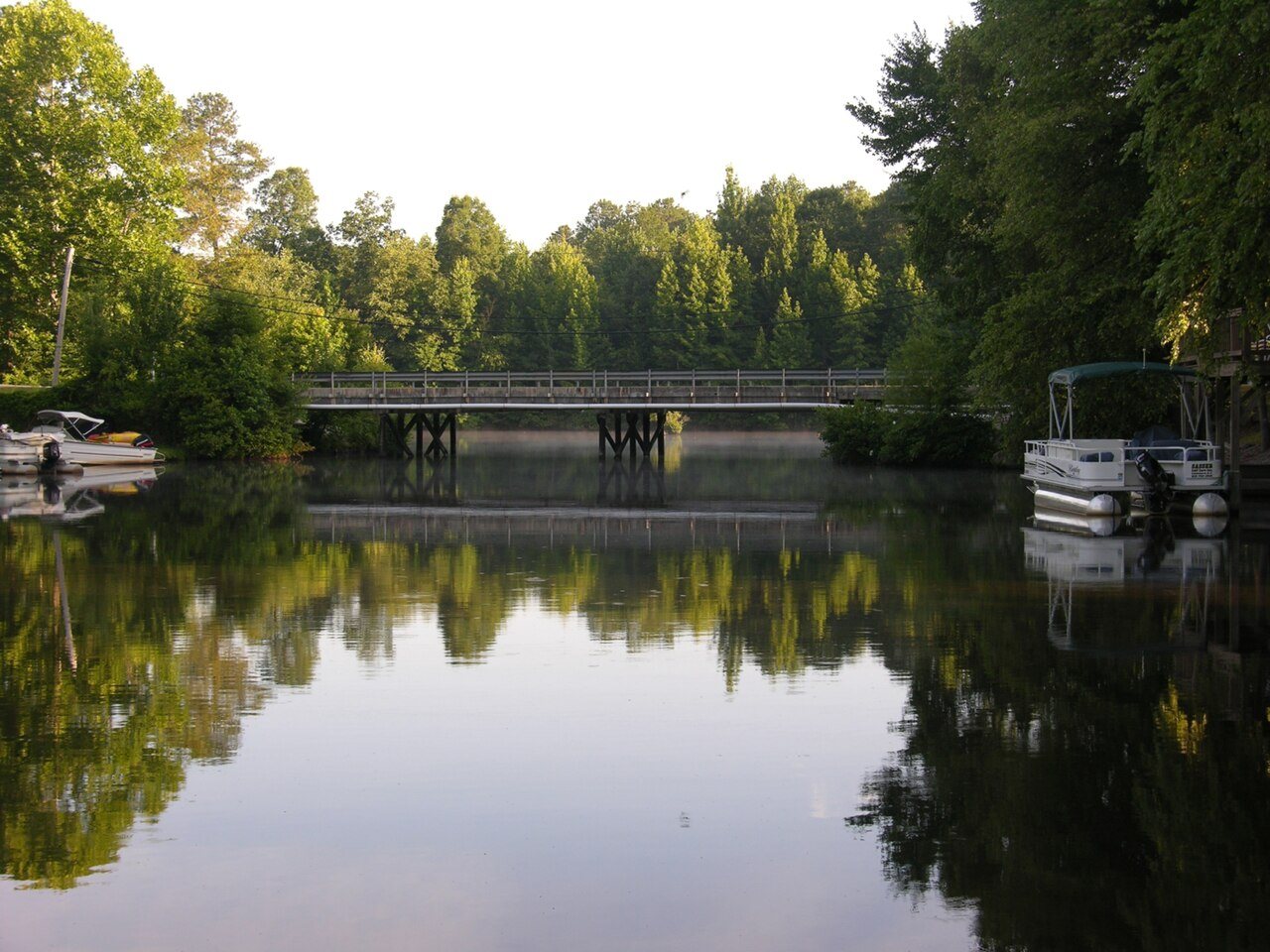
Lake Royale Bridge, 2009
Lake Royale’s story
Lake Royale in pictures
The archive holds 3 old photos and papers going back to 2009 and 2 maps from 1902 on.
Explore the history →Each edition grades its towns against each other only.

3,168 people live in this town in North Carolina.
Some subjects shine; others lag. With a B− overall, Lake Royale is better than nearly half of U.S. towns and ranks 98th of 286 in North Carolina. Where it falls short is walkability. Most errands need a car: it is less walkable than 88% of U.S. towns. Its strongest is cost of living: a typical home costs about $280K, 2.8 years of the Raleigh metro’s $100K median household income. The town has 1 place on the National Register. Lake Royale’s mean commuting time is 37 minutes, above both North Carolina’s towns (24 minutes) and U.S. towns (25 minutes). 12% of residents are under 18 here, where North Carolina’s towns sit at 22% and U.S. towns at 22%.
Figures: home values, Zillow · incomes, Census ACS, 2020–24 · National Register of Historic Places.
2,506 counted in 2010 and 3,392 in 2020.
U.S. Census 2010 & 2020 counts
Each subject compared with towns across the country (schools within North Carolina), ordered by how far Lake Royale is from typical.
How TownRatings grades towns →
The archive holds 3 old photos and papers going back to 2009 and 2 maps from 1902 on.
Explore the history →Lake Royale is unincorporated, so Franklin County and regional agencies provide most services.
EPA SDWIS (Oct 9, 2026) · HIFLD + EIA-861 2025 · Census 2020 ZCTAs · NCES 2024–25 · registration: vote.gov, updated Nov 18, 2024.
Ordered by what stands out in Lake Royale.
Lake Royale trades lower home prices for longer drives to work, is a second-home town and has a longer frost-free season than most of the country, though not than most of North Carolina.
4.3 miles of trail. In Lake Royale, the density of trails is 0.6 miles per square mile.
Trails & parks © OpenStreetMap contributors · Conserved land: USGS PAD-US
Lake Royale has 91 jobs for its 1,707 working residents: even if every job went to a resident, most would still commute out. The average commute takes 36.6 minutes, against 25.1 across North Carolina.
Employers in Lake Royale added 24 jobs between 2013 and 2023, to 91. Only 1% of working residents stay in Lake Royale for work; the rest commute out. In Lake Royale, the median household income is $108,000. Also worth knowing: among 290 North Carolina towns, just 7 have a higher mean commuting time than Lake Royale.
| Lake Royale | North Carolina towns | U.S. towns | |
|---|---|---|---|
| Average trip to work | 37 minutes | 24 minutes | 25 minutes |
| Median household income | $108,000 | $69,000 | $80,000 |
| Below the poverty line | 7.3% | 13% | 9.6% |
| Working residents who work in town | 1.3% | 6.8% | 8% |
Census LEHD 2023 · ACS
The Louisburg weather station, 12 miles away, records that the frost-free season runs about 201 days: longer than most of the country, but shorter than 80% of North Carolina places with climate records.
Summer afternoons peak near 90° in July, and January nights bottom out around 30°; snowfall runs to about 2 inches a winter.
NOAA U.S. Climate Normals, 1991–2020
Against the 7,488 U.S. towns with household incomes like Lake Royale’s, it is less healthy than 87%, so it trails even them.
Among adults in Lake Royale, 13% binge drink and 82% had a checkup this year. The town does better than the North Carolina average on 4 of 32 CDC measures and worse on 9. In Lake Royale, just over two in five adults have high blood pressure.
| Lake Royale | North Carolina towns | U.S. towns | |
|---|---|---|---|
| High blood pressure (CDC PLACES) | 42% | 38% | 35% |
| Binge drink (CDC PLACES) | 13% | 15% | 16% |
| Yearly checkup (CDC PLACES) | 82% | 80% | 79% |
| Diabetes (CDC PLACES) | 14% | 13% | 12% |
| What stands out | Lake Royale | NC |
|---|---|---|
| Fewer adults facing housing insecurity | 10.3% | 12.2% |
| Fewer adults facing a utility shut-off | 6.9% | 8.1% |
| More older adults who have lost all their teeth | 21.2% | 13.9% |
CDC PLACES 2025 · modeled estimates for adults · CMS · HRSA
Expected damage from storms and floods is higher here than in 51% of U.S. communities. 57% of Lake Royale’s expected losses from natural hazards come from inland flooding, followed by tornadoes at 16%.
FEMA National Risk Index · OpenFEMA
Homes are within reach (A− for cost of living), but half of working residents commute more than 30 miles. At 2.8 years of the Raleigh metro’s $100K median household income, the typical home costs less against local pay than in 91% of North Carolina towns; that ratio is one input to its A− for cost of living.
A home in Lake Royale typically sold within 80 days of listing. For households in the town, the share who live in a home they own is 95%. The rent at the middle of the market for Lake Royale comes to $1,390 a month.
| Lake Royale | North Carolina towns | U.S. towns | |
|---|---|---|---|
| Households that own their home | 95% | 67% | 73% |
| Median rent | $1,390 a month | $1,084 a month | $1,185 a month |
Census ACS, 2020–24 · Zillow Home Value Index · Redfin Data Center
1 within 15 miles of the center of Lake Royale
About 2 of every 100 Lake Royale residents are enrolled in college, against 6 across North Carolina.
Where Lake Royale’s working residents go each day. Line width shows the share.
Census LEHD 2023
Census-designated place in North Carolina, United States
Lake Royale is a census-designated place (CDP) in southeastern Franklin County, North Carolina, United States. The population was 3,392 at the 2020 census. It is a gated resort community which surrounds a man-made lake with the same name. The main entrance to Lake Royale is off Sledge Road (SR 1611), 3 miles (5 km) east of Bunn.
From Wikipedia, licensed CC BY-SA 4.0 · facts via Wikidata (CC0)
Short answers, built from the data on this page.
Lake Royale grades B− overall, better than 49% of U.S. towns and #98 of 286 in North Carolina. It grades C+ for health and C+ for schools. Walkability is its weak spot, with a D.
Not for the area. The typical home is worth about $280,000, 16% below the North Carolina typical home. Cost of living, which also weighs rents, property taxes and how many households pay 30% or more of their income for housing, grades A−.