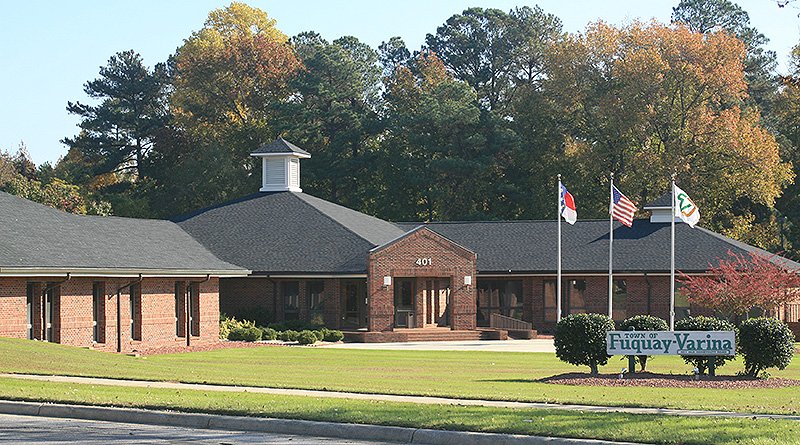
 Photo: Fvman · Public domain
Households in Fuquay-Varina have higher incomes than those in 86% of U.S. towns
Home is the office for 30% of workers, next to 16% for North Carolina as a whole. Below the poverty line: 8.2% of residents, next to 13.0% for North Carolina as a whole. Jobs and income earn Fuquay-Varina A−; getting around on foot earns it B+.
Census ACS 2020–24, Census LEHD 2024, EPA Smart Location Database. How the two grades are made
What the numbers say about work in Fuquay-Varina
Home offices are common in Fuquay-Varina
30% of Fuquay-Varina workers work from home, against 16% across North Carolina. Time on the road ↓
Fuquay-Varina has added jobs fast
Jobs based in Fuquay-Varina went from 7,932 in 2014 to 13,008 in 2024, +64%. The jobs ↓
Fuquay-Varina workers spend longer getting to work
The average trip takes 33 minutes each way, against 25 across North Carolina. Over a year that’s about 253 hours of commuting, 61 more than the state’s typical worker. Time on the road ↓
Fuquay-Varina draws workers from far and wide
The 13,008 jobs in Fuquay-Varina are filled from a wide area. Fuquay-Varina’s own residents hold 11% and the ten next-biggest home towns 27%; the other 62% come from many towns beyond those. The commute map ↓
Written from the Census figures on this page. Commute flows, distances and jobs are Census LEHD 2024, primary jobs only (the self-employed aren’t counted); commute time and working from home are from the Census American Community Survey; a jump in jobs can partly be a big employer changing how it reports its locations.
How Fuquay-Varina earns its Jobs & income grade
On income, poverty, unemployment and job access, Fuquay-Varina is better than 77% of U.S. towns, #57 of 290 in North Carolina. Household income is its strongest input ($115,497, U.S. $80,734); the poverty rate ranks lowest, though still above most U.S. towns. It also does well on the poverty rate and unemployment and job access by car.
A fairly firm grade. Within the Census margins of error for income, poverty and unemployment, Fuquay-Varina could be anywhere from B to A.
How long Fuquay-Varina spends getting to work: about 33 minutes
Round trip, about 230 workdays a year: roughly 10.6 full days in the car, bus or train.
Average commute minutes, one way
of Fuquay-Varina workers work from home, vs 16% across North Carolina. Their commute is the hallway.
Share of the 13,211 commuters (the 30% who work from home are left out). Across North Carolina: 85% drive alone, 1% take transit; U.S.: 81% and 4%. Census ACS 2020–24.
From the Census survey of workers who don’t work from home.
What the 13,008 jobs in Fuquay-Varina are
What kind of work
What it pays
Who does it
Jobs based in Fuquay-Varina, 2014 → 2024: 7,932 → 13,008. Big swings can come from how a large employer reports its locations, not only from real openings or closings.
Primary jobs covered by unemployment insurance (not the self-employed). Pay is monthly earnings. LEHD 2024.
Here is what they are, next to the jobs Fuquay-Varina’s own residents hold wherever they work.
23% of working residents work in Raleigh
Where Fuquay-Varina clocks in
 23% of workers
 12% of workers
 8% of workers
Lines run between town centers. The top 10 towns each way; “Everywhere else” is the rest, including other states.
A thicker line means more commuters. Switch between where residents work and where the people who work here live.
Who works in Fuquay-Varina, and who works elsewhere
On a workday 17,356 residents head out to work, 1,419 work right here, and 11,589 people come in from elsewhere.
About 43,000 people are in Fuquay-Varina on a workday afternoon, 12% fewer than live here.
0.69 jobs for every working resident, so most people commute out.
Workday population = residents − those who work elsewhere + those who come in (the Census “commuter-adjusted” method). Residents: Census survey; commuters: LEHD 2024, primary jobs.
How far Fuquay-Varina goes to work
About 15% show a job over 50 miles away. Some of that is real, and some is employers that report every worker at a head office, so a few long commutes are on paper only.
Straight-line distance from each worker’s home block to their main job’s block. LEHD 2024.
Every working resident’s trip, home to work, as the crow flies. Roads add to it, so real drives run longer.
Fuquay-Varina is a driving town
On EPA’s walkability index and the share of commuters who walk, bike or take transit, Fuquay-Varina is more walkable than 67% of U.S. towns, #68 of 290 in North Carolina. Both inputs place Fuquay-Varina near the same point nationally.
A firm grade. EPA’s index has no published margin of error; the commuting share comes from a Census survey of 18,862 workers.
How TownRatings grades walkability →
Transit service (shown, not graded). 0% of residents live within a ¾-mile walk of a bus or train stop, 0% within a quarter mile. At the weekday evening rush, about 0.4 trips an hour stop near the typical resident, more than in 49% of the 9,825 U.S. towns with transit data.
Transit at the evening rush trips an hour stopping within ¼ mile of the typical resident, EPA 2020
Households without a car (shown, not graded). 5.1% of Fuquay-Varina households have no vehicle (North Carolina 5.3%, U.S. 8.4%). <1% of Fuquay-Varina’s commuters take a bus or train.
For jobs and income, Fuquay-Varina is 338th of 927 U.S. towns of 34,000 to 66,000
| # | Town | People | Household income | Poverty | Unemployment | Work in town | Grade |
|---|---|---|---|---|---|---|---|
| 1 | McLean VA | 49,627 | $250K | 2.9% | 2.3% | 6% | A+ |
| 2 | Leawood KS | 34,093 | $186K | 3.1% | 2.0% | 9% | A+ |
| 3 | Upper Arlington OH | 35,893 | $155K | 3.3% | 2.0% | 8% | A+ |
| … | |||||||
| 89 | Cornelius NC | 35,094 | $114K | 5.4% | 2.4% | 9% | A |
| … | |||||||
| 104 | Chapel Hill NC | 63,565 | $86K | 18.6% | 4.5% | 27% | A |
| … | |||||||
| 153 | Holly Springs NC | 50,288 | $136K | 4.8% | 3.4% | 8% | A |
| … | |||||||
| 336 | Sylvania Township OH | 50,627 | $105K | 6.2% | 4.8% | 18% | A− |
| 337 | Glendora CA | 49,671 | $114K | 7.3% | 6.1% | 9% | A− |
| 338 | Fuquay-Varina NC | 48,536 | $115K | 8.2% | 3.6% | 8% | A− |
| 339 | Jackson Township NJ | 61,281 | $116K | 7.9% | 4.6% | 9% | A− |
| 340 | Lincoln CA | 57,367 | $112K | 6.9% | 4.2% | 9% | A− |
| … | |||||||
| 927 | Bullhead City AZ | 43,987 | $51K | 18.7% | 11.5% | 25% | D− |
Census ACS 2020–24 (income, poverty, unemployment), Census LEHD (work in town), TownRatings Jobs & income grades. Each town links to its Work & commute page.
Ranked on the Jobs & income grade: the towns either side of Fuquay-Varina, the top three, the last and three more from North Carolina.
Around Fuquay-Varina: the bordering towns
The biggest share goes to Holly Springs (4%).
Average commute minutes, one way
Jobs & commute next door
| Town | Fuquay-Varina workers there | Jobs & income | Walkability | Commute | Household income |
|---|---|---|---|---|---|
| Fuquay-Varina | – | A− | B+ | 33 min | $115,497 |
| Holly Springs | 4% | A | B | 29 min | $135,578 |
| Garner | 3% | B | B | 26 min | $78,756 |
Same-state neighbors only. Commute: average minutes each way, Census ACS 2020–24.
Darker towns draw more of Fuquay-Varina’s workers. Tap a town to see its commute.
What this data can and can’t tell you
- Two sources, two years. Trips, distances and jobs based here: Census LEHD 2024, primary jobs, where the employer reports them. Income, poverty, unemployment, commute time and how people travel: Census ACS 2020–24 averages.
- Straight lines, older transit. Miles are as the crow flies. EPA’s walkability and transit files use 2017–20 inputs.
Jobs and commuting in Fuquay-Varina: questions
What is the median household income in Fuquay-Varina?
$115,497 (±$8,663) (Census ACS 2020–24), against $72,388 across North Carolina and $80,734 nationally.
What is the poverty rate in Fuquay-Varina?
8.2%, against 13.0% across North Carolina and 12.5% nationally (Census ACS 2020–24).
How long is the commute from Fuquay-Varina?
33 minutes each way on average, against 25 across North Carolina and 26 nationally. 30% of workers work from home.
Where do people who live in Fuquay-Varina work?
8% work in town. The top destinations elsewhere are Raleigh (23%, 19 mi), Cary (12%, 13 mi), Durham (8%, 28 mi) (Census LEHD 2024).
Is Fuquay-Varina walkable?
Fuquay-Varina is more walkable than 67% of U.S. towns (Walkability B+): an EPA walkability index of 8.1 out of 20, and 3% of commuters walk, bike or take transit.
Can you get around Fuquay-Varina without a car?
<1% of commuters take transit and 5% of households have no car. 0% of residents live within a quarter mile of a stop.
Commuter talk
Getting to work from Fuquay-Varina, from the people who make the trip.
More of Fuquay-Varina
Flows, distances and jobs: U.S. Census Bureau, LEHD Origin-Destination Employment Statistics (LODES 8), 2024, primary jobs. Commute time, working from home and working out of state: U.S. Census Bureau, American Community Survey 5-year estimates. Distances are straight lines between home and work; real drives run longer. Walkability index, job access and transit service: U.S. EPA Smart Location Database. The two grades are our own summaries of these figures, not official ratings.