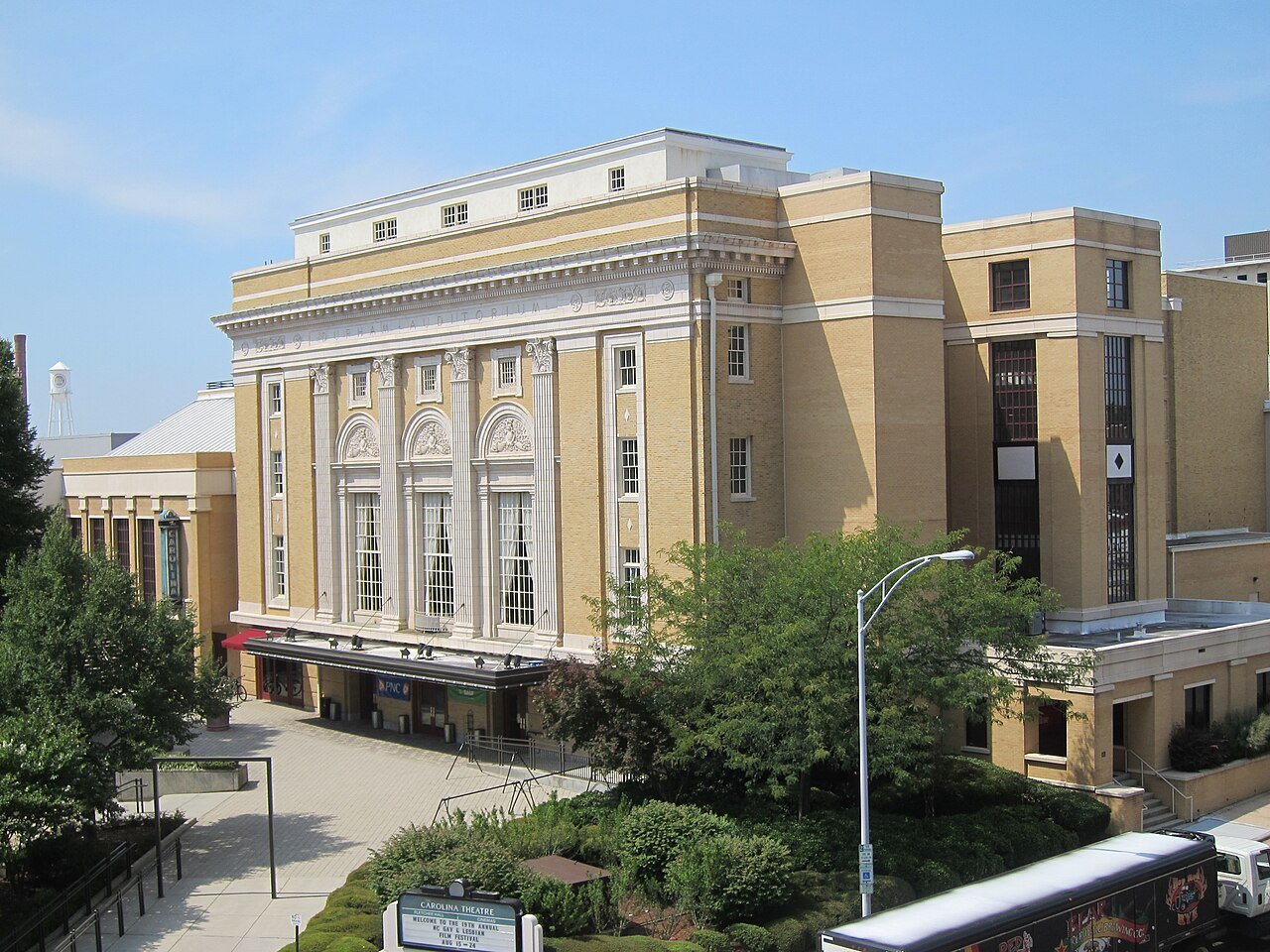
 Photo: Maria Miracoli · CC BY-SA 4.0
Durham’s public schools score below 63% of North Carolina districts on tests and graduation
On the state math tests, 42% of Durham’s students scored proficient, below the North Carolina average (51%). The grade covers the public school district serving Durham, from kindergarten through graduation, on state tests and graduation. Each state writes its own tests, so this is the one TownRatings grade compared within North Carolina, not nationally.
From North Carolina state tests taken in spring 2022, when 98% of students in the tested grades sat them, and the class of 2023’s four-year graduation rate, as reported to the U.S. Department of Education.
Durham’s schools, in brief
Against towns with similar incomes
Among the 264 North Carolina towns with household incomes within a quarter of Durham’s, its schools beat 17%, lower than their 37% against all the state’s districts. The grade ↓
Results trail the state
In spring 2022, 44% of tested students were proficient in reading and 42% in math, against 50% and 51% statewide; 98% of students in the tested grades sat the tests. The grade ↓
Graduation
84% of the class of 2023 graduated in four years, against 86% across North Carolina. Districts ↓
Spending and class size
The district spends $15,851 per student, against $13,045 across North Carolina (FY2024). Spending doesn’t count toward the grade. Districts ↓
28 elementary schools, then nine middle and nine high schools
Which school depends on the address at every step. See the path ↓
Choice beyond the district
Maureen Joy Charter School, Durham Charter School, Community School of Digital & Visual Art, Kestrel Heights School, Research Triangle Charter, Central Park School For Children, Voyager Academy, Global Scholars Academy, The Institute Development Young Leaders, Reaching All Minds Academy, Excelsior Classical Academy, KIPP Durham College Preparatory, Durham Academy (private), Durham Academy (private), Durham Academy Middle School Div (private), Trinity School of Durham & Chapel Hill (private), Immaculata Catholic School (private), Duke School (private), Montessori School of Raleigh (private), Liberty Christian School (private), Triangle Day School (private), Cresset Christian Academy (private), Cristo Rey Research Triangle (private), Mount Zion Christian Academy (private), Hill Learning Center (private), Fellowship Baptist Academy (private), Montessori School of Durham (private), International Montessori School (private), Lerner Jewish Community Day School (private), Hope Creek Academy (private), My Dynamic Academy (private), Durham Nativity School (private), Quality Education Institute of Durham (private), Faith Assembly Christian Academy (private), Veritas Collaborative School (private), Insight Colearning Center (private), Five Oaks Seventh-Day Adventist Christian School (private), Montessori Farm School (private), Empowered Minds Academy (private), The Studio School of Durham (private) and Gift of Knowledge Academy (private) are in town. North Carolina Cyber Academy and NC Virtual Academy, online schools, are based here too; they aren’t counted as local schools. Every school ↓
Written from the figures on this page. Tests are from 2021–22, graduation from the class of 2023; each school’s own letter uses 2020–21 results.
What’s behind Durham’s grade
C+: better than 37% of North Carolina school districts, #238 of 290 North Carolina towns. Both inputs trail the North Carolina average; test scores are the closer of the two to typical.
Where will my kid go?
Pick a grade. These are the public schools that serve Durham, with each school’s own grade.
Durham’s public schools are run by Durham Public Schools. To confirm the school for a specific address, ask the district.
The district
Spending and class size are shown but don’t count toward the grade. Each district’s own page has every school.
Well below the state in reading
Durham vs. its neighbors
Schools grades for the North Carolina towns that share Durham’s borders.
| Town | Schools | Main districts |
|---|---|---|
| Durham | C+ | Durham |
| Raleigh | A− | Wake County Schools |
| Chapel Hill | A | Chapel Hill-Carrboro Schools |
| Morrisville | A− | Wake County Schools |
| Cary | A− | Wake County Schools |
Every school in Durham
91 schools. Each public school’s letter compares its own 2020–21 reading and math results with North Carolina’s other public schools (the newest school-level results we have).
Left off: 3 public programs with fewer than 25 students (North Oak Academy, DPS Hospital School and Holton Career and Resource Center). 1 duplicate private-school records merged.
Questions about Durham’s schools
Are Durham’s schools good?
On North Carolina’s tests they score below most of the state: the public schools Durham children attend score below 63% of North Carolina’s school districts on tests and graduation, a C+ Schools grade, #238 of 290 North Carolina towns. Among towns with similar incomes they beat 17%. Tests are from 2021–22, graduation from the class of 2023.
What school district is Durham in?
Durham Public Schools, which runs grades PK–12 and enrolls 31,797 students in 55 schools (2024–25).
Where do Durham kids go to high school?
One of 9 high schools, depending on your address: C E Jordan High, Riverside High, Durham School of the Arts, Hillside High, Southern School of Energy and Sustainabi, Northern High, J D Clement Early College HS, City of Medicine Academy and Durham School of Technology.
What is Durham’s graduation rate?
84% of the class of 2023 in Durham Public Schools graduated in four years, against 86% across North Carolina.
How much does Durham spend per student?
$15,851 in Durham Public Schools (FY2024), against $13,045 across North Carolina. Spending doesn’t count toward the grade.
Are there private schools in Durham?
Yes: Durham Academy (nonsectarian, grades PK–12, 1,249 students), Durham Academy (nonsectarian, grades PK–12, 1,249 students), Durham Academy Middle School Div (nonsectarian, grades PK–12, 1,247 students), Trinity School of Durham & Chapel Hill (religious, grades K–12, 583 students), Immaculata Catholic School (Catholic, grades PK–8, 505 students), Duke School (nonsectarian, grades PK–8, 500 students), Montessori School of Raleigh (nonsectarian, grades PK–12, 438 students), Liberty Christian School (religious, grades PK–12, 335 students), Triangle Day School (nonsectarian, grades K–8, 321 students), Cresset Christian Academy (religious, grades PK–12, 231 students), Cristo Rey Research Triangle (Catholic, grades 9–11, 219 students), Mount Zion Christian Academy (religious, grades K–12, 182 students), Hill Learning Center (special education, grades 2–12, 176 students), Fellowship Baptist Academy (religious, grades K–12, 176 students), Montessori School of Durham (nonsectarian, grades PK–6, 174 students), International Montessori School (nonsectarian, grades PK–6, 166 students), Lerner Jewish Community Day School (religious, grades PK–5, 128 students), Hope Creek Academy (special education, grades K–12, 69 students), My Dynamic Academy (nonsectarian, grades PK–10, 44 students), Durham Nativity School (nonsectarian · all-boys, grades 5–8, 44 students), Quality Education Institute of Durham (religious, grades PK–4, 36 students), Faith Assembly Christian Academy (religious, grades K–12, 31 students), Veritas Collaborative School (nonsectarian, grades 4–12, 28 students), Insight Colearning Center (nonsectarian, grades 9–12, 24 students), Five Oaks Seventh-Day Adventist Christian School (religious, grades K–8, 22 students), Montessori Farm School (nonsectarian, grades PK–K, 21 students), Empowered Minds Academy (nonsectarian, grades PK–4, 16 students), The Studio School of Durham (nonsectarian, grades K–4, 15 students) and Gift of Knowledge Academy (nonsectarian, grades K–1, 5 students). Durham also has 12 charter schools, free and open by application.
Parents talk
What Durham families are saying about school.
Looking for colleges? Colleges near Durham → They have their own page.
School data: state test results (2021–22, with participation) and four-year graduation rates (class of 2023) reported to the U.S. Department of Education (EDFacts via ED Data Express); each school’s own letter uses its 2020–21 results (EDFacts via the Urban Institute); schools and enrollment from NCES (2024–25; private schools 2023–24); spending from the Census Bureau’s school finance survey (FY2024). The School Grade is our own summary, graded within North Carolina. Stars are from neighbors.