Beaufort dates to 1709, and 15% of its homes were built before 1940
More historic than 89% of U.S. towns · #15 of 290 in North Carolina. What drives it
5 places in town are on the National Register, among them a historic district with 16 buildings. Below: 11 old photos and papers, maps from 1885 on, and the census since 1800.
Founding year: Wikidata; Wikipedia’s history section gives the same year. First post office: 1797.The full story ↓
History grade
What drives Beaufort’s History grade
On its age, its old homes and the National Register, Beaufort is more historic than 89% of U.S. towns, #15 of 290 in North Carolina. All 3 inputs are above most U.S. towns; its age ranks highest and its share of homes from before 1940 lowest.
A
HistoryA character grade: shown, never part of Beaufort’s overall grade.
North Carolina towns list more on the Register than most of the country (a typical North Carolina town has 12.5 per 10,000 residents, the U.S. 2.4), so Beaufort’s 40.5 sits above most of its state (67% of North Carolina towns have fewer) while its 19 historic buildings outnumber those of 79% of U.S. towns.
How sure. Graded on any two of the three inputs instead, the letter would range from B+ to A. The pre-1940 share is a Census survey estimate (±4.5 points). Two sources give 1709.
Founding year: Wikidata (other dates in Quick answers). Homes: Census ACS 2020–24. National Register: National Park Service, May 2026 list; each listing counted once (boundary changes and added documentation belong to their listing), and a historic district counts its contributing buildings. How TownRatings grades history →
What stands out about Beaufort’s past
Read from the archive, the National Register and the record. The page puts what stands out first.
Fire insurance maps drew every building, what it was made of and what it was used for, so insurers could price the risk of fire. Pick a year, then a sheet.
1885Sheet 1 of 1
Edition
Sheets
BrickWoodStone
Sanborn Map Company, via the Library of Congress. Editions published in 1930 or earlier, which are in the public domain.
Timeline
Beaufort, 1709 to 1949
Woven from the archive, old maps, post office records, the National Register and the people born here.
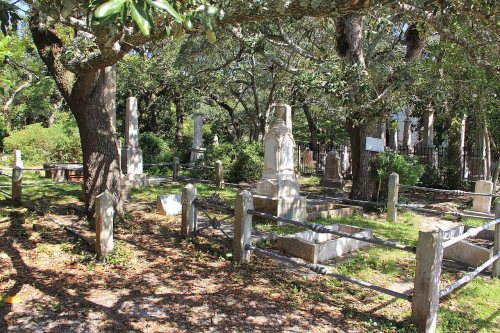
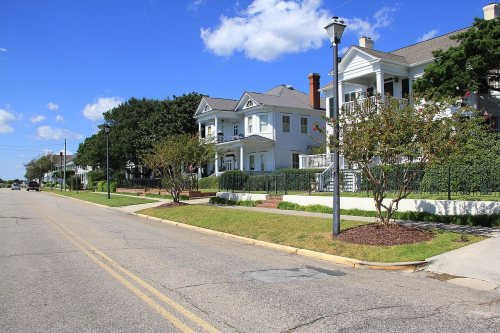
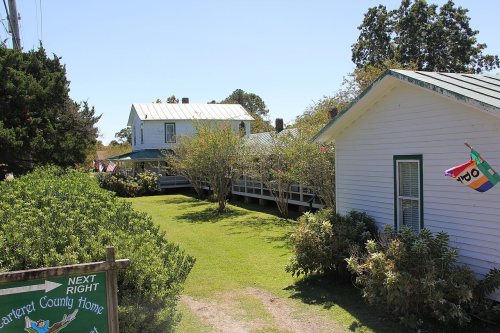
The Beaufort Historic District, Carteret County Home, Duncan House, Gibbs House, Jacob Henry House, and Old Burying Ground are listed on the National Register of Historic Places. In June 1718, Blackbeard the pirate ran his flagship, the Queen Anne's Revenge and his sloop Adventure, aground near present-day Beaufort Inlet, NC. The Queen Anne's Revenge was added to the National Register of Historic Places in 2004 with the reference number 04000148. Thirty-two years later, in August 1750, at least three Spanish merchantmen ran aground in North Carolina during a hurricane. One of the three, the El Salvador, sank near Cape Lookout.
Passages that mention Beaufort, cut from the printed page as they were published.
The James Sprunt Historical Publications vol 14, No 2 Some Colonial History of Beaufort County, N C1916 · page 25Read the page →
Read the text
cincts hereinafter mentioned, that is to say * 5 * Perquimans, Currituck and Hyde, to be parishes & bounded by the limits of the several precincts: the Remaining part of Pamlico river, and the branches thereof, commonly called Beaufort precinct, to be one parish by the name of St. Thomas parish." Неге we see the name first lawfully recognized, by which the same parish is known today. Vestrymen were appointed for the various parishes. Those named for St. Thomas parish being
Text read by machine from the scan; it may contain errors.
The Williams history, tracing the descendants in America of Robert Williams of Ruthin, North Wales, who settled in Carteret County, North Carolina, in 17631921Read the page →
Read the text
liams, livingin Beaufort 50 years after Beaufort was founded in 1713, wiU say he lived here during 1775-1776. If you v/Ul look over the copies of the letters that I sent you relative to his making salt at Gallants Point, and at what is now known as the old Salt Works which is on what is now known as Taylor's Creek, about one mile East of Beaufort, during this period.
Text read by machine from the scan; it may contain errors.
The James Sprunt Historical Publications vol 14, No 2 Some Colonial History of Beaufort County, N C1916 · page 38Read the page →
Read the text
Until a comparatively late date there was but one church in our present county of Beaufort, and this was the church of St. Thomas Parish at Bath. The parish had been established long before the church was built in 1734, and the ministers were sent from England. But, aside from this, the religious life of Bath County was, like the farm life, isolated and necessarily self-contained and sustained on each farm. The head of the family always instructed his sons and his slaves in some of the funda-
Text read by machine from the scan; it may contain errors.
The Williams history, tracing the descendants in America of Robert Williams of Ruthin, North Wales, who settled in Carteret County, North Carolina, in 17631921Read the page →
Read the text
Among the customers of Great Grandfathei' Robert Williams at his store of general merchandise in connection with the grist mill that he first operated near Beaufort was a man named Jonas Linch. Apparently Jonas had a saw mill, possibly located on the same place as the present saw mill now occupying the opposite end of the dam from the old grist mill of
Text read by machine from the scan; it may contain errors.
Scans and text from the Internet Archive. Books published in 1930 or earlier, which are in the public domain.
By decade
Beaufort, decade by decade
4 decades in the archive, from the 1850s to the 1900s. Scroll each row; tap a photo for its story.
Nothing in the archives for these yearsWeddings on Main Street, storms, parades, school pictures, the old store. If it’s in your family album, it belongs here.
In 1709, according to Wikidata and Wikipedia’s history of the town. Beaufort’s post office opened in 1797, and the census of 1800 counted 437 people here.
How does Beaufort rank for history?
Beaufort is more historic than 89% of U.S. towns, #15 of 290 in North Carolina. The History grade combines the town’s founding era, the share of homes built before 1940 and its National Register listings. It’s a character grade, so it isn’t part of the overall grade. How it works.
What is on the National Register in Beaufort?
5 listings: 3 buildings, among them the Gibbs House (listed 1973, the first), 1 historic district, the Beaufort Historic District, with 16 contributing buildings, and 1 site. 19 historic buildings in all.
How old are the homes in Beaufort?
15% of Beaufort’s homes were built before 1940 (Census estimate, ±4.5 points), against a typical 4.1% for a North Carolina town; the median home was built in 1986.
Founding dates: Wikidata, Wikipedia, the U.S. post office records of Blevins & Helbock (CC0) and the Census. Homes by year built: Census ACS 2020–24. National Register of Historic Places: National Park Service (list of May 22, 2026). Old photos, postcards and papers: Wikimedia Commons, the Library of Congress and other public archives, credited on each item’s page. Maps: U.S. Geological Survey historical topographic maps (via Esri) and Sanborn fire-insurance maps (Library of Congress). History text and census tables: Wikipedia (CC BY-SA 4.0). Places that used to be: USGS Geographic Names Information System (2021).
From Wikimedia Commons (10), the Library of Congress (1), Wikidata (1), the National Register of Historic Places (5), Wikipedia, Wikidata and Wikipedia for famous people, U.S. Geological Survey historical maps, U.S. Census counts (via Wikipedia), the US Post Offices dataset (Blevins & Helbock), the USGS Geographic Names Information System, Sanborn fire insurance maps (Library of Congress) and old county and town histories (Internet Archive). Archive images are copied here with their credits and licenses, shown on each photo’s page. Refreshed monthly.


 1863
 1863
 1864
 1901
 1901
 1901
 1901