Washington’s post office opened in 1837, and 17% of its homes were built before 1940
More historic than 91% of U.S. towns · #9 of 247 in Missouri. What drives it
41 places in town are on the National Register, among them six historic districts with 397 buildings between them. Below: 12 old photos and papers, maps from 1893 on, and the census since 1880.
The Washington post office opened in 1837, the earliest record of the town by name. Another post office, South Point (1855), opened inside today’s city and later closed.
First census: 2,421 in 18802020 census: 14,500189 years
How historic is Washington?
A
More historic than 91% of U.S. towns, on its age, its old homes and the National Register.
Founding year: the first Washington post office (Blevins & Helbock, CC0).The full story ↓
History grade
What drives Washington’s History grade
On its age, its old homes and the National Register, Washington is more historic than 91% of U.S. towns, #9 of 247 in Missouri. All 3 inputs are above most U.S. towns; its National Register listings ranks highest and its share of homes from before 1940 lowest.
A
HistoryA character grade: shown, never part of Washington’s overall grade.
Missouri towns list about as much on the Register as the country (a typical Missouri town has 2.4 per 10,000 residents, the U.S. 2.4), so Washington’s 294 sits above most of its state (97% of Missouri towns have fewer) while its 445 historic buildings outnumber those of 97% of U.S. towns.
How sure. Graded on any two of the three inputs instead, the letter would range from A− to A+. The pre-1940 share is a Census survey estimate (±3.9 points). The founding year is the first post office, not a stated founding date.
Founding year: the first post office (other dates in Quick answers). Homes: Census ACS 2020–24. National Register: National Park Service, May 2026 list; each listing counted once (boundary changes and added documentation belong to their listing), and a historic district counts its contributing buildings. How TownRatings grades history →
What stands out about Washington’s past
Read from the archive, the National Register and the record. The page puts what stands out first.
National Park Service, National Register of Historic Places. Photos from Wikimedia Commons, credited on each place’s page.
Every building
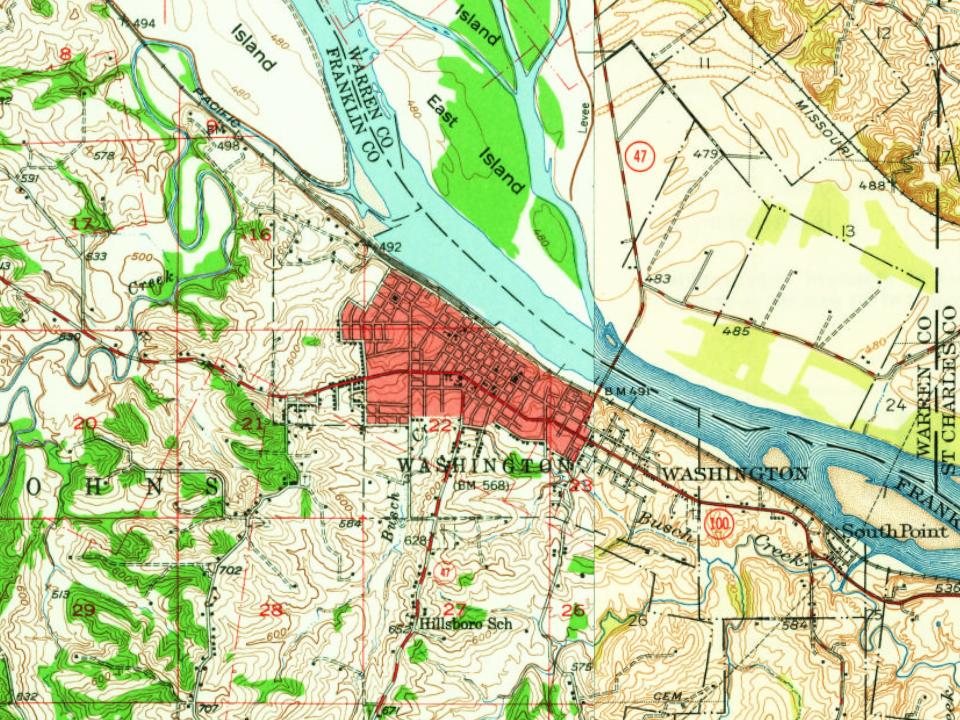
Washington, building by building, 1893–1916
Fire insurance maps drew every building, what it was made of and what it was used for, so insurers could price the risk of fire. Pick a year, then a sheet.
Named after George Washington after it came under American control, the town was first settled during the rule of the Spanish Empire. It was originally called St. John Meyer's Settlement and was the site of the Spanish log fort San Juan del Misuri (1796–1803).
Family and followers of Daniel Boone settled the area across the river from Washington, Missouri starting in 1799. In 1814 a ferry boat was licensed for crossing the Missouri River to the north, and the settlement became known as Washington Landing. In 1827 a town was laid out, with sale of lots starting in 1829. The cost of land was waived if the buyer could build a substantial house within two years. This encouraged many new settlers.
Passages that mention Washington, cut from the printed page as they were published.
Reminiscences of the bench and bar of Missouri [electronic resource]1878 · page 92Read the page →
Read the text
He was a graduate of Washington College, now known as Washington and Lee University. He finished his legal studies in his native place, and in the fall of 1829 came to Missouri, and in the spring following opened a law-office in the town of St. Charles. He made no effort to obtain business, but his ability soon became known, and from that time he was able to command any practice he wished. The next year he was sent to the General Assembly, and finally chosen
Text read by machine from the scan; it may contain errors.
Reminiscences of the bench and bar of Missouri [electronic resource]1878 · page 165Read the page →
Read the text
benefit of his health, and to escape the severe winters of the North, he visited his uncle, Dr. Joseph Lovell, who was the surgeon-general of the United States army, holding his office in Washington City. He remained in Washington about two years, during which time he was a pupil in a private school taught by Salmon P. Chase, who afterwards became so distinguished in life, filling successsively the positions of governor of Ohio, United States senator, secretary
Text read by machine from the scan; it may contain errors.
organized as the county of Washington, and extending nominally westward to the Mississippi. Soon after, some of the more daring pioneers made a settlement at Bledsoe’s Station, in Middle Tennes¬ see, in the heart of the Chickasaw nation, and separated several hundred miles, by the usual traveled route, from their kinsmen on the Holston. A number of French traders had previously estab¬ lished a trading post and erected a few cabins at the “Bluff” near the site of Nashville. To the same vicinity Colonel James
Text read by machine from the scan; it may contain errors.
Scans and text from the Internet Archive. Books published in 1930 or earlier, which are in the public domain.
Timeline
Washington, 1837 to 1959
Woven from the archive, old maps, post office records, the National Register and the people born here.
Nothing in the archives for these yearsWeddings on Main Street, storms, parades, school pictures, the old store. If it’s in your family album, it belongs here.
The Washington post office opened in 1837, the earliest record of the town by name (U.S. post office records).
How does Washington rank for history?
Washington is more historic than 91% of U.S. towns, #9 of 247 in Missouri. The History grade combines the town’s founding era, the share of homes built before 1940 and its National Register listings. It’s a character grade, so it isn’t part of the overall grade. How it works.
What is on the National Register in Washington?
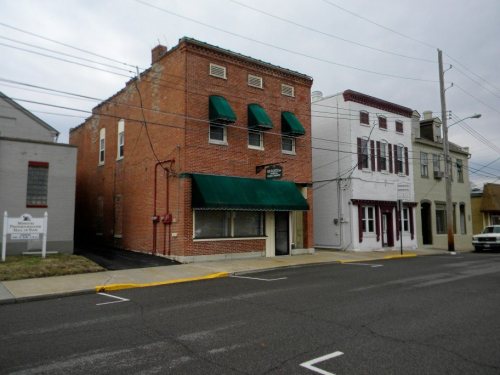
41 listings: 35 buildings, among them the Franz Schwarzer House (listed 1978, the first), and 6 historic districts with 397 contributing buildings. 445 historic buildings in all.
How old are the homes in Washington?
17% of Washington’s homes were built before 1940 (Census estimate, ±3.9 points), against a typical 8.4% for a Missouri town; the median home was built in 1978.
Founding dates: Wikidata, Wikipedia, the U.S. post office records of Blevins & Helbock (CC0) and the Census. Homes by year built: Census ACS 2020–24. National Register of Historic Places: National Park Service (list of May 22, 2026). Old photos, postcards and papers: Wikimedia Commons, the Library of Congress and other public archives, credited on each item’s page. Maps: U.S. Geological Survey historical topographic maps (via Esri) and Sanborn fire-insurance maps (Library of Congress). History text and census tables: Wikipedia (CC BY-SA 4.0). Places that used to be: USGS Geographic Names Information System (2021).
From Wikimedia Commons (9), the Library of Congress (3), the National Register of Historic Places (41), Wikipedia, Wikidata and Wikipedia for famous people, U.S. Geological Survey historical maps, U.S. Census counts (via Wikipedia), the US Post Offices dataset (Blevins & Helbock), the USGS Geographic Names Information System, Sanborn fire insurance maps (Library of Congress) and old county and town histories (Internet Archive). Archive images are copied here with their credits and licenses, shown on each photo’s page. Refreshed monthly.





 1882
 c. 1885
 c. 1890
 1908
 1908
 1908
 1908
 1908