More historic than 19% of U.S. towns · #219 of 273 in Minnesota. What drives it
Most of Little Canada was built recently: 4% of its homes predate 1940 and the median home dates from 1979. Below: maps from 1902 on and the census since 1960.
Founding year: the first Little Canada post office (Blevins & Helbock, CC0). Wikidata: 1953.The full story ↓
History grade
What drives Little Canada’s History grade
On its age, its old homes and the National Register, Little Canada is more historic than 19% of U.S. towns, #219 of 273 in Minnesota. Its age holds the grade up; its National Register listings pull it down.
C−
HistoryA character grade: shown, never part of Little Canada’s overall grade.
Minnesota towns list about as much on the Register as the country (a typical Minnesota town has 2.1 per 10,000 residents, the U.S. 2.4), so Little Canada’s 0.0 sits below most of its state (23% of Minnesota towns have fewer) while its 0 listings outnumber those of 23% of U.S. towns.
How sure. Graded on any two of the three inputs instead, the letter would still be C−. The pre-1940 share (±2.1 points) is firm at this size. The founding year is the first post office, not a stated founding date; Wikidata gives 1953.
Founding year: the first post office (other dates in Quick answers). Homes: Census ACS 2020–24. National Register: National Park Service, May 2026 list; each listing counted once (boundary changes and added documentation belong to their listing), and a historic district counts its contributing buildings. How TownRatings grades history →
What stands out about Little Canada’s past
Read from the archive, the National Register and the record. The page puts what stands out first.
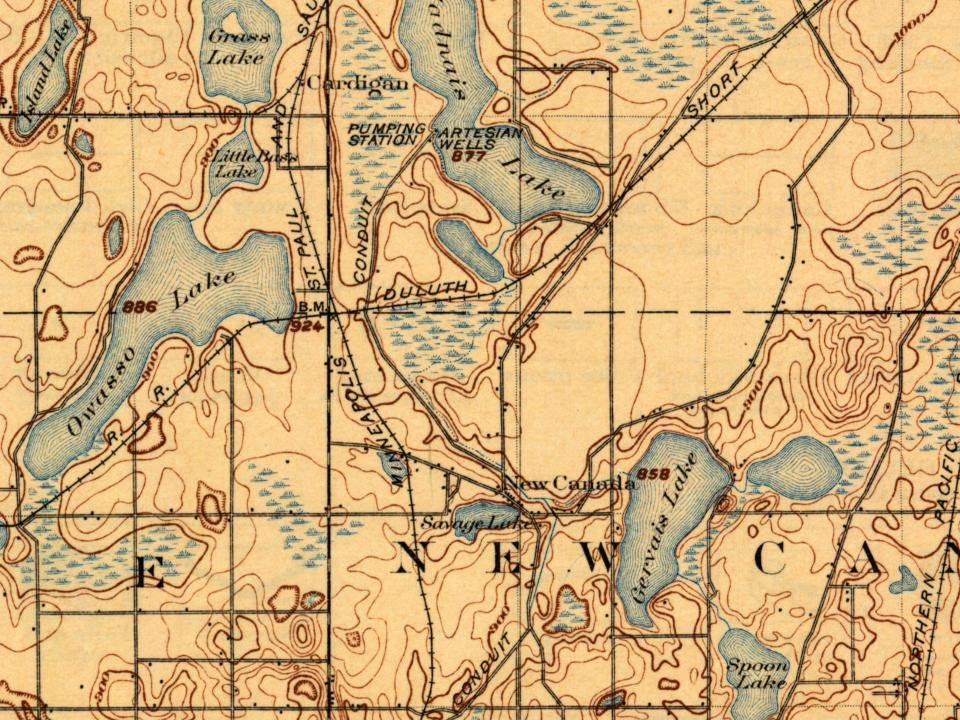
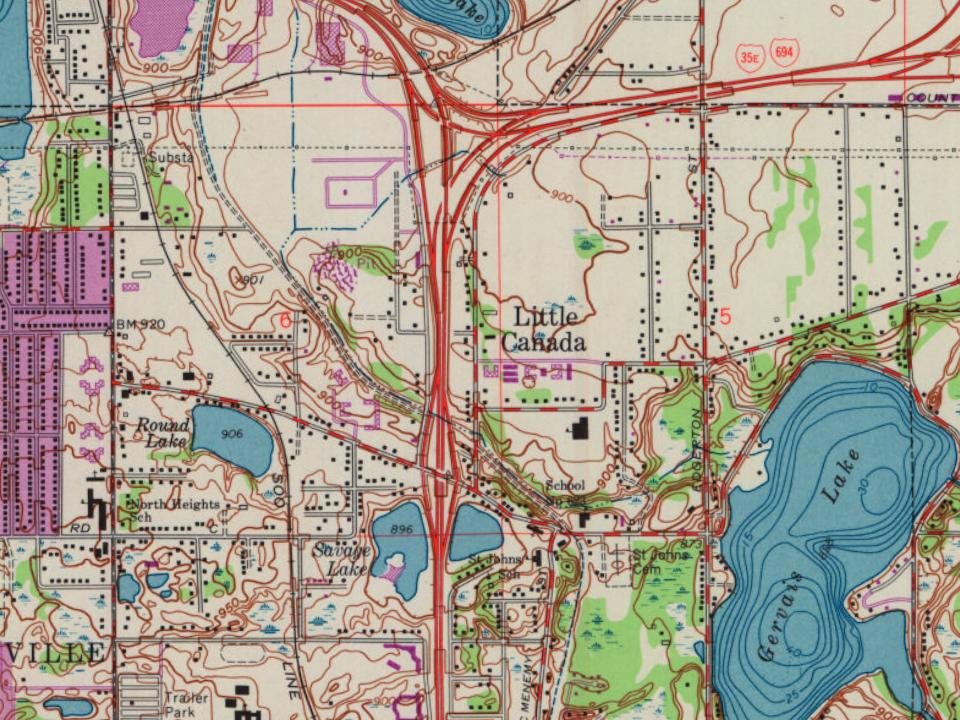
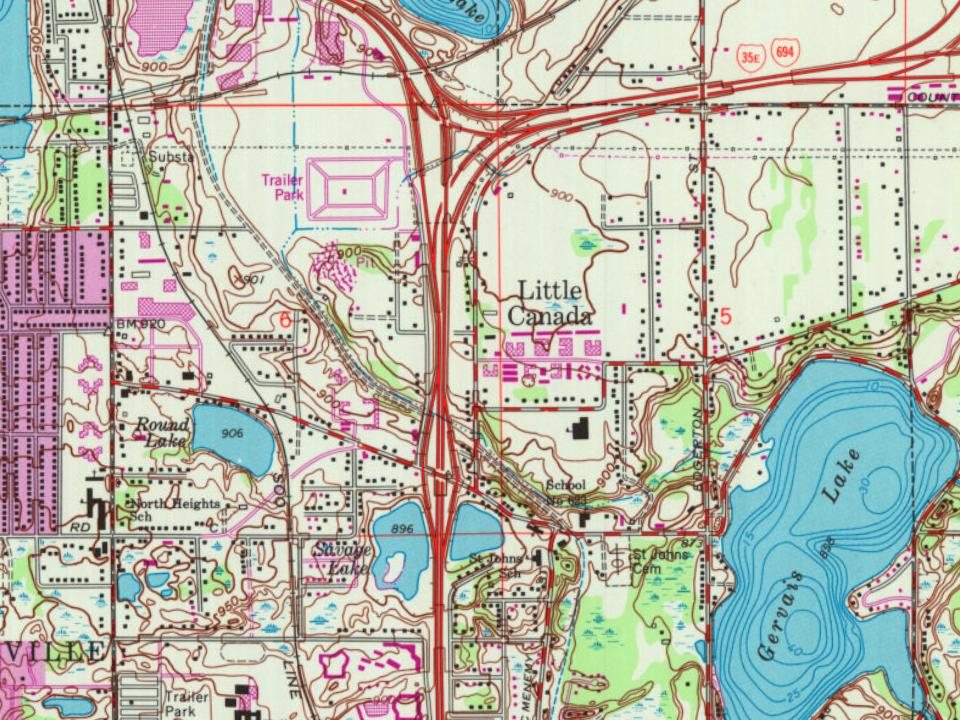
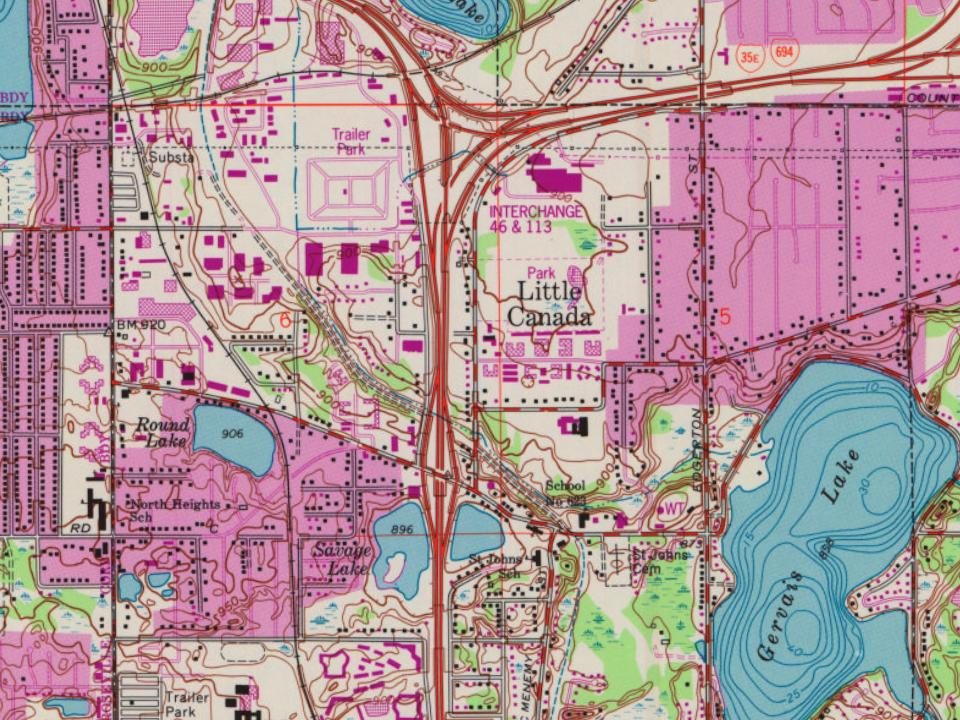
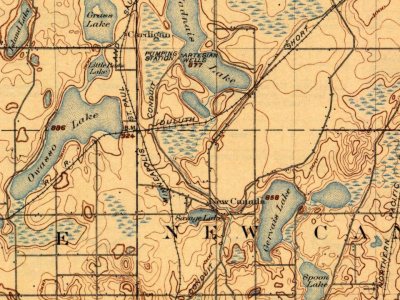
Every edition of the U.S. Geological Survey’s map of Little Canada. Tap a year, or press play to watch the town change.
1902White Bear sheet · 1:62,500
U.S. Geological Survey historical topographic maps (public domain), via Esri’s collection of the scans. The red ring marks the center of Little Canada.
In 1844, French Canadian settler Benjamin Gervais moved north from Saint Paul to claim land in order to build the first grist mill in Minnesota that was independent from the government. The large lake on the east side of Little Canada bears his name (Lake Gervais). The grist mill was converted into a park, which is recognized as the birthplace of the city. Little Canada began as the township of New Canada in 1858. In the 1950s, the township was threatened by the suburban sprawl of the ensuing larger communities that were formed, such as Maplewood. In 1953, the city leaders came together and established the village of Little Canada. It became a city in 1974.
Passages that mention Little Canada, cut from the printed page as they were published.
History of Ramsey County and the city of St. Paul, including the Explorers and pioneers of Minnesota1881 · page 185Read the page →
Read the text
During this year. Little Canada was settled, a more extended account of which will be given in the sketch of that township, in a later iiart of this work.
Text read by machine from the scan; it may contain errors.
History of Ramsey County and the city of St. Paul, including the Explorers and pioneers of Minnesota1881 · page 292Read the page →
Read the text
The first school organization effected in what is now the town of New Canada, was in 1850, by the French people who were the early settlers at what was known as Little Canada, now known as St. John's City. The officers were, Alexander Ducharme, Joseph Leboure and Rev. Father Fayolle then priest at this point; the first schoolhouse was of logs, located near the site of the
Text read by machine from the scan; it may contain errors.
Scans and text from the Internet Archive. Books published in 1930 or earlier, which are in the public domain.
Timeline
Little Canada, 1852 to 1997
Woven from the archive, old maps, post office records, the National Register and the people born here.
The Little Canada post office opened in 1852, the earliest record of the town by name (U.S. post office records). Wikidata gives 1953.
How does Little Canada rank for history?
Little Canada is more historic than 19% of U.S. towns, #219 of 273 in Minnesota. The History grade combines the town’s founding era, the share of homes built before 1940 and its National Register listings. It’s a character grade, so it isn’t part of the overall grade. How it works.
How old are the homes in Little Canada?
4% of Little Canada’s homes were built before 1940 (Census estimate, ±2.1 points), against a typical 8.1% for a Minnesota town; the median home was built in 1979.
Founding dates: Wikidata, Wikipedia, the U.S. post office records of Blevins & Helbock (CC0) and the Census. Homes by year built: Census ACS 2020–24. National Register of Historic Places: National Park Service (list of May 22, 2026). Old photos, postcards and papers: Wikimedia Commons, the Library of Congress and other public archives, credited on each item’s page. Maps: U.S. Geological Survey historical topographic maps (via Esri) and Sanborn fire-insurance maps (Library of Congress). History text and census tables: Wikipedia (CC BY-SA 4.0). Places that used to be: USGS Geographic Names Information System (2021).
From Wikimedia Commons (6), Wikipedia, Wikidata and Wikipedia for famous people, U.S. Geological Survey historical maps, U.S. Census counts (via Wikipedia), the US Post Offices dataset (Blevins & Helbock), the USGS Geographic Names Information System and old county and town histories (Internet Archive). Archive images are copied here with their credits and licenses, shown on each photo’s page. Refreshed monthly.





 2011
 2011
 2011
 2011
 2011
 2005