Founding year: the first Fosston post office (Blevins & Helbock, CC0). Wikidata: 1889.The full story ↓
History grade
What drives Fosston’s History grade
On its age, its old homes and the National Register, Fosston is more historic than 43% of U.S. towns. Its share of homes from before 1940 holds the grade up; its National Register listings pull it down.
C+
HistoryA character grade: shown, never part of Fosston’s overall grade.
Minnesota towns list about as much on the Register as the country (a typical Minnesota town has 2.1 per 10,000 residents, the U.S. 2.4), so Fosston’s 0.0 sits below most of its state (23% of Minnesota towns have fewer) while its 0 listings outnumber those of 23% of U.S. towns.
How sure. Graded on any two of the three inputs instead, the letter would range from C− to B. The pre-1940 share is a Census survey estimate (±6.1 points). The founding year is the first post office, not a stated founding date; Wikidata’s 1889 falls in the same era, so the grade doesn’t depend on which one is used.
Founding year: the first post office (other dates in Quick answers). Homes: Census ACS 2020–24. National Register: National Park Service, May 2026 list; each listing counted once (boundary changes and added documentation belong to their listing), and a historic district counts its contributing buildings. How TownRatings grades history →
What stands out about Fosston’s past
Read from the archive, the National Register and the record. The page puts what stands out first.
Fire insurance maps drew every building, what it was made of and what it was used for, so insurers could price the risk of fire. Pick a year, then a sheet.
In 1876, the first white settlers came to the Fosston area, arriving in covered wagons, bringing with them a few cattle, oxen, horses and mules. Charles Adair was the first to file a claim on the land, with nine others soon following. Fosston is in sections 3 and 4 of Rosebud Township, and was named after Louis Foss, an immigrant from the Nyttingnes, a village in Sogn og Fjordane county, Norway. The townsite was organized by W. J. Hilligoss, who selected and purchased it in 1884, had it surveyed, platted a four-block area, and built a hotel. Hilligoss died in 1941. The town was named Fosston when Foss moved his store and opened a post office there. The village was incorporated on August 22, 1895. The incorporation papers of Fosston were recorded on June 8, 1889, by the Register of Deeds in Crookston. Fosston was a busy depot on the Great Northern Railway line.
Passages that mention Fosston, cut from the printed page as they were published.
Compendium of history and biography of Polk County, Minnesota1916 · page 94Read the page →
Read the text
In the year 1883 Albert Kaiser went to Fosston, and founded the well known journal called the Thirteen Towns. He possessed the rare combination of a good newspaper man and a good business man. In a year or two he had saved enough money to go into the banking business at Fosston, and sold the Thirteen Towns to W. A. Foss, who is still conducting it successfully.
Text read by machine from the scan; it may contain errors.
Compendium of history and biography of Polk County, Minnesota1916 · page 235Read the page →
Read the text
his private interests, he has aided in the promotion of important business activities and is a stockholder in the Farmers Elevator and Cooperative store companies at Fosston and in the elevator company at Trail, located on the Soo railroad and about five miles north of his farm which is situated ten and a half miles northeast of Fosston. Mr. Engebretson has
Text read by machine from the scan; it may contain errors.
Scans and text from the Internet Archive. Books published in 1930 or earlier, which are in the public domain.
Timeline
Fosston, 1883 to 1983
Woven from the archive, old maps, post office records, the National Register and the people born here.
Nothing in the archives for these yearsWeddings on Main Street, storms, parades, school pictures, the old store. If it’s in your family album, it belongs here.
The Fosston post office opened in 1883, the earliest record of the town by name (U.S. post office records). Wikidata gives 1889.
How does Fosston rank for history?
Fosston is more historic than 43% of U.S. towns. The History grade combines the town’s founding era, the share of homes built before 1940 and its National Register listings. It’s a character grade, so it isn’t part of the overall grade. How it works.
How old are the homes in Fosston?
24% of Fosston’s homes were built before 1940 (Census estimate, ±6.1 points), against a typical 8.1% for a Minnesota town; the median home was built in 1965.
Founding dates: Wikidata, Wikipedia, the U.S. post office records of Blevins & Helbock (CC0) and the Census. Homes by year built: Census ACS 2020–24. National Register of Historic Places: National Park Service (list of May 22, 2026). Old photos, postcards and papers: Wikimedia Commons, the Library of Congress and other public archives, credited on each item’s page. Maps: U.S. Geological Survey historical topographic maps (via Esri) and Sanborn fire-insurance maps (Library of Congress). History text and census tables: Wikipedia (CC BY-SA 4.0). Places that used to be: USGS Geographic Names Information System (2021).
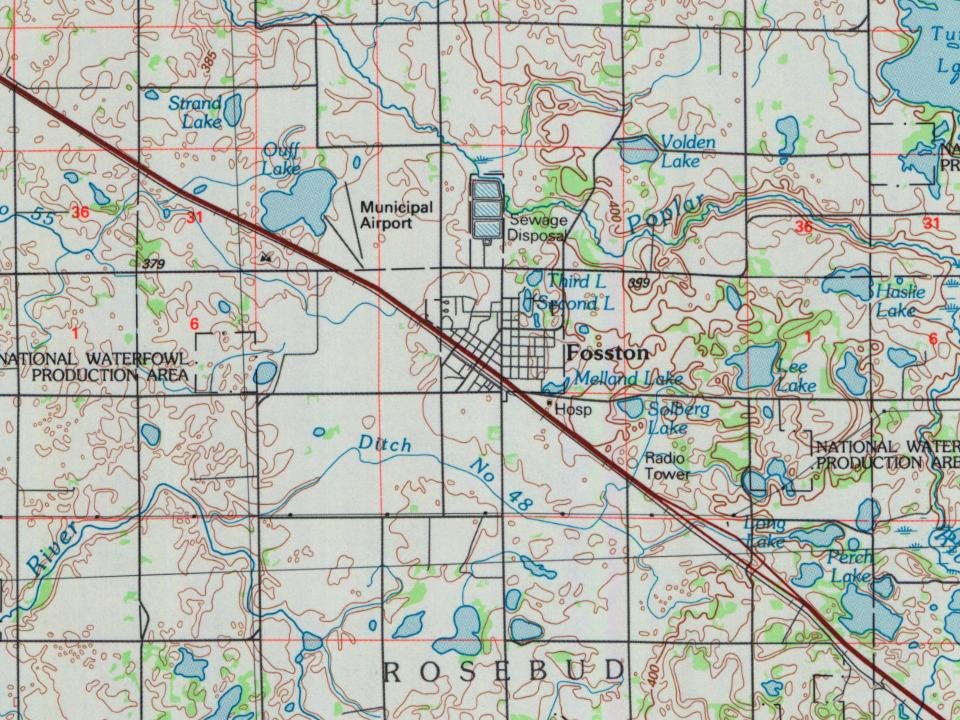
From Wikimedia Commons (1), the Library of Congress (2), Wikipedia, Wikidata and Wikipedia for famous people, U.S. Geological Survey historical maps, U.S. Census counts (via Wikipedia), the US Post Offices dataset (Blevins & Helbock), the USGS Geographic Names Information System, Sanborn fire insurance maps (Library of Congress) and old county and town histories (Internet Archive). Archive images are copied here with their credits and licenses, shown on each photo’s page. Refreshed monthly.


 1910