Founding year: the first Cottonwood post office (Blevins & Helbock, CC0).
History grade
What drives Cottonwood’s History grade
On its age, its old homes and the National Register, Cottonwood is more historic than 70% of U.S. towns. Its share of homes from before 1940 holds the grade up; its age pulls it down.
B+
HistoryA character grade: shown, never part of Cottonwood’s overall grade.
Minnesota towns list about as much on the Register as the country (a typical Minnesota town has 2.1 per 10,000 residents, the U.S. 2.4), so Cottonwood’s 18.9 sits above most of its state (83% of Minnesota towns have fewer) while its 2 historic buildings outnumber those of 60% of U.S. towns.
How sure. Graded on any two of the three inputs instead, the letter would range from B to A−. The pre-1940 share is a Census survey estimate (±8.8 points). The founding year is the first post office, not a stated founding date.
Founding year: the first post office (other dates in Quick answers). Homes: Census ACS 2020–24. National Register: National Park Service, May 2026 list; each listing counted once (boundary changes and added documentation belong to their listing), and a historic district counts its contributing buildings. How TownRatings grades history →
What stands out about Cottonwood’s past
Read from the archive, the National Register and the record. The page puts what stands out first.
Wikipedia doesn’t have a history of Cottonwood yet. The photos, dates and memories neighbors add here are how it gets written.
Cottonwood is a city in Lyon County, Minnesota, United States. The population was 1,149 at the 2020 census.
Its first post office opened in 1888. Between the 2010 and 2020 censuses its population fell from 1,212 to 1,149 (-5%).
Intro from Wikipedia. Population: U.S. Census Bureau.
From the old history books
What they wrote about Cottonwood, 1912–1916
Passages that mention Cottonwood, cut from the printed page as they were published.
History of Cottonwood and Watonwan counties, Minnesota1916 · page 123Read the page →
Read the text
Amo was formed as a civil township of Cottonwood county in February, 1873, at a special meeting of the board of county commissioners. It was effected through a petition signed by the legal voters of township 108, ranges 37 and 38, asking that they be set off as a separate civil township, to be known as Amo, the territory formerly being included in Westbrook township. The first election was held March 4, 1873, at the school house in district No. 4. in township 108, range 37, west.
Text read by machine from the scan; it may contain errors.
History of Cottonwood and Watonwan counties, Minnesota1916 · page 277Read the page →
Read the text
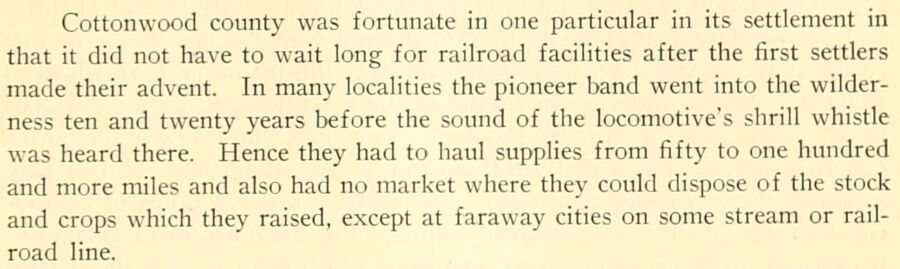
Cottonwood county was fortunate in one particular in its settlement in that it did not have to wait long for railroad facilities after the first settlers made their advent. In many localities the pioneer band went into the wilderness ten and twenty years before the sound of the locomotive's shrill whistle was heard there. Hence they had to haul supplies from fifty to one hundred and more miles and also had no market where they could dispose of the stock and crops which they raised, except at faraway cities on some stream or railroad line.
Text read by machine from the scan; it may contain errors.
An illustrated history of Lyon County, Minnesota1912 · page 236Read the page →
Read the text
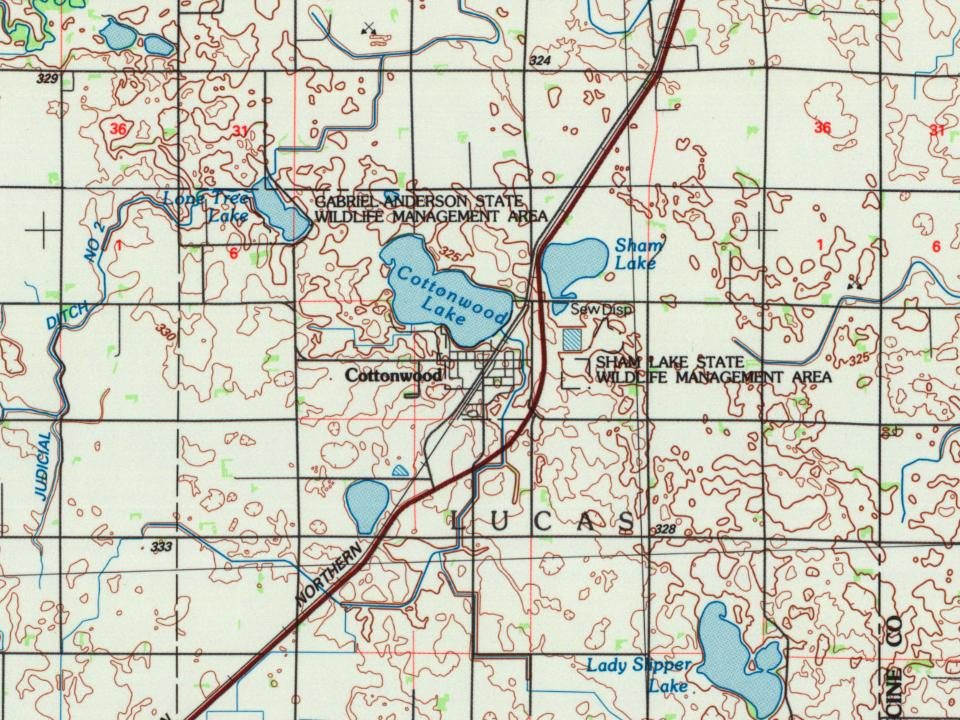
One of the most beautiful lakes in the county is Cottonwood lake, on whose shores the village of Cottonwood is situated. It is a small body of water and has some timber on its shores.
Text read by machine from the scan; it may contain errors.
An illustrated history of Lyon County, Minnesota1912 · page 189Read the page →
Read the text
railroad was built through the county in 1888 northeastern Lyon county became rapidly filled with settlers and the village of Cottonwood was founded and had a rapid growth. It will be remembered that the prexThe Marshall News-Messenger of November 11, 1887, said: "While we have not official authority for
Text read by machine from the scan; it may contain errors.
Scans and text from the Internet Archive. Books published in 1930 or earlier, which are in the public domain.
By decade
No old photos in the archives yet
Weddings on Main Street, storms, parades, school pictures, the old store. If it’s in your family album, it belongs here.
Be the first to add onePhotograph a print flat, in daylight, no flash.
The Cottonwood post office opened in 1888, the earliest record of the town by name (U.S. post office records).
How does Cottonwood rank for history?
Cottonwood is more historic than 70% of U.S. towns. The History grade combines the town’s founding era, the share of homes built before 1940 and its National Register listings. It’s a character grade, so it isn’t part of the overall grade. How it works.
What is on the National Register in Cottonwood?
One place: the Martin Norseth House (listed 1982).
How old are the homes in Cottonwood?
24% of Cottonwood’s homes were built before 1940 (Census estimate, ±8.8 points), against a typical 8.1% for a Minnesota town; the median home was built in 1973.
Founding dates: Wikidata, Wikipedia, the U.S. post office records of Blevins & Helbock (CC0) and the Census. Homes by year built: Census ACS 2020–24. National Register of Historic Places: National Park Service (list of May 22, 2026). Old photos, postcards and papers: Wikimedia Commons, the Library of Congress and other public archives, credited on each item’s page. Maps: U.S. Geological Survey historical topographic maps (via Esri) and Sanborn fire-insurance maps (Library of Congress). History text and census tables: Wikipedia (CC BY-SA 4.0). Places that used to be: USGS Geographic Names Information System (2021).
From Wikidata (1), the National Register of Historic Places (1), U.S. Geological Survey historical maps, U.S. Census counts (via Wikipedia), the US Post Offices dataset (Blevins & Helbock), the USGS Geographic Names Information System and old county and town histories (Internet Archive). Archive images are copied here with their credits and licenses, shown on each photo’s page. Refreshed monthly.