Founding year: Wikidata. First post office: 1834.The full story ↓
History grade
What drives Homer’s History grade
On its age, its old homes and the National Register, Homer is more historic than 98% of U.S. towns. All 3 inputs are above most U.S. towns; its National Register listings ranks highest and its age lowest.
A+
HistoryA character grade: shown, never part of Homer’s overall grade.
Few Michigan towns list much on the Register (a typical Michigan town has 0.0 per 10,000 residents, the U.S. 2.4), so Homer’s 1,161 sits above most of its state (99% of Michigan towns have fewer) while its 187 historic buildings outnumber those of 93% of U.S. towns.
How sure. Graded on any two of the three inputs instead, the letter would range from A to A+. The pre-1940 share is a Census survey estimate (±9.4 points). Two sources give 1832.
Founding year: Wikidata (other dates in Quick answers). Homes: Census ACS 2020–24. National Register: National Park Service, May 2026 list; each listing counted once (boundary changes and added documentation belong to their listing), and a historic district counts its contributing buildings. How TownRatings grades history →
What stands out about Homer’s past
Read from the archive, the National Register and the record. The page puts what stands out first.
Fire insurance maps drew every building, what it was made of and what it was used for, so insurers could price the risk of fire. Pick a year, then a sheet.
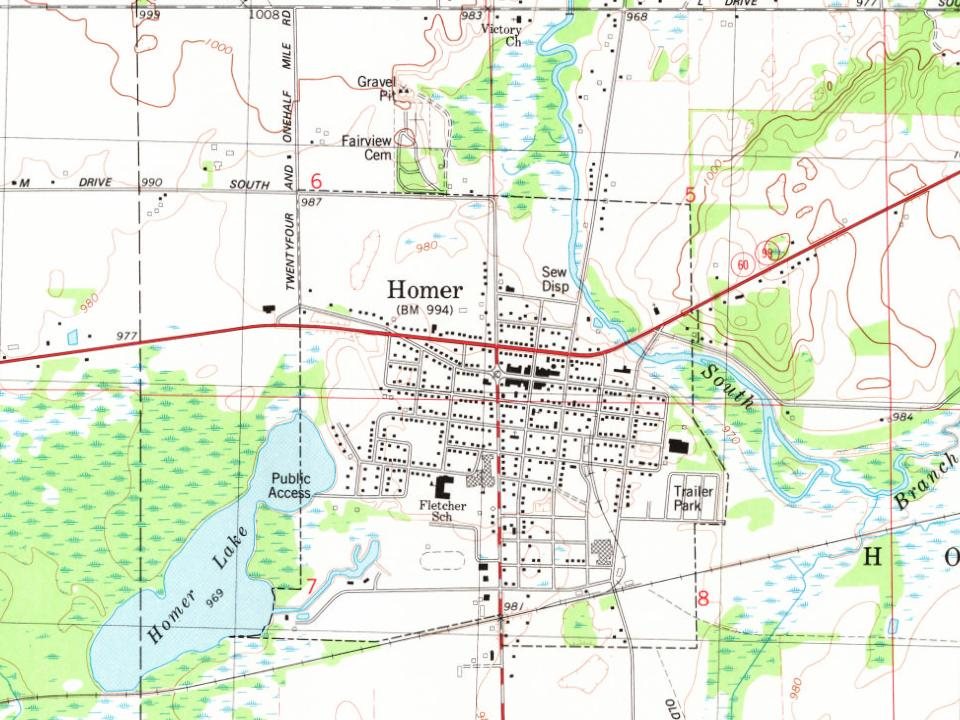
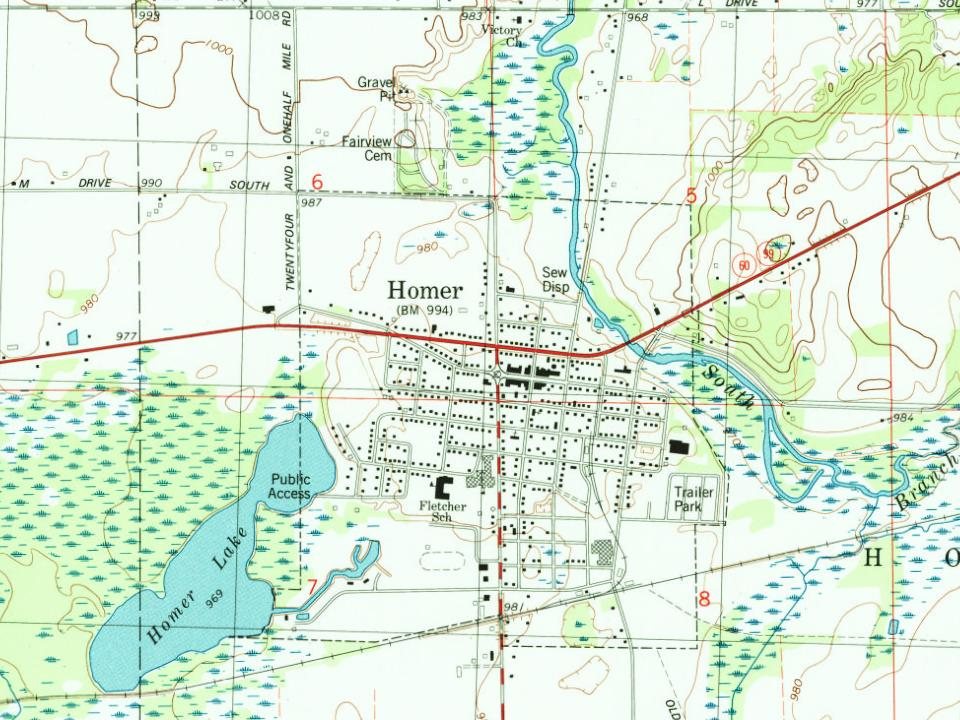
Milton Barney arrived from Lyons, New York the summer of 1832 to scout the area and returned that September with his family and workmen to settle on the south bank of the Kalamazoo River in Section 5. Soon after Barney hired Osha Wilder to layout the plat for the village of Barneyville on the SW corner of Section 5, SE corner of Section 6, NE corner of Section 7, and NW corner of Section 8. For more a detailed history of the surrounding area see the entry for Homer Township and Clarendon Township.
Passages that mention Homer, cut from the printed page as they were published.
History of Calhoun county, Michigan1913 · page 189Read the page →
Read the text
By aet of the legislative eouneil in 1834, the township of Homer was organized with an area of twelve mile square. For judicial purposes this tract embraced the present townships of Homer, Albion, Eckford and Clarendon. The early settlers bunched their holdings, resulting in the formation of settlements in diiTerent sections with Homer as a sort of center. ^Vhat for many years was known as the Pennsylvania settlement on the plains northeast of Homer was begun in 1832, when Henry and Richard ^IcBIurtrie and Powell Grover, all single men, came in from
Text read by machine from the scan; it may contain errors.
History of Calhoun county, Michigan1913 · page 20Read the page →
Read the text
Battle Creek and Albion, other parts of the county were by no means passed by. In 1832, Henry and Richard McMurtrie, Powell Grover and William Wintersteen, all from Pennsylvania, settled within the limits of the present township of Homer. In the same year last named, Henry Cook located on what is now known as Cook's Plains, northwest of Homer Village but in the present township of Eckford. The same year also, Anthony Doolittle, coming direct from Ohio, though originally from the State of New York, settled in what is now the township of Claren-
Text read by machine from the scan; it may contain errors.
Scans and text from the Internet Archive. Books published in 1930 or earlier, which are in the public domain.
By decade
Homer, decade by decade
One decade in the archive so far: the 1910s. Scroll each row; tap a photo for its story.
Nothing in the archives for these yearsWeddings on Main Street, storms, parades, school pictures, the old store. If it’s in your family album, it belongs here.
In 1832, according to Wikidata. Homer’s post office opened in 1834, and the census of 1870 counted 685 people here.
How does Homer rank for history?
Homer is more historic than 98% of U.S. towns. The History grade combines the town’s founding era, the share of homes built before 1940 and its National Register listings. It’s a character grade, so it isn’t part of the overall grade. How it works.
How old are the homes in Homer?
37% of Homer’s homes were built before 1940 (Census estimate, ±9.4 points), against a typical 12% for a Michigan town; the median home was built in 1956.
Founding dates: Wikidata, Wikipedia, the U.S. post office records of Blevins & Helbock (CC0) and the Census. Homes by year built: Census ACS 2020–24. National Register of Historic Places: National Park Service (list of May 22, 2026). Old photos, postcards and papers: Wikimedia Commons, the Library of Congress and other public archives, credited on each item’s page. Maps: U.S. Geological Survey historical topographic maps (via Esri) and Sanborn fire-insurance maps (Library of Congress). History text and census tables: Wikipedia (CC BY-SA 4.0). Places that used to be: USGS Geographic Names Information System (2021).
From Wikimedia Commons (5), Wikidata (1), Wikipedia, Wikidata and Wikipedia for famous people, U.S. Geological Survey historical maps, U.S. Census counts (via Wikipedia), Sanborn fire insurance maps (Library of Congress) and old county and town histories (Internet Archive). Archive images are copied here with their credits and licenses, shown on each photo’s page. Refreshed monthly.


 2019
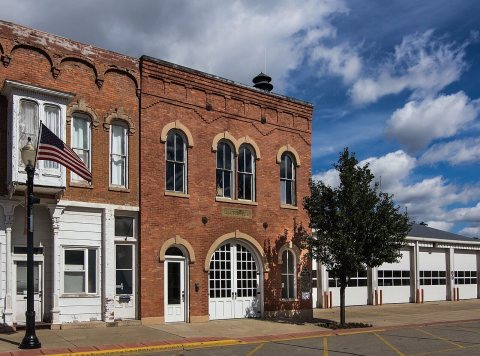 2018
 2016
 2005