More historic than 41% of U.S. towns · #455 of 701 in Michigan. What drives it
Most of Grand Blanc was built recently: 5% of its homes predate 1940 and the median home dates from 1973. Below: 2 old photos and papers, maps from 1920 on, and the census since 1880.
Founding year: Wikidata. First post office: 1834.The full story ↓
History grade
What drives Grand Blanc’s History grade
On its age, its old homes and the National Register, Grand Blanc is more historic than 41% of U.S. towns, #455 of 701 in Michigan. Its age holds the grade up; its National Register listings pull it down.
C+
HistoryA character grade: shown, never part of Grand Blanc’s overall grade.
Few Michigan towns list much on the Register (a typical Michigan town has 0.0 per 10,000 residents, the U.S. 2.4), so Grand Blanc’s 0.0 sits below most of its state (32% of Michigan towns have fewer) while its 0 listings outnumber those of 23% of U.S. towns.
How sure. Graded on any two of the three inputs instead, the letter would range from C− to B−. The pre-1940 share is a Census survey estimate (±3.0 points). Two sources give 1823.
Founding year: Wikidata (other dates in Quick answers). Homes: Census ACS 2020–24. National Register: National Park Service, May 2026 list; each listing counted once (boundary changes and added documentation belong to their listing), and a historic district counts its contributing buildings. How TownRatings grades history →
What stands out about Grand Blanc’s past
Read from the archive, the National Register and the record. The page puts what stands out first.
The unincorporated village of Grand Blanc, or Grumlaw, was a former Indian campground first settled by Jacob Stevens in 1822. Several years later, settlers improved the Indian trail to Saginaw; they laid out and staked it in 1829 as Saginaw Road. Grand Blanc Township formed in 1833 in an area that became the city. The township center began to boom in 1864 with the arrival of the railroad (now known as the CSX Saginaw Subdivision). With the post office there, the village was called Grand Blanc Centre by 1873, with the former Grand Blanc assuming the name Gibsonville.
Passages that mention Grand Blanc, cut from the printed page as they were published.
History of Genesee county, Michigan. With illustrations and biographical sketches of its prominent men and pioneers1879 · page 41Read the page →
Read the text
corporated by act approved April 3, 1848, with power " to lay out, establish, and construct a plank-road and all necessary buildings from the village of Flint to the south line of the township of Grand Blanc, on the Saginaw road, in the county of Genesee, with the privilege of uniting at any point with the road of any other company." The capital stock was placed at twenty-five thousand dollars, and the powers of the company to continue for the term of sixty
Text read by machine from the scan; it may contain errors.
History of Genesee county, Michigan. With illustrations and biographical sketches of its prominent men and pioneers1879 · page 242Read the page →
Read the text
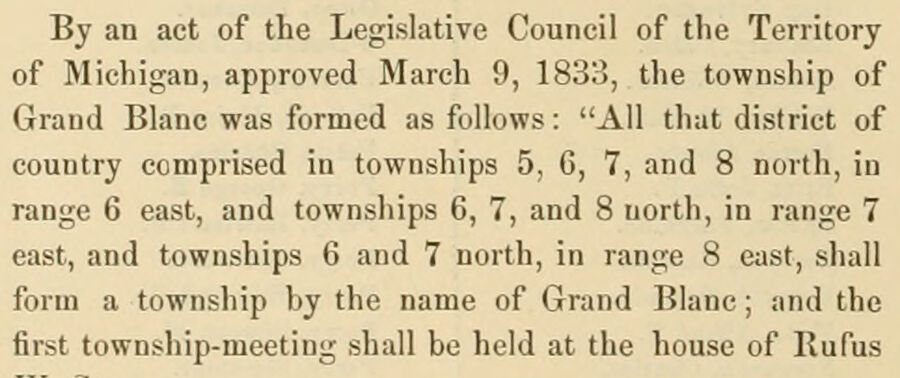
By an act of the Legislative Council of the Territory of Michigan, approved March 9, 1833, the township of Grand Blanc was formed as follows : "All that district of country comprised in townships 5, 6, 7, and 8 north, in range 6 east, and townships 6, 7, and 8 north, in range 7 east, and townships 6 and 7 north, in range 8 east, shall form a township by the name of Grand Blanc ; and the first township-meeting shall be held at the house of Rufus
Text read by machine from the scan; it may contain errors.
History of Genesee county Michigan1916 · page 741Read the page →
Read the text
selling goods. He followed that business one year, after which he purcased a grain elevator at Grand Blanc, where he did a very good business over a wide territory. Four years later he sold his interests in the elevator, and bought a half interest in the elevator at Fenton, but sold out a year later, trading for a farm two miles west of Grand Blanc, where he lived until the death of his wife's father, when he bought out the interest of the other heirs of the Parsons estate, two miles south of Grand Blanc, and on that place he lived for some years, then moved to Grand Blanc, where he
Text read by machine from the scan; it may contain errors.
History of Genesee county Michigan1916 · page 849Read the page →
Read the text
C. Wortman, who is now living in Grand Blanc. Ward H. Parker spent two years in the Flint high school and later became a student in Michigan Agricultural College, where he remained in continuous attendance for five years. After graduating with the degree of Bachelor of Science in 1908, he taught chemistry for three years. He then took charge of his father's farm, the latter moving into the village of Grand Blanc. His next move found him employed by the United States department of agriculture as county agriculturist of Genesee comity, a position he
Text read by machine from the scan; it may contain errors.
Scans and text from the Internet Archive. Books published in 1930 or earlier, which are in the public domain.
By decade
Grand Blanc, decade by decade
2 decades in the archive, from the 1890s to the 1990s. Scroll each row; tap a photo for its story.
Nothing in the archives for these yearsWeddings on Main Street, storms, parades, school pictures, the old store. If it’s in your family album, it belongs here.
Between 216 and 8,276 people in every census since 1880.
11 censuses, 1880–2020.
U.S. Census Bureau decennial counts, from the census table on Grand Blanc’s Wikipedia page.
Questions about Grand Blanc’s history
What year was Grand Blanc founded?
In 1823, according to Wikidata. Grand Blanc’s post office opened in 1834, and the census of 1880 counted 216 people here.
How does Grand Blanc rank for history?
Grand Blanc is more historic than 41% of U.S. towns, #455 of 701 in Michigan. The History grade combines the town’s founding era, the share of homes built before 1940 and its National Register listings. It’s a character grade, so it isn’t part of the overall grade. How it works.
How old are the homes in Grand Blanc?
5% of Grand Blanc’s homes were built before 1940 (Census estimate, ±3.0 points), against a typical 12% for a Michigan town; the median home was built in 1973.
Founding dates: Wikidata, Wikipedia, the U.S. post office records of Blevins & Helbock (CC0) and the Census. Homes by year built: Census ACS 2020–24. National Register of Historic Places: National Park Service (list of May 22, 2026). Old photos, postcards and papers: Wikimedia Commons, the Library of Congress and other public archives, credited on each item’s page. Maps: U.S. Geological Survey historical topographic maps (via Esri) and Sanborn fire-insurance maps (Library of Congress). History text and census tables: Wikipedia (CC BY-SA 4.0). Places that used to be: USGS Geographic Names Information System (2021).
From Wikimedia Commons (6), Wikipedia, U.S. Geological Survey historical maps, U.S. Census counts (via Wikipedia), the US Post Offices dataset (Blevins & Helbock), the USGS Geographic Names Information System and old county and town histories (Internet Archive). Archive images are copied here with their credits and licenses, shown on each photo’s page. Refreshed monthly.




 2015
 2015
 2014
 2012