Founding year: Wikidata. First post office: 1851.The full story ↓
History grade
What drives Frankenmuth’s History grade
On its age, its old homes and the National Register, Frankenmuth is more historic than 52% of U.S. towns, #340 of 701 in Michigan. Its age holds the grade up; its National Register listings pull it down.
B−
HistoryA character grade: shown, never part of Frankenmuth’s overall grade.
Few Michigan towns list much on the Register (a typical Michigan town has 0.0 per 10,000 residents, the U.S. 2.4), so Frankenmuth’s 0.0 sits below most of its state (32% of Michigan towns have fewer) while its 0 listings outnumber those of 23% of U.S. towns.
How sure. Graded on any two of the three inputs instead, the letter would range from C to B+. The pre-1940 share is a Census survey estimate (±4.2 points). Two sources give 1845.
Founding year: Wikidata (other dates in Quick answers). Homes: Census ACS 2020–24. National Register: National Park Service, May 2026 list; each listing counted once (boundary changes and added documentation belong to their listing), and a historic district counts its contributing buildings. How TownRatings grades history →
What stands out about Frankenmuth’s past
Read from the archive, the National Register and the record. The page puts what stands out first.
The area was settled and named by conservative Lutheran immigrants from Roßtal area of Franconia in Germany. The group of settlers left Germany aboard the Caroline on April 20, 1845, and arrived at Castle Garden in New York seven weeks later. They traveled via canals and the Great Lakes from New York to Detroit and arrived in August 1845. Sailing then on the Nelson Smith, the settlers made their way to Saginaw and traveled over land to what is now the city of Frankenmuth.
Passages that mention Frankenmuth, cut from the printed page as they were published.
History of Saginaw County, Michigan1881 · page 836Read the page →
Read the text
Anotlie frame building constructed in 1880, is located within the village of Frankenmuth. It is well-ordered, commodious and a telling monument to the zeal of the German settlers. The schools are German almost in every feature. The elementary American courses are taught, but the cultivation of the German language is the main object. They may be considered denominational in the fnllese sense of the term.
Text read by machine from the scan; it may contain errors.
History of Saginaw County, Michigan1881 · page 835Read the page →
Read the text
and under the jurisdiction of Saginaw county, in the State of Michigan; and be it further ordered that the first annual meeting for election of township officers in said township be held at the old church in said township of Frankenmuth on the first Monda}7 in April next ensuing, and that the following named persons, to-wit: G. A. Ranzenberger, G. M. Shafer and A. Koch, being three electors of said township, be, and they are, hereby designated and appointed to preside at such election, and to perform all the duties
Text read by machine from the scan; it may contain errors.
History of Saginaw County, Michigan1881 · page 835Read the page →
Read the text
and under the jurisdiction of Saginaw county, in the State of Michigan ; and be it further ordered that the first annual meeting for election of township officers in said township be held at the old church in said township of Frankenmuth on the first Monday in April next ensuing, and that the following named persons, to-wit: G. A. Ranzenberger, G. M. Shafer and A. Koch, being three electors of said township, be, and they are, hereby designated and appointed to preside at such election, and to perform all the duties
Text read by machine from the scan; it may contain errors.
History of Saginaw County, Michigan1881 · page 263Read the page →
Read the text
"The first German settlement made in Saginaw county was at Frankenmuth, about 1845. From Saginaw, by the path through the woods, it was 14 miles; but the traveled road, where they went with their teams, was much farther. One of the German girls, Margaret, came to my grandfather's, as a servant, and she was such a specimen as is seldom seen now-a-days, — -five feet five in her stockings, with broad shoulders, great brawny aims, and feet in thick cloth shoes nine by fourteen, lined with sheep-skin with the
Text read by machine from the scan; it may contain errors.
Scans and text from the Internet Archive. Books published in 1930 or earlier, which are in the public domain.
By decade
Frankenmuth, decade by decade
2 decades in the archive, from the 1940s to the 1980s. Scroll each row; tap a photo for its story.
Nothing in the archives for these yearsWeddings on Main Street, storms, parades, school pictures, the old store. If it’s in your family album, it belongs here.
Nothing in the archives for these yearsWeddings on Main Street, storms, parades, school pictures, the old store. If it’s in your family album, it belongs here.
In 1845, according to Wikidata. Frankenmuth’s post office opened in 1851, and the census of 1910 counted 693 people here.
How does Frankenmuth rank for history?
Frankenmuth is more historic than 52% of U.S. towns, #340 of 701 in Michigan. The History grade combines the town’s founding era, the share of homes built before 1940 and its National Register listings. It’s a character grade, so it isn’t part of the overall grade. How it works.
How old are the homes in Frankenmuth?
11% of Frankenmuth’s homes were built before 1940 (Census estimate, ±4.2 points), against a typical 12% for a Michigan town; the median home was built in 1977.
Founding dates: Wikidata, Wikipedia, the U.S. post office records of Blevins & Helbock (CC0) and the Census. Homes by year built: Census ACS 2020–24. National Register of Historic Places: National Park Service (list of May 22, 2026). Old photos, postcards and papers: Wikimedia Commons, the Library of Congress and other public archives, credited on each item’s page. Maps: U.S. Geological Survey historical topographic maps (via Esri) and Sanborn fire-insurance maps (Library of Congress). History text and census tables: Wikipedia (CC BY-SA 4.0). Places that used to be: USGS Geographic Names Information System (2021).
From Wikimedia Commons (18), Wikipedia, U.S. Geological Survey historical maps, U.S. Census counts (via Wikipedia), the US Post Offices dataset (Blevins & Helbock), the USGS Geographic Names Information System and old county and town histories (Internet Archive). Archive images are copied here with their credits and licenses, shown on each photo’s page. Refreshed monthly.


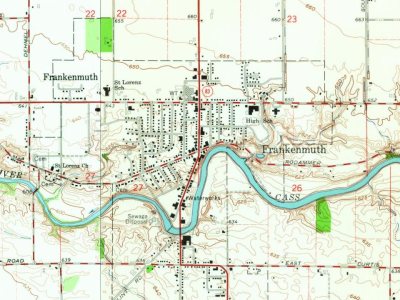


 1942
 2015
 2015
 2015
 2015
 2015
 2015
 2015
 2015
 2010
 2009
 2009
 2008
 2007
 2005
 2002


