The Lansing post office opened in 1875, the earliest record of the town by name. Wikidata gives 1959. Another post office, Petersburgh (1865), opened inside today’s city and later closed.
First census: 933 in 18802020 census: 11,239151 years
How historic is Lansing?
C
More historic than 28% of U.S. towns, on its age, its old homes and the National Register.
Founding year: the first Lansing post office (Blevins & Helbock, CC0). Wikidata: 1959.The full story ↓
History grade
What drives Lansing’s History grade
On its age, its old homes and the National Register, Lansing is more historic than 28% of U.S. towns, #103 of 151 in Kansas. Its share of homes from before 1940 holds the grade up; its National Register listings pull it down.
C
HistoryA character grade: shown, never part of Lansing’s overall grade.
Kansas towns list more on the Register than most of the country (a typical Kansas town has 5.1 per 10,000 residents, the U.S. 2.4), so Lansing’s 0.0 sits below most of its state (19% of Kansas towns have fewer) while its 0 listings outnumber those of 23% of U.S. towns.
How sure. Graded on any two of the three inputs instead, the letter would range from D to C+. The pre-1940 share is a Census survey estimate (±5.7 points). The founding year is the first post office, not a stated founding date; Wikidata gives 1959.
Founding year: the first post office (other dates in Quick answers). Homes: Census ACS 2020–24. National Register: National Park Service, May 2026 list; each listing counted once (boundary changes and added documentation belong to their listing), and a historic district counts its contributing buildings. How TownRatings grades history →
What stands out about Lansing’s past
Read from the archive, the National Register and the record. The page puts what stands out first.
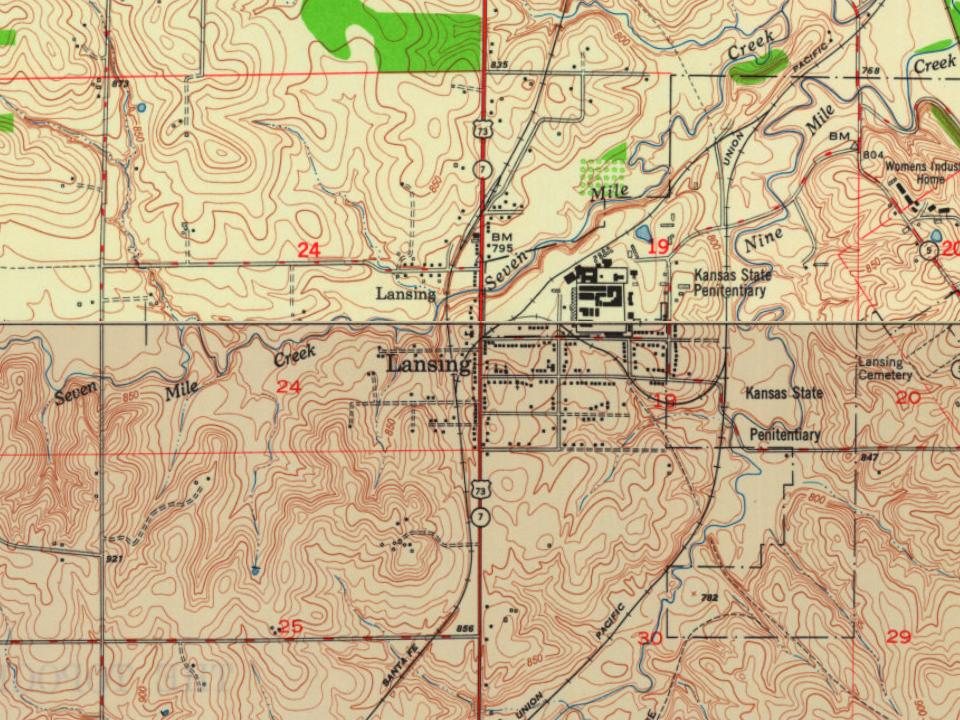
Lansing is named for James Lansing, a pioneer settler. Formerly William Lansing Taylor, James changed his name upon his enlistment in 1862 as a hospital steward in the 7th Kansas Cavalry. Following the Civil War, he earned a position at the new state penitentiary in Kansas as a hospital steward. He later resigned and opened a general mercantile store, which held the post office and an apothecary business, in the area called "Town of Progress". "Doc Lansing", as he became known, and his friend John C. Schmidt became co-owners of 90 acres (360,000 m2) of land that was platted into town lots in 1878; they named the area "Town of Lansing". Lansing did not become an incorporated city until 1959.
Passages that mention Lansing, cut from the printed page as they were published.
History of Leavenworth County Kansas1921 · page 234Read the page →
Read the text
Father Downey, who was succeeded at the fort parish and also in the mission in Delaware Township by Rev. John Hurley, had made numerous attempts to secure a site for a church in the city of Lansing without avail. Father Kinsella, who succeeded Rev. John Hurley at the Delaware Mission, bought the ground in Lansing on which the Catholic Church of that place now stands and had the small church building which was standing on the present site of old Delaware moved -to the new location.
Text read by machine from the scan; it may contain errors.
History of Leavenworth County Kansas1921 · page 326Read the page →
Read the text
Lansing Skeleton. — Two brothers, Joseph and Michael Concannon, were digging a trench on their farm near Lansing and on March 23, 1902, they unearthed a human skeleton. It was deeply imbedded under a stratum of earth and rock. During the summer Michael Concannon took the skull to Kansas City and gave the particulars of the find to a newspaper reporter. An article was written at the time and aroused the interests of the scientists all over the United States. From all parts of the country they came to the Concannon farm to look over the find. Some
Text read by machine from the scan; it may contain errors.
Scans and text from the Internet Archive. Books published in 1930 or earlier, which are in the public domain.
Timeline
Lansing, 1865 to 1987
Woven from the archive, old maps, post office records, the National Register and the people born here.
The Lansing post office opened in 1875, the earliest record of the town by name (U.S. post office records). Wikidata gives 1959.
How does Lansing rank for history?
Lansing is more historic than 28% of U.S. towns, #103 of 151 in Kansas. The History grade combines the town’s founding era, the share of homes built before 1940 and its National Register listings. It’s a character grade, so it isn’t part of the overall grade. How it works.
How old are the homes in Lansing?
11% of Lansing’s homes were built before 1940 (Census estimate, ±5.7 points), against a typical 10% for a Kansas town; the median home was built in 1986.
Founding dates: Wikidata, Wikipedia, the U.S. post office records of Blevins & Helbock (CC0) and the Census. Homes by year built: Census ACS 2020–24. National Register of Historic Places: National Park Service (list of May 22, 2026). Old photos, postcards and papers: Wikimedia Commons, the Library of Congress and other public archives, credited on each item’s page. Maps: U.S. Geological Survey historical topographic maps (via Esri) and Sanborn fire-insurance maps (Library of Congress). History text and census tables: Wikipedia (CC BY-SA 4.0). Places that used to be: USGS Geographic Names Information System (2021).
From Wikimedia Commons (6), Wikipedia, Wikidata and Wikipedia for famous people, U.S. Geological Survey historical maps, U.S. Census counts (via Wikipedia), the US Post Offices dataset (Blevins & Helbock), the USGS Geographic Names Information System and old county and town histories (Internet Archive). Archive images are copied here with their credits and licenses, shown on each photo’s page. Refreshed monthly.



 2015
 2015
 2010
 2009
 2008
 2004