Founding year: the first La Cygne post office (Blevins & Helbock, CC0).The full story ↓
History grade
What drives La Cygne’s History grade
On its age, its old homes and the National Register, La Cygne is more historic than 30% of U.S. towns. Its share of homes from before 1940 holds the grade up; its National Register listings pull it down.
C
HistoryA character grade: shown, never part of La Cygne’s overall grade.
Kansas towns list more on the Register than most of the country (a typical Kansas town has 5.1 per 10,000 residents, the U.S. 2.4), so La Cygne’s 0.0 sits below most of its state (19% of Kansas towns have fewer) while its 0 listings outnumber those of 23% of U.S. towns.
How sure. Graded on any two of the three inputs instead, the letter would range from D to C+. The pre-1940 share is a Census survey estimate (±7.0 points). The founding year is the first post office, not a stated founding date.
Founding year: the first post office (other dates in Quick answers). Homes: Census ACS 2020–24. National Register: National Park Service, May 2026 list; each listing counted once (boundary changes and added documentation belong to their listing), and a historic district counts its contributing buildings. How TownRatings grades history →
What stands out about La Cygne’s past
Read from the archive, the National Register and the record. The page puts what stands out first.
La Cygne was founded in 1869 as soon as the people were assured of the building of a track for the Missouri River, Ft. Scott & Gulf Railroad. A town company was organized and purchased 1,400 acres (5.7 km2) of land, but had only 140 acres (0.57 km2) laid out as a town site. La Cygne was incorporated on January 14, 1870, and a board of trustees was appointed. In the fall of that year the town had grown so that it had inhabitants enough to organize as a city of the third class, and F. A. Foote was elected the first mayor. The first school was taught in 1869 in Cady's hall. It was a private subscription school and was kept open until 1870, when the public school house was built. It was a commodious two-story brick building containing the graded and high schools. The Methodist church organized in 1870 and soon after built a house of worship. The Presbyterian church was organized the same y…
Rockville where he had a general store, and later enlisted in Company D, Fifteenth Kansas Cavalry and served to the end of the war. When the Gulf railroad came through and the town of La Cygne was started Croxton opened a hardware store there in partnership with Mr. Lobdell whose son then a small boy is now Hon. Charles Lobdell of the Federal Farm Loan Board with offices in New York City. Ike got out of the hardware business by being elected sheriff of Linn County in
Text read by machine from the scan; it may contain errors.
Among the earliest of the permanent settlers of Scott township was James Cattell Marshall who in the spring of 1857 preempted a claim of 160 acres of prairie land about six and a half miles west of the present town of La Cygne.
Text read by machine from the scan; it may contain errors.
Scans and text from the Internet Archive. Books published in 1930 or earlier, which are in the public domain.
Timeline
La Cygne, 1869 to 1987
Woven from the archive, old maps, post office records, the National Register and the people born here.
The La Cygne post office opened in 1869, the earliest record of the town by name (U.S. post office records).
How does La Cygne rank for history?
La Cygne is more historic than 30% of U.S. towns. The History grade combines the town’s founding era, the share of homes built before 1940 and its National Register listings. It’s a character grade, so it isn’t part of the overall grade. How it works.
How old are the homes in La Cygne?
13% of La Cygne’s homes were built before 1940 (Census estimate, ±7.0 points), against a typical 10% for a Kansas town; the median home was built in 1977.
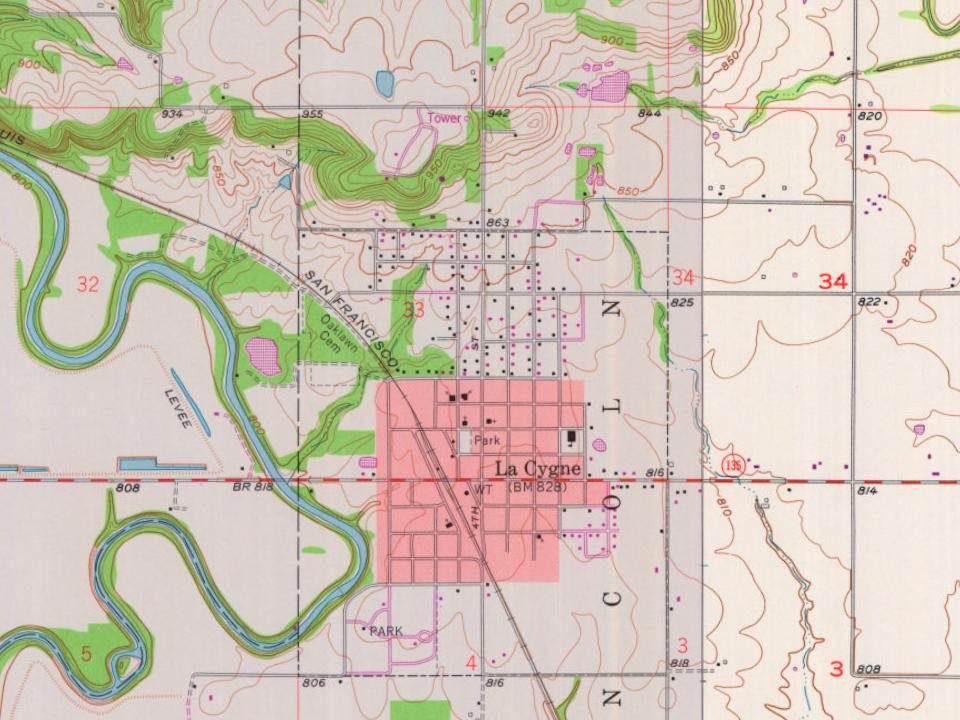
Founding dates: Wikidata, Wikipedia, the U.S. post office records of Blevins & Helbock (CC0) and the Census. Homes by year built: Census ACS 2020–24. National Register of Historic Places: National Park Service (list of May 22, 2026). Old photos, postcards and papers: Wikimedia Commons, the Library of Congress and other public archives, credited on each item’s page. Maps: U.S. Geological Survey historical topographic maps (via Esri) and Sanborn fire-insurance maps (Library of Congress). History text and census tables: Wikipedia (CC BY-SA 4.0). Places that used to be: USGS Geographic Names Information System (2021).
From Wikimedia Commons (4), Wikipedia, Wikidata and Wikipedia for famous people, U.S. Geological Survey historical maps, U.S. Census counts (via Wikipedia), the US Post Offices dataset (Blevins & Helbock), the USGS Geographic Names Information System and old county and town histories (Internet Archive). Archive images are copied here with their credits and licenses, shown on each photo’s page. Refreshed monthly.


 2006
 2006
 2006
 2004