Founding year: the first Concordia post office (Blevins & Helbock, CC0). Wikidata: 1871.The full story ↓
History grade
What drives Concordia’s History grade
On its age, its old homes and the National Register, Concordia is more historic than 72% of U.S. towns, #41 of 151 in Kansas. Its share of homes from before 1940 holds the grade up; its age pulls it down.
B+
HistoryA character grade: shown, never part of Concordia’s overall grade.
Kansas towns list more on the Register than most of the country (a typical Kansas town has 5.1 per 10,000 residents, the U.S. 2.4), so Concordia’s 8.0 sits near the middle of its state (58% of Kansas towns have fewer) while its 4 listings outnumber those of 68% of U.S. towns.
How sure. Graded on any two of the three inputs instead, the letter would range from B− to A. The pre-1940 share is a Census survey estimate (±6.1 points). The founding year is the first post office, not a stated founding date; Wikidata’s 1871 falls in the same era, so the grade doesn’t depend on which one is used.
Founding year: the first post office (other dates in Quick answers). Homes: Census ACS 2020–24. National Register: National Park Service, May 2026 list; each listing counted once (boundary changes and added documentation belong to their listing), and a historic district counts its contributing buildings. How TownRatings grades history →
What stands out about Concordia’s past
Read from the archive, the National Register and the record. The page puts what stands out first.
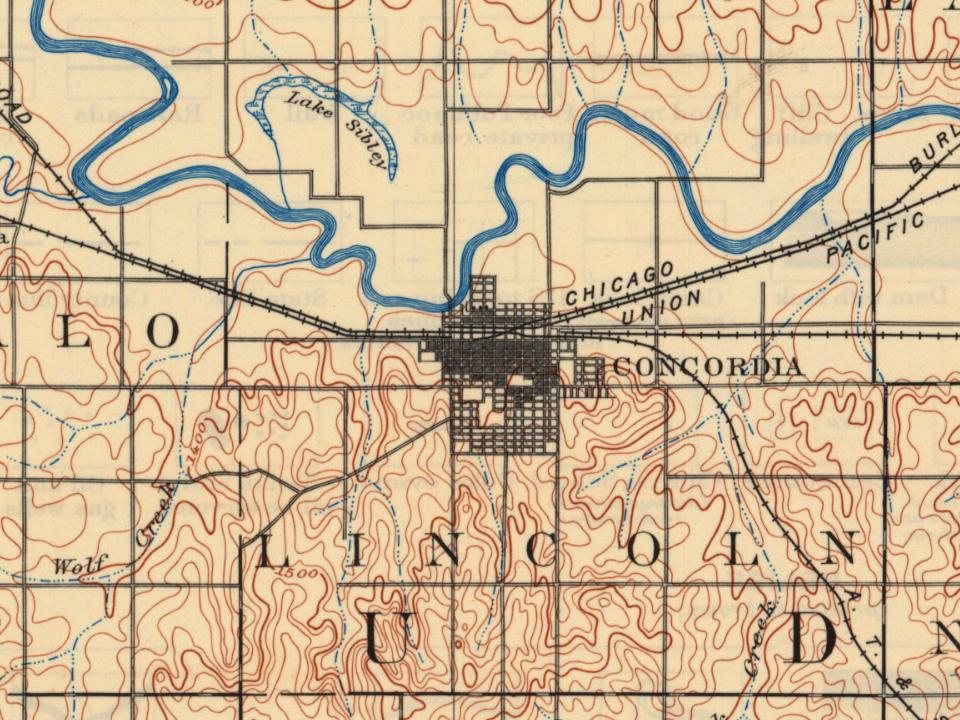
Every edition of the U.S. Geological Survey’s map of Concordia. Tap a year, or press play to watch the town change.
1892Concordia sheet · 1:125,000
U.S. Geological Survey historical topographic maps (public domain), via Esri’s collection of the scans. The red ring marks the center of Concordia.
Every building
Concordia, building by building, 1885–1917
Fire insurance maps drew every building, what it was made of and what it was used for, so insurers could price the risk of fire. Pick a year, then a sheet.
Concordia holds the distinction of being elected the county seat before the town was created. The founder of the town, James M. Hagaman, had created a complete layout of the town on paper including streets, blocks, courthouse, and parks. The name "Concordia" was chosen because a member of the early group of promoters ("Cap" Snyder) had once lived in Concordia, Missouri, and liked the name because it paid homage to the settlers-to-be's German heritage; the name "Concordia" is a German name found in many early Germanic poems.
Passages that mention Concordia, cut from the printed page as they were published.
Biographical history of Cloud County, Kansas1903 · page 887Read the page →
Read the text
The town of Rice is a small village, situated on the Central Branch railroad, the first station east of Concordia. Its business enterprises consist of a store, an extensive elevator, a neat little house of worship and a school building. The town is too near Concordia to ever l)e more than a railroad station with a trade from the mimediate neighborhood. The farmers in the vicinity of Rice are all well-to-do and much of the town is occupied bv farmers, whose estates adjoin the townsite.
Text read by machine from the scan; it may contain errors.
Biographical history of Cloud County, Kansas1903 · page 173Read the page →
Read the text
March 5, 1878, Concordia was brought into closer connection with the outside world by the operating of the telegraph line which was attached to the batteries on that day. Concordia is the natural center of a large tributary of rich farming lands, and like the old saying "all roads lead to Rome," this city being a railroad center, all roads lead to Concordia.
Text read by machine from the scan; it may contain errors.
Scans and text from the Internet Archive. Books published in 1930 or earlier, which are in the public domain.
Timeline
Concordia, 1870 to 1970
Woven from the archive, old maps, post office records, the National Register and the people born here.
Nothing in the archives for these yearsWeddings on Main Street, storms, parades, school pictures, the old store. If it’s in your family album, it belongs here.
The Concordia post office opened in 1870, the earliest record of the town by name (U.S. post office records). Wikidata gives 1871.
How does Concordia rank for history?
Concordia is more historic than 72% of U.S. towns, #41 of 151 in Kansas. The History grade combines the town’s founding era, the share of homes built before 1940 and its National Register listings. It’s a character grade, so it isn’t part of the overall grade. How it works.
What is on the National Register in Concordia?
4 listings: 4 buildings, among them the Nazareth Convent and Academy (listed 1973, the first).
How old are the homes in Concordia?
34% of Concordia’s homes were built before 1940 (Census estimate, ±6.1 points), against a typical 10% for a Kansas town; the median home was built in 1957.
Founding dates: Wikidata, Wikipedia, the U.S. post office records of Blevins & Helbock (CC0) and the Census. Homes by year built: Census ACS 2020–24. National Register of Historic Places: National Park Service (list of May 22, 2026). Old photos, postcards and papers: Wikimedia Commons, the Library of Congress and other public archives, credited on each item’s page. Maps: U.S. Geological Survey historical topographic maps (via Esri) and Sanborn fire-insurance maps (Library of Congress). History text and census tables: Wikipedia (CC BY-SA 4.0). Places that used to be: USGS Geographic Names Information System (2021).
From Wikimedia Commons (2), Wikidata (4), the National Register of Historic Places (4), Wikipedia, Wikidata and Wikipedia for famous people, U.S. Geological Survey historical maps, U.S. Census counts (via Wikipedia), the US Post Offices dataset (Blevins & Helbock), the USGS Geographic Names Information System, Sanborn fire insurance maps (Library of Congress) and old county and town histories (Internet Archive). Archive images are copied here with their credits and licenses, shown on each photo’s page. Refreshed monthly.







 1909