The Columbus post office opened in 1869, the earliest record of the town by name.
First census: 402 in 18702020 census: 2,929157 years
How did Columbus get its name?
Columbus was named Columbus by A.L. Peters, one of the European-American founders, for his hometown of Columbus, Ohio; the name thus indirectly honors Christopher Columbus, the explorer.
How historic is Columbus?
B
More historic than 59% of U.S. towns, on its age, its old homes and the National Register.
On its age, its old homes and the National Register, Columbus is more historic than 59% of U.S. towns, #66 of 151 in Kansas. Its share of homes from before 1940 holds the grade up; its age pulls it down.
B
HistoryA character grade: shown, never part of Columbus’ overall grade.
Kansas towns list more on the Register than most of the country (a typical Kansas town has 5.1 per 10,000 residents, the U.S. 2.4), so Columbus’ 3.5 sits near the middle of its state (42% of Kansas towns have fewer) while its 1 listings outnumber those of 51% of U.S. towns.
How sure. Graded on any two of the three inputs instead, the letter would range from C to B+. The pre-1940 share is a Census survey estimate (±7.7 points). The founding year is the first post office, not a stated founding date.
Founding year: the first post office (other dates in Quick answers). Homes: Census ACS 2020–24. National Register: National Park Service, May 2026 list; each listing counted once (boundary changes and added documentation belong to their listing), and a historic district counts its contributing buildings. How TownRatings grades history →
What stands out about Columbus’ past
Read from the archive, the National Register and the record. The page puts what stands out first.
Fire insurance maps drew every building, what it was made of and what it was used for, so insurers could price the risk of fire. Pick a year, then a sheet.
Nothing in the archives for these yearsWeddings on Main Street, storms, parades, school pictures, the old store. If it’s in your family album, it belongs here.
The first settlement was made at Columbus in 1868. The first post office in Columbus was established in 1869.
Columbus was a railroad junction for the Saint Louis and San Francisco, and the Missouri, Kansas, and Texas railroads. It was named Columbus by A.L. Peters, one of the European-American founders, for his hometown of Columbus, Ohio; the name thus indirectly honors Christopher Columbus, the explorer. Coal, lead and zinc were mined in the region. Columbus had a considerable trade in agricultural products, and its businesses included machine shops, grain elevators, flour mills, a cigar factory, bottle works (soft drinks), a canning factory, and an extensive brick-making plant.
Dr. Baxter's settlement at Columbus was something in the nature of an accident. After graduation, while looking about for a suitable location, he advanced to met an old acquaintance, Jonathan Hunt, of Martinsville, Indiana, formerly sheriff of the county, who interested him in the new town of Columbus, in Cherokee County. It resulted in Dr. Baxter settling
Text read by machine from the scan; it may contain errors.
of Indiana, and prior to coming to Cherokee County, in 1869, followed farming in that State. After locating on a claim in Ross township, two miles north of Columbus, he spent about two years in hauling freight between Columbus and Independence. In 1873 he started his livery at Columbus, and has been in the business continuously ever since, being the
Text read by machine from the scan; it may contain errors.
Scans and text from the Internet Archive. Books published in 1930 or earlier, which are in the public domain.
Timeline
Columbus, 1869 to 1936
Woven from the archive, old maps, post office records, the National Register and the people born here.
The Columbus post office opened in 1869, the earliest record of the town by name (U.S. post office records).
How does Columbus rank for history?
Columbus is more historic than 59% of U.S. towns, #66 of 151 in Kansas. The History grade combines the town’s founding era, the share of homes built before 1940 and its National Register listings. It’s a character grade, so it isn’t part of the overall grade. How it works.
What is on the National Register in Columbus?
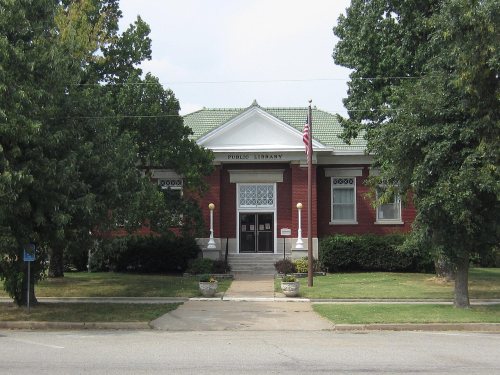
One place: the Columbus Public Carnegie Library (listed 1987).
How old are the homes in Columbus?
27% of Columbus’ homes were built before 1940 (Census estimate, ±7.7 points), against a typical 10% for a Kansas town; the median home was built in 1961.
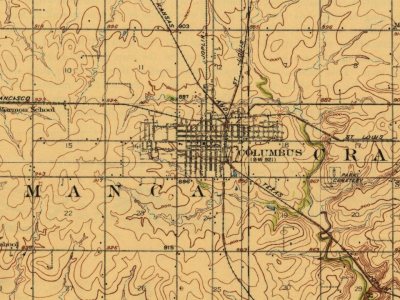
Founding dates: Wikidata, Wikipedia, the U.S. post office records of Blevins & Helbock (CC0) and the Census. Homes by year built: Census ACS 2020–24. National Register of Historic Places: National Park Service (list of May 22, 2026). Old photos, postcards and papers: Wikimedia Commons, the Library of Congress and other public archives, credited on each item’s page. Maps: U.S. Geological Survey historical topographic maps (via Esri) and Sanborn fire-insurance maps (Library of Congress). History text and census tables: Wikipedia (CC BY-SA 4.0). Places that used to be: USGS Geographic Names Information System (2021).
From Wikimedia Commons (5), the Library of Congress (10), Wikidata (1), the National Register of Historic Places (1), Wikipedia, Wikidata and Wikipedia for famous people, U.S. Geological Survey historical maps, U.S. Census counts (via Wikipedia), the US Post Offices dataset (Blevins & Helbock), the USGS Geographic Names Information System, Sanborn fire insurance maps (Library of Congress) and old county and town histories (Internet Archive). Archive images are copied here with their credits and licenses, shown on each photo’s page. Refreshed monthly.


 1920
 1920
 1920
 1936
 1936
 1936
 1936
 1936
 1936
 1936
 1936
 1936
 2013
 2005
 2004