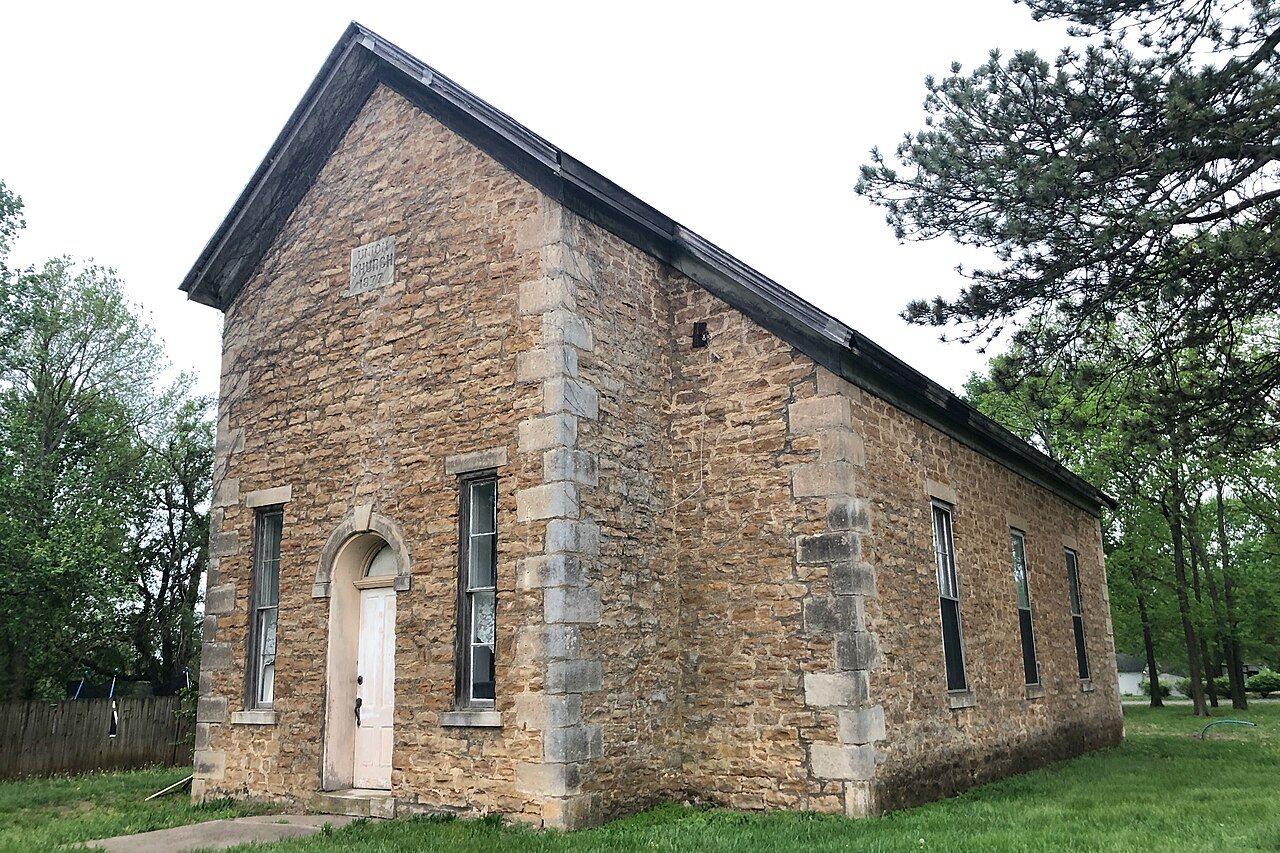
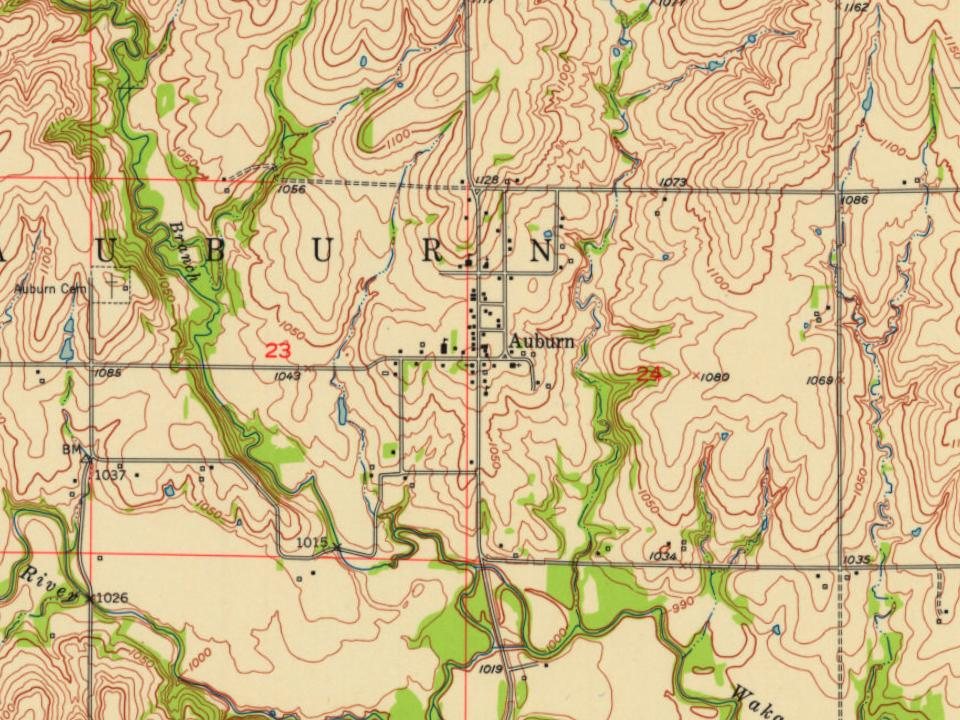
Most of Auburn was built recently: 0.6% of its homes predate 1940 and the median home dates from 1978. Its Register listing is the Union Church Building. Below: maps from 1952 on and the census since 1880.
The Auburn post office opened in 1859, the earliest record of the town by name. Another post office, Brownsville (1856), opened inside today’s city and later closed.
First census: 100 in 18802020 census: 1,273167 years
How historic is Auburn?
C
More historic than 26% of U.S. towns, on its age, its old homes and the National Register.
Founding year: the first Auburn post office (Blevins & Helbock, CC0).The full story ↓
History grade
What drives Auburn’s History grade
On its age, its old homes and the National Register, Auburn is more historic than 26% of U.S. towns. Its National Register listings hold the grade up; its share of homes from before 1940 pulls it down.
C
HistoryA character grade: shown, never part of Auburn’s overall grade.
Kansas towns list more on the Register than most of the country (a typical Kansas town has 5.1 per 10,000 residents, the U.S. 2.4), so Auburn’s 8.7 sits near the middle of its state (61% of Kansas towns have fewer) while its 1 listings outnumber those of 51% of U.S. towns.
How sure. Graded on any two of the three inputs instead, the letter would range from D to C+. The pre-1940 share (±0.8 points) is firm at this size. The founding year is the first post office, not a stated founding date.
Founding year: the first post office (other dates in Quick answers). Homes: Census ACS 2020–24. National Register: National Park Service, May 2026 list; each listing counted once (boundary changes and added documentation belong to their listing), and a historic district counts its contributing buildings. How TownRatings grades history →
What stands out about Auburn’s past
Read from the archive, the National Register and the record. The page puts what stands out first.
In July 1854, John W. Brown came to this area and found it highly suitable for a homestead. He acquired 800 acres (3.2 km2) through bartering with local Indians and later returned home to Missouri to tell his family and friends about the area, some of whom returned with him. In 1856, Mr. Brown, along with M. C. Dickey, Loring Farnsworth and Henry Fox pre-empted 320 acres (1.3 km2) for the purpose of a town. They christened it Brownville, although it was changed in 1857 to its present name of "Auburn" due to the fact there was another settlement with the same name. This was before the introduction of postal codes. It was located on the California Road and work began at once on the many buildings needed in a town of Brownville's size. Two daily stage lines brought mail and people to the town and business was very good.
Passages that mention Auburn, cut from the printed page as they were published.
History of Shawnee County, Kansas1905 · page 45Read the page →
Read the text
One of the oldest towns in the State was estabHshed here in 1856, under the name of Brownsville, which was changed to Auburn in 1857, for the reason that a Brownsville post office already existed in another part of the Territory. At one time there were 400 people living in Auburn. Many good buildings were erectel, including a three-story hotel, a brick church and numerous brick residences of the old Dutch pattern, with walls rising above the gables, and roofs sloping to the street. A weekly newspaper called the Auburn Docket was started in i860 by David B. Emmert, later of Fort
Text read by machine from the scan; it may contain errors.
Scans and text from the Internet Archive. Books published in 1930 or earlier, which are in the public domain.
Timeline
Auburn, 1856 to 1952
Woven from the archive, old maps, post office records, the National Register and the people born here.
National Park Service, National Register of Historic Places. Photos from Wikimedia Commons, credited on each place’s page.
People over time
Auburn, census by census
Grew from 100 people in 1880 to 1,273 in 2020, more than tenfold.
7 censuses, 1880–2020.
U.S. Census Bureau decennial counts, from the census table on Auburn’s Wikipedia page.
Places that used to be
Lost post offices
Auburn’s post office has been open since 1859. Another post office, Brownsville, opened and closed inside today’s town.
Brownsville
1856–1859
Auburn
1859–today
18501940today
US Post Offices dataset (Blevins & Helbock, CC0). Places and cemeteries from the USGS Geographic Names Information System (2021).
Questions about Auburn’s history
What year was Auburn founded?
The Auburn post office opened in 1859, the earliest record of the town by name (U.S. post office records).
How does Auburn rank for history?
Auburn is more historic than 26% of U.S. towns. The History grade combines the town’s founding era, the share of homes built before 1940 and its National Register listings. It’s a character grade, so it isn’t part of the overall grade. How it works.
What is on the National Register in Auburn?
One place: the Union Church Building (listed 2024).
How old are the homes in Auburn?
0.6% of Auburn’s homes were built before 1940 (Census estimate), against a typical 10% for a Kansas town; the median home was built in 1978.
Founding dates: Wikidata, Wikipedia, the U.S. post office records of Blevins & Helbock (CC0) and the Census. Homes by year built: Census ACS 2020–24. National Register of Historic Places: National Park Service (list of May 22, 2026). Old photos, postcards and papers: Wikimedia Commons, the Library of Congress and other public archives, credited on each item’s page. Maps: U.S. Geological Survey historical topographic maps (via Esri) and Sanborn fire-insurance maps (Library of Congress). History text and census tables: Wikipedia (CC BY-SA 4.0). Places that used to be: USGS Geographic Names Information System (2021).
From the National Register of Historic Places (1), Wikipedia, Wikidata and Wikipedia for famous people, U.S. Geological Survey historical maps, U.S. Census counts (via Wikipedia), the US Post Offices dataset (Blevins & Helbock), the USGS Geographic Names Information System and old county and town histories (Internet Archive). Archive images are copied here with their credits and licenses, shown on each photo’s page. Refreshed monthly.