On its age, its old homes and the National Register, Walkerton is more historic than 80% of U.S. towns. Its share of homes from before 1940 holds the grade up; its age pulls it down.
A−
HistoryA character grade: shown, never part of Walkerton’s overall grade.
Indiana towns list more on the Register than most of the country (a typical Indiana town has 7.9 per 10,000 residents, the U.S. 2.4), so Walkerton’s 113 sits above most of its state (82% of Indiana towns have fewer) while its 24 historic buildings outnumber those of 80% of U.S. towns.
How sure. Graded on any two of the three inputs instead, the letter would range from B to A. The pre-1940 share is a Census survey estimate (±7.2 points). The founding year is the first post office, not a stated founding date.
Founding year: the first post office (other dates in Quick answers). Homes: Census ACS 2020–24. National Register: National Park Service, May 2026 list; each listing counted once (boundary changes and added documentation belong to their listing), and a historic district counts its contributing buildings. How TownRatings grades history →
What stands out about Walkerton’s past
Read from the archive, the National Register and the record. The page puts what stands out first.
Walkerton was platted in 1856. It was named for John Walker, a railroad promoter. The town was laid out by the railroad surveyors and the first lot was taken by C.W.N. Stephens, Walkerton's first postmaster. Stephens relocated his general store from nearby West York. The Walkerton post office has been in operation since 1860.
During World War II Walkerton housed some of the workers for the nearby Kingsbury Ordnance Plant. The plant initially sought 10,000 workers, and the entire population of LaPorte numbered only 16,000 in 1940. In August 1941 Kingsbury's first shells were loaded and en route to the front lines.
In July 2006, Walkerton celebrated its sesquicentennial (150-year anniversary).
Passages that mention Walkerton, cut from the printed page as they were published.
History of St. Joseph County, Indiana1880 · page 734Read the page →
Read the text
In 185r) the wishes of the people were much gratified at the construction of the L, P. & C. railroad. Then the business prospects of Walkerton began to brighten. It continued to grow, and in 1873 the Baltimore & Ohio railroad was built, crossing the 1., P. & C. railroad at West Troy, which now forms the western part of Walkerton. In IBTO Walkerton was incorporated. The petitions were presented in 1874, but by some mistake were not received until 1S76.
Text read by machine from the scan; it may contain errors.
A history of St. Joseph County, Indiana1907 · page 316Read the page →
Read the text
as West Troy. Burk's addition to West Troy was platted April 27, 1860. On December 11, 1868, Jacob Rupel had the plats of his first three additions to Walkerton placed on record. A fourth addition was platted by him on July 2, 1875, and a fifth on January 23, 1884. Dixon W. Place platted his first addition to Walkerton September 3, 1887. All
Text read by machine from the scan; it may contain errors.
A history of St. Joseph County, Indiana1907 · page 291Read the page →
Read the text
No section of St. Joseph county has a brighter future then Lincoln township and its enterprising town of Walkerton. The population of the township, according to the census of 1900, was one thousand, five hundred and ninety-nine. This included the population of Walkerton, which was eight hundred and eighty-five.
Text read by machine from the scan; it may contain errors.
History of St. Joseph County, Indiana1880 · page 748Read the page →
Read the text
The year 1868 he followed railroading, and about seven months of 1869 he clerked in C. Behrn's store at Walkerton. Tliere he was packer iu a flouring mill for a time. He then followed his trade, carpenter and joiner, till the fall of 1S76, when he in connection with his father opened a furniture store at Walkerton, and were also undertakers. They carry a stock of goods, consisting of house furniture, caskets, etc., to the amount of $3,000. Their annual sales amount to $4,000. Mr. V. was married Aug. 23, 1S69, to Rebecca
Text read by machine from the scan; it may contain errors.
Scans and text from the Internet Archive. Books published in 1930 or earlier, which are in the public domain.
The Walkerton post office opened in 1860, the earliest record of the town by name (U.S. post office records).
How does Walkerton rank for history?
Walkerton is more historic than 80% of U.S. towns. The History grade combines the town’s founding era, the share of homes built before 1940 and its National Register listings. It’s a character grade, so it isn’t part of the overall grade. How it works.
What is on the National Register in Walkerton?
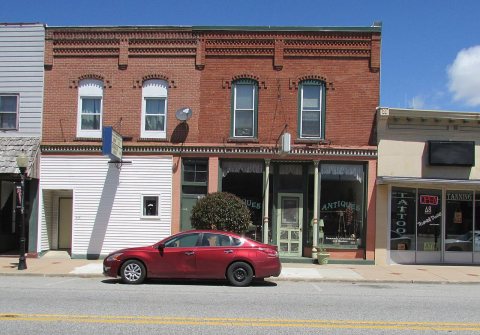
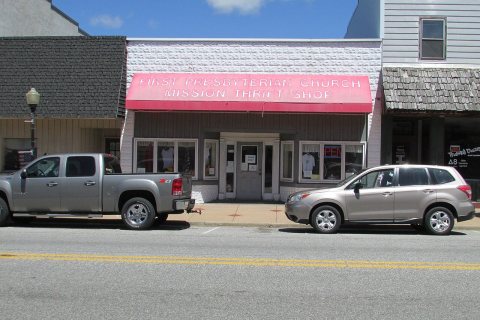
One place: the Walkerton Historic District (listed 2021).
How old are the homes in Walkerton?
32% of Walkerton’s homes were built before 1940 (Census estimate, ±7.2 points), against a typical 14% for an Indiana town; the median home was built in 1964.
Founding dates: Wikidata, Wikipedia, the U.S. post office records of Blevins & Helbock (CC0) and the Census. Homes by year built: Census ACS 2020–24. National Register of Historic Places: National Park Service (list of May 22, 2026). Old photos, postcards and papers: Wikimedia Commons, the Library of Congress and other public archives, credited on each item’s page. Maps: U.S. Geological Survey historical topographic maps (via Esri) and Sanborn fire-insurance maps (Library of Congress). History text and census tables: Wikipedia (CC BY-SA 4.0). Places that used to be: USGS Geographic Names Information System (2021).
From Wikimedia Commons (6), the National Register of Historic Places (1), Wikipedia, the US Post Offices dataset (Blevins & Helbock), the USGS Geographic Names Information System and old county and town histories (Internet Archive). Archive images are copied here with their credits and licenses, shown on each photo’s page. Refreshed monthly.


 2021
 2021
 2021
 2021
 2021
 2016