Founding year: the first Upland post office (Blevins & Helbock, CC0).The full story ↓
History grade
What drives Upland’s History grade
On its age, its old homes and the National Register, Upland is more historic than 31% of U.S. towns, #473 of 593 in Indiana. Its share of homes from before 1940 holds the grade up; its National Register listings pull it down.
C
HistoryA character grade: shown, never part of Upland’s overall grade.
Indiana towns list more on the Register than most of the country (a typical Indiana town has 7.9 per 10,000 residents, the U.S. 2.4), so Upland’s 0.0 sits below most of its state (22% of Indiana towns have fewer) while its 0 listings outnumber those of 23% of U.S. towns.
How sure. Graded on any two of the three inputs instead, the letter would range from D to C+. The pre-1940 share is a Census survey estimate (±5.8 points). The founding year is the first post office, not a stated founding date.
Founding year: the first post office (other dates in Quick answers). Homes: Census ACS 2020–24. National Register: National Park Service, May 2026 list; each listing counted once (boundary changes and added documentation belong to their listing), and a historic district counts its contributing buildings. How TownRatings grades history →
What stands out about Upland’s past
Read from the archive, the National Register and the record. The page puts what stands out first.
Lost a third of its people between 1920 and 1940, then grew 4-fold.
14 censuses, 1880–2020.
U.S. Census Bureau decennial counts, from the census table on Upland’s Wikipedia page.
Every building
Upland, building by building, 1898–1920
Fire insurance maps drew every building, what it was made of and what it was used for, so insurers could price the risk of fire. Pick a year, then a sheet.
1898Sheet 1 of 1
Edition
Sheets
BrickWoodStone
Sanborn Map Company, via the Library of Congress. Editions published in 1930 or earlier, which are in the public domain.
Most of the land that is now part of Upland was purchased by John Oswalt in the 1830s. He was a speculator, and believed that a canal connecting Indianapolis and Fort Wayne might pass through the area. The town was formed in the late 1860s by Jacob Bugher, who planned for it to be a depot point on the Indiana Central Railroad. The town's name comes from the fact it was believed to be the highest point on the rail line between Columbus and Chicago. By 1880, the town had a population of around 150 and included a school, two churches, several stores, a blacksmith shop, and a sawmill.
Passages that mention Upland, cut from the printed page as they were published.
Centennial History of Grant County Indiana1914 · page 851Read the page →
Read the text
John W. Williams. The history of the village of Upland will always commemorate the Williams family, since it was a man of that name who owned much of the land where the village now stands who laid out the plat on some of his acreage, donated ground for the railroad station, and in many other ways took the part of a leader in establishing and develop¬ ing that center of trade and population. Mr. John W. Williams, a son of the pioneer at Upland, has for many years devoted himself to farming and stock raising, and his home place in section eight of Jefferson town¬
Text read by machine from the scan; it may contain errors.
Centennial History of Grant County Indiana1914 · page 949Read the page →
Read the text
George W. Jones. One of the men whose enterprise has contributed to the trade and general activities of the village of Upland is George W. Jones, whose earlier life was spent in Jefferson township in farming pursuits and who for a number of years hrfs been in the feed and grain business at Upland. Mr. Jones is a man of recognized integrity and fair dealing, has a host of friends in the vicinity and has never failed to hold up his end of responsibilities, whether in private or in business life.
Text read by machine from the scan; it may contain errors.
Scans and text from the Internet Archive. Books published in 1930 or earlier, which are in the public domain.
Timeline
Upland, 1867 to 2010
Woven from the archive, old maps, post office records, the National Register and the people born here.
The Upland post office opened in 1867, the earliest record of the town by name (U.S. post office records).
How does Upland rank for history?
Upland is more historic than 31% of U.S. towns, #473 of 593 in Indiana. The History grade combines the town’s founding era, the share of homes built before 1940 and its National Register listings. It’s a character grade, so it isn’t part of the overall grade. How it works.
How old are the homes in Upland?
13% of Upland’s homes were built before 1940 (Census estimate, ±5.8 points), against a typical 14% for an Indiana town; the median home was built in 1977.
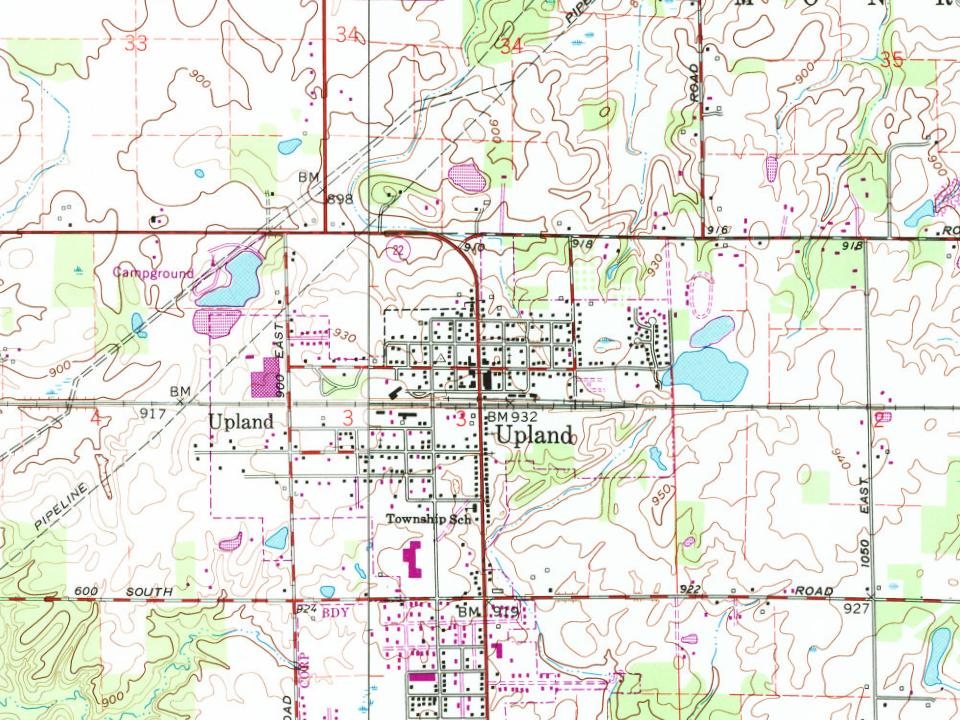
Founding dates: Wikidata, Wikipedia, the U.S. post office records of Blevins & Helbock (CC0) and the Census. Homes by year built: Census ACS 2020–24. National Register of Historic Places: National Park Service (list of May 22, 2026). Old photos, postcards and papers: Wikimedia Commons, the Library of Congress and other public archives, credited on each item’s page. Maps: U.S. Geological Survey historical topographic maps (via Esri) and Sanborn fire-insurance maps (Library of Congress). History text and census tables: Wikipedia (CC BY-SA 4.0). Places that used to be: USGS Geographic Names Information System (2021).
From Wikimedia Commons (4), the Library of Congress (2), Wikipedia, Wikidata and Wikipedia for famous people, U.S. Geological Survey historical maps, U.S. Census counts (via Wikipedia), the US Post Offices dataset (Blevins & Helbock), the USGS Geographic Names Information System, Sanborn fire insurance maps (Library of Congress) and old county and town histories (Internet Archive). Archive images are copied here with their credits and licenses, shown on each photo’s page. Refreshed monthly.


 Date?
 Date?
 2025
 2016
 2007
 2007