Founding year: Wikipedia. First post office: 1852.The full story ↓
History grade
What drives Union City’s History grade
On its age, its old homes and the National Register, Union City is more historic than 96% of U.S. towns, #61 of 593 in Indiana. All 3 inputs are above most U.S. towns; its share of homes from before 1940 ranks highest and its age lowest.
A+
HistoryA character grade: shown, never part of Union City’s overall grade.
Indiana towns list more on the Register than most of the country (a typical Indiana town has 7.9 per 10,000 residents, the U.S. 2.4), so Union City’s 165 sits above most of its state (86% of Indiana towns have fewer) while its 59 historic buildings outnumber those of 86% of U.S. towns.
How sure. Graded on any two of the three inputs instead, the letter would range from A to A+. The pre-1940 share is a Census survey estimate (±11.1 points). Two sources give 1849.
Founding year: Wikipedia (other dates in Quick answers). Homes: Census ACS 2020–24. National Register: National Park Service, May 2026 list; each listing counted once (boundary changes and added documentation belong to their listing), and a historic district counts its contributing buildings. How TownRatings grades history →
What stands out about Union City’s past
Read from the archive, the National Register and the record. The page puts what stands out first.
National Park Service, National Register of Historic Places. Photos from Wikimedia Commons, credited on each place’s page.
Every building
Union City, building by building, 1885–1920
Fire insurance maps drew every building, what it was made of and what it was used for, so insurers could price the risk of fire. Pick a year, then a sheet.
Union City was platted in 1849, eleven years after its twin city of Union City, Ohio. A post office has been in operation at Union City, Indiana since 1852.
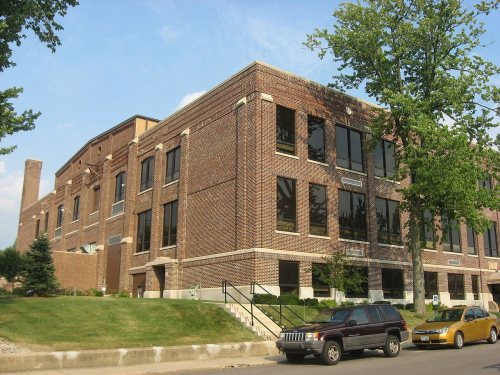
The William Kerr House, Raphael Kirshbaum Building, Union City Commercial Historic District, Union City Passenger Depot, Union City Public Library, and Union City School are listed on the National Register of Historic Places.
Passages that mention Union City, cut from the printed page as they were published.
History of Randolph County, Indiana with illustrations and biographical sketches of some of its prominent men and pioneers1882 · page 440Read the page →
Read the text
B. Dickey began tailoring, both near the flouring-mill, Mr. J. D. Carter, now of Winchester, says that he moved rom that [)lace to Union City, Ohio, building the first saw-mill on that ground in 1852, and a re.sidence; and that his family were the first to move to that town, that his mill was opposite the brewery, and that he remained at Union City till 1857. In 1800, Witham & Son built a handle factory, east of State Line and south of the railroad. The building was biu-ned, and a
Text read by machine from the scan; it may contain errors.
was ‘‘waked up” by the unearthly screeching of every enginewhistle on every railroad of the State. specially were the ears of our Senator, whose residence is close to the railroad depot in Union City, greeted with whistling fit to “‘wake the’ dead.”’ When the railroad men were asked, “‘ what does this mean?” they replied, ‘‘ Senator Cadwallader’s whistle-bill requires it.”
Text read by machine from the scan; it may contain errors.
History of Randolph County, Indiana with illustrations and biographical sketches of some of its prominent men and pioneers1882 · page 162Read the page →
Read the text
has numbered from twelve to twenty persons. During the summer season, they have held many meetings in the country, going sometimes twenty miles for that purpose. At the j)re8ent time, about sixty persons in Union City profess enjoyment of the blessing of Holine.ss; and, on the whole, the work is on the advance. Two camp-meetings have been held at Union City Fair Grounds for the promotion of the cause, one by the Holiness Band, in connection with the Warsaw Holiness Camp-Meeting Association,
Text read by machine from the scan; it may contain errors.
HISTORY RANDOLPH COUNTY, INDIANA, Illustrations and Biographical Sketches WITH OF SOME OF ITS PROMINENT MEN AND PIONEERS, TO WHICH ARE APPENDED MAPS OF ITS SEVERAL TOWNSHIPS.1882 · page 449Read the page →
Read the text
in this region is nut always of the best quality, and the durability of the road bed is somewhat lessened thereby. Two new pikes, both of them of considerable advantage\to the prosperity of Union City, are in process of construction during the summer of 1882. First, one leading from the Winchester Deerfield Pike eastward through Saratoga to the toll gate northwest of Union City; second, one commencing at the Wayne County line, southoast of Spartansburg, and running directly north to the toll
Text read by machine from the scan; it may contain errors.
Scans and text from the Internet Archive. Books published in 1930 or earlier, which are in the public domain.
Timeline
Union City, 1849 to 1970
Woven from the archive, old maps, post office records, the National Register and the people born here.
In 1849, according to Wikipedia’s history of the town. Union City’s post office opened in 1852, and the census of 1870 counted 1,439 people here.
How does Union City rank for history?
Union City is more historic than 96% of U.S. towns, #61 of 593 in Indiana. The History grade combines the town’s founding era, the share of homes built before 1940 and its National Register listings. It’s a character grade, so it isn’t part of the overall grade. How it works.
What is on the National Register in Union City?
6 listings: 5 buildings, among them the Union City Passenger Depot (listed 1983, the first), and 1 historic district, the Union City Commercial Historic District, with 53 contributing buildings. 59 historic buildings in all.
How old are the homes in Union City?
37% of Union City’s homes were built before 1940 (Census estimate, ±11.1 points), against a typical 14% for an Indiana town; the median home was built in 1953.
Founding dates: Wikidata, Wikipedia, the U.S. post office records of Blevins & Helbock (CC0) and the Census. Homes by year built: Census ACS 2020–24. National Register of Historic Places: National Park Service (list of May 22, 2026). Old photos, postcards and papers: Wikimedia Commons, the Library of Congress and other public archives, credited on each item’s page. Maps: U.S. Geological Survey historical topographic maps (via Esri) and Sanborn fire-insurance maps (Library of Congress). History text and census tables: Wikipedia (CC BY-SA 4.0). Places that used to be: USGS Geographic Names Information System (2021).
From Wikimedia Commons (6), the National Register of Historic Places (6), Wikipedia, Wikidata and Wikipedia for famous people, U.S. Geological Survey historical maps, U.S. Census counts (via Wikipedia), the US Post Offices dataset (Blevins & Helbock), the USGS Geographic Names Information System, Sanborn fire insurance maps (Library of Congress) and old county and town histories (Internet Archive). Archive images are copied here with their credits and licenses, shown on each photo’s page. Refreshed monthly.




 2012
 2010
 2010
 2010
 2010
 2006


